


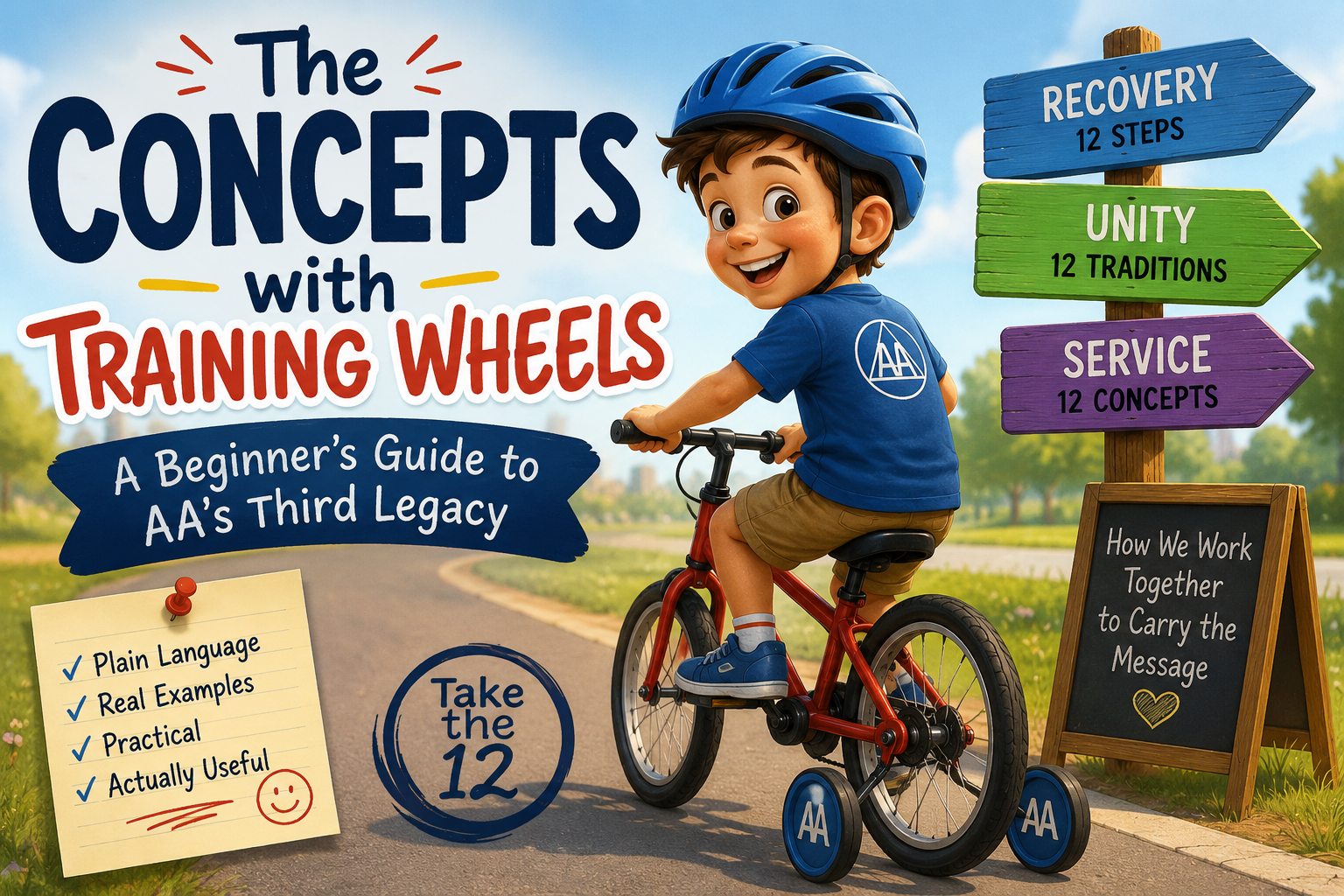
The Concepts with Training Wheels
A Beginner’s Guide to AA’s Third Legacy
There they are. Hanging on the wall. You’ve probably looked at them a hundred times.
The Twelve Steps are over there. We know those. We talk about those all the time. The Twelve Traditions are hanging nearby. We may not completely understand those yet, but at least we’ve heard people talk about them. And then there’s that other shade. The Twelve Concepts for World Service.
You glance at it. Concept I. Concept II. Concept III. Final responsibility… ultimate authority… delegated authority… traditional Right of Decision… Good grief. And then you go directly into a coma because, after all, you came into Alcoholics Anonymous because you were trying to figure out how to not drink today, and apparently somebody has hung the AA Constitution on the wall. So you do what any self-respecting newcomer does.
You stop reading.
“Whatever that stuff is, I’m pretty sure it has absolutely nothing to do with me staying sober.” And for a while, you might be right. Sort of.
But before you go into that coma – eventually, if you stick around, get a sponsor, take the Steps, become part of a home group, and start doing a little service, something interesting may happen.
Your sponsor says: “Okay. I think it’s time we started looking at the Concepts.” You stare at them. “The whats?” “The Twelve Concepts for World Service. They’ll help you understand our Third Legacy.” And then comes the question that probably should have been asked a long time ago: “Wait!!! There’s a THIRD Legacy?” Yep. “Then what are the first two?” Excellent question. Welcome to class. Pull out your crayons. We’re going to learn about the Three Legacies of Alcoholics Anonymous. And nobody is getting homework. Probably.
AA Is a Three-Legacy Program
One of the things I think we sometimes fail to explain very well in Alcoholics Anonymous is that AA has three Legacies: Recovery. Unity. Service. That’s it. Three words. And each Legacy has a set of Twelve attached to it.
- Recovery → Twelve Steps
- Unity → Twelve Traditions
- Service → Twelve Concepts for World Service
If I were teaching this to a room full of fifth graders, I might draw three big boxes on the board:
- RECOVERY: How do I stay sober and change?
- UNITY: How do we stay together?
- SERVICE: How do we work together to carry the message?
Congratulations. You now understand the basic architecture of Alcoholics Anonymous better than I did for quite a long time. The three Legacies aren’t competing systems. They support one another. The Steps help me recover. The Traditions help us remain united. The Concepts help us work together so AA can continue carrying its message. Or, even simpler: Steps: Me. Traditions: We. Concepts: How We Get Stuff Done.
There will be a quiz later. Just kidding. 🤣
Legacy One: Recovery
This is usually where we begin. For good reason. When I walked through the doors of Alcoholics Anonymous, I wasn’t particularly concerned about the General Service Board. I wasn’t losing sleep over the Conference Charter. I wasn’t wondering whether the trustees were maintaining an appropriate balance between responsibility and authority. I had slightly more immediate problems. Like alcoholism. So we begin with the Twelve Steps. The Steps introduce me to an entirely different way of living. They deal with things like honesty, surrender, inventory, amends, prayer, meditation, and helping other alcoholics.
Through that process, something begins to happen. I change. That’s our First Legacy: Recovery. But then AA introduces me to something rather inconvenient. Apparently, I’m not recovering by myself. There are other people here. Which brings us to Legacy Two.
Legacy Two: Unity
Eventually, I join a home group. And now I discover that alcoholics have opinions. Who knew? We have opinions about the meeting format. The coffee. The temperature. The literature rack. The birthday cake. Whether the chairperson talks too much. Whether the chairperson doesn’t talk enough. Whether we should buy new chairs. Why we bought those chairs. And apparently someone has been leaving approximately three tablespoons of coffee in the pot instead of making another one.
Clearly, civilization is collapsing. Enter the Twelve Traditions. The Traditions answer a different question than the Steps. The Steps ask: How can I become recovered? The Traditions ask: How can we stay together while we’re recovering? They teach us about our common welfare, group authority, membership, autonomy, money, outside enterprises, professionalism, public relations, anonymity, and keeping our primary purpose at the center of what we do.
The Traditions remind me that AA isn’t just about my sobriety. There is an us here. And sometimes preserving the us means I don’t get my way. I know. Terrible system. But now something else happens. Thousands of autonomous AA groups are scattered across cities, states, provinces, countries, and continents. They need literature. They need communication. They need services. They need a way for the collective voice of AA groups to be heard.
- Someone has to publish the Big Book.
- Someone has to protect AA’s copyrights.
- Someone has to respond when people around the world ask for information about Alcoholics Anonymous.
- Someone has to maintain relationships with professionals who encounter alcoholics.
- Someone has to help carry the message into correctional and treatment facilities.
- Someone has to make sure Alcoholics Anonymous can continue functioning beyond our individual home groups.
Which raises a fascinating question: How does a worldwide fellowship with no bosses actually get anything done? Welcome to Legacy Three.
Legacy Three: Service
This is where the Twelve Concepts enter the picture. And this is also where many of us quietly back toward the door. Because we start encountering words like:
- authority
- responsibility
- delegation
- trustees
- Conference
- corporations
- committees
- leadership
- participation
And suddenly the Concepts sound less like Alcoholics Anonymous and more like orientation for a government job. But underneath all that language are some surprisingly simple ideas. Things like: Who is ultimately responsible? Who gets to make which decisions? If I give you responsibility, have I also given you enough authority to actually do the job? Who gets a voice? How do we handle disagreements? How do we keep power from becoming concentrated in too few hands? How do leaders lead without becoming rulers? How do we make decisions without silencing the minority? How do we hold people accountable without micromanaging them?
Those aren’t obscure corporate questions. Those are human-being-working-with-other-human-being questions. And suddenly the Concepts start getting interesting.
Think of It Like a School
Remember, we’re in fifth grade today. Imagine our school has a giant field day coming up. Everybody wants field day to happen. But somebody has to organize it. You can’t have 600 students simultaneously deciding where the potato-sack race goes. Chaos. So the school delegates responsibility.
Someone handles games. Someone handles food. Someone handles volunteers. Someone handles safety. Someone handles schedules.
But here’s the important part: If you tell Mrs. Johnson she’s responsible for organizing the games but require her to ask 47 people for permission every time she needs another hula hoop, you haven’t really given her responsibility. You’ve given her a headache. That’s one of the ideas behind the Concepts: Responsibility and authority need to match. If we’re going to ask someone to do a job, we have to give them reasonable freedom to do it.
Another example: Suppose everybody votes for kickball, but three kids raise their hands and say: “There’s a problem nobody has considered.” Do we say: “TOO BAD! WE WON! 597 TO 3!” Not necessarily. Maybe those three kids noticed that the kickball field is covered in fire ants. Perhaps we should hear them out.
Hello, minority opinion.
See? You’re already learning the Concepts. And nobody has even mentioned a Conference Committee yet.
So What Are the Concepts Actually For?
The Twelve Concepts describe principles that help Alcoholics Anonymous conduct its world services responsibly. They grew out of AA’s experience as Bill W. and the early Fellowship wrestled with an enormous question: What happens to Alcoholics Anonymous when its founders aren’t around anymore? That’s a pretty important question.
AA couldn’t remain dependent forever on Bill W., Dr. Bob, or a handful of early members. Responsibility for AA’s future had to pass to the Fellowship itself. The Concepts help explain how that responsibility is shared and delegated throughout our service structure. The groups have a voice. Groups elect General Service Representatives. GSRs participate in districts. Districts participate in areas. Delegates carry the conscience of their areas to the General Service Conference. Trustees and various service entities have particular responsibilities. Different people and bodies are given different kinds of authority. Checks and balances exist. Everybody doesn’t decide everything. Nobody gets to decide everything.
That’s the basic idea.
And yes, the actual structure gets more detailed than that. We’ll save that for sixth grade.
“But What Does Any of This Have to Do With My Sobriety?”
More than I originally thought. Because the principles underneath the Concepts don’t stay neatly inside a General Service Conference room. Consider some of them.
- Can I give someone responsibility without controlling exactly how they perform it?
- Can I trust people?
- Can I participate without needing to dominate?
- Can I disagree without becoming disagreeable?
- Can I listen seriously to the person who lost the vote?
- Can I accept that I might be wrong even when I’m in the majority?
- Can I lead without becoming a dictator?
- Can I follow without becoming resentful?
- Can I distinguish between authority and power?
- Can I make a decision and take responsibility for it?
- Can I allow someone else the dignity of making a decision I wouldn’t have made?
Oh. Well, this just got personal. Sound familiar? It should.
Because the same character defects I discover through the Steps don’t magically disappear when someone hands me a GSR handbook. I bring myself into service. My ego comes with me. My fear comes with me. My desire to control comes with me. My need to be right comes with me. Fortunately, so do the spiritual principles I’ve been learning through the Steps and Traditions. That’s why the Three Legacies belong together.
The Three-Legged Stool
Here’s another way to picture it. Imagine AA sitting on a three-legged stool. One leg is Recovery. One is Unity. One is Service. Remove Recovery and we lose our reason for existing. Remove Unity and we eventually tear ourselves apart. Remove Service and we lose our ability to effectively carry the message beyond ourselves and into the future.
A two-legged stool isn’t particularly useful. Unless your spiritual program includes falling over. The Three Legacies need each other. Recovery gives us a life worth living. Unity gives us a Fellowship in which to live it. Service helps preserve that Fellowship for the alcoholic who hasn’t arrived yet. That last part matters enormously. Because AA isn’t ours. We inherited it. And if we’re doing this correctly, we’re eventually going to hand it to somebody else.
Maybe That Shade on the Wall Is About You After All
So the next time you’re sitting in a meeting and your eyes wander toward that mysterious third shade hanging on the wall, don’t panic. Nobody is going to make you diagram the General Service structure before you’re allowed another cup of coffee. Just remember:
- Steps = Recovery. How I learn to live.
- Traditions = Unity. How we learn to live together.
- Concepts = Service. How we learn to work together to carry the message.
That’s the beginner’s version. The Concepts with training wheels.
Eventually, we can take the training wheels off and start exploring things like the Right of Decision, the Right of Participation, the Right of Appeal, leadership, delegated authority, trusteeship, and why Bill Wilson thought all of this mattered enough to write it down.
But first we need to understand something much simpler: Alcoholics Anonymous gave us three Legacies, not one. And perhaps we don’t talk about that enough.
Why Take the 12 Exists
In fact, that is one of the primary reasons I created Take the 12. I wanted there to be one place where an AA member could explore all three Legacies of Alcoholics Anonymous, not only the one we tend to talk about most. I need to do a better job of that. The Twelve Steps matter enormously. They are our program of Recovery. But AA also gave us Twelve Traditions to protect our Unity and Twelve Concepts to guide our Service.
12 Steps. 12 Traditions. 12 Concepts. Recovery. Unity. Service.
36 principles forming three Legacies that help make Alcoholics Anonymous what it is.
Take the 12 exists to help us explore all of them in ordinary language, because you shouldn’t need a law degree, a parliamentary procedure manual, and three past delegates sitting beside you just to understand Concept IV. We can learn this stuff. We can even have some fun doing it. Most importantly, understanding our Three Legacies can help us become better members of Alcoholics Anonymous, not simply people who attend meetings, but people who understand what we’ve inherited and accept some responsibility for carrying it forward.
Because somewhere today, an alcoholic is going to walk through the doors of AA for the first time. They’ll sit down. They’ll nervously look around the room. Eventually their eyes may wander toward those three shades hanging on the wall. The Steps. The Traditions. And that strange third one. They may squint at it and think: “Whatever that is, I’m pretty sure it has nothing to do with me.”
Give them time. They’ve only just gotten here. We’ll explain it later. After all, they’ve got three Legacies to discover.
In love & service,
