


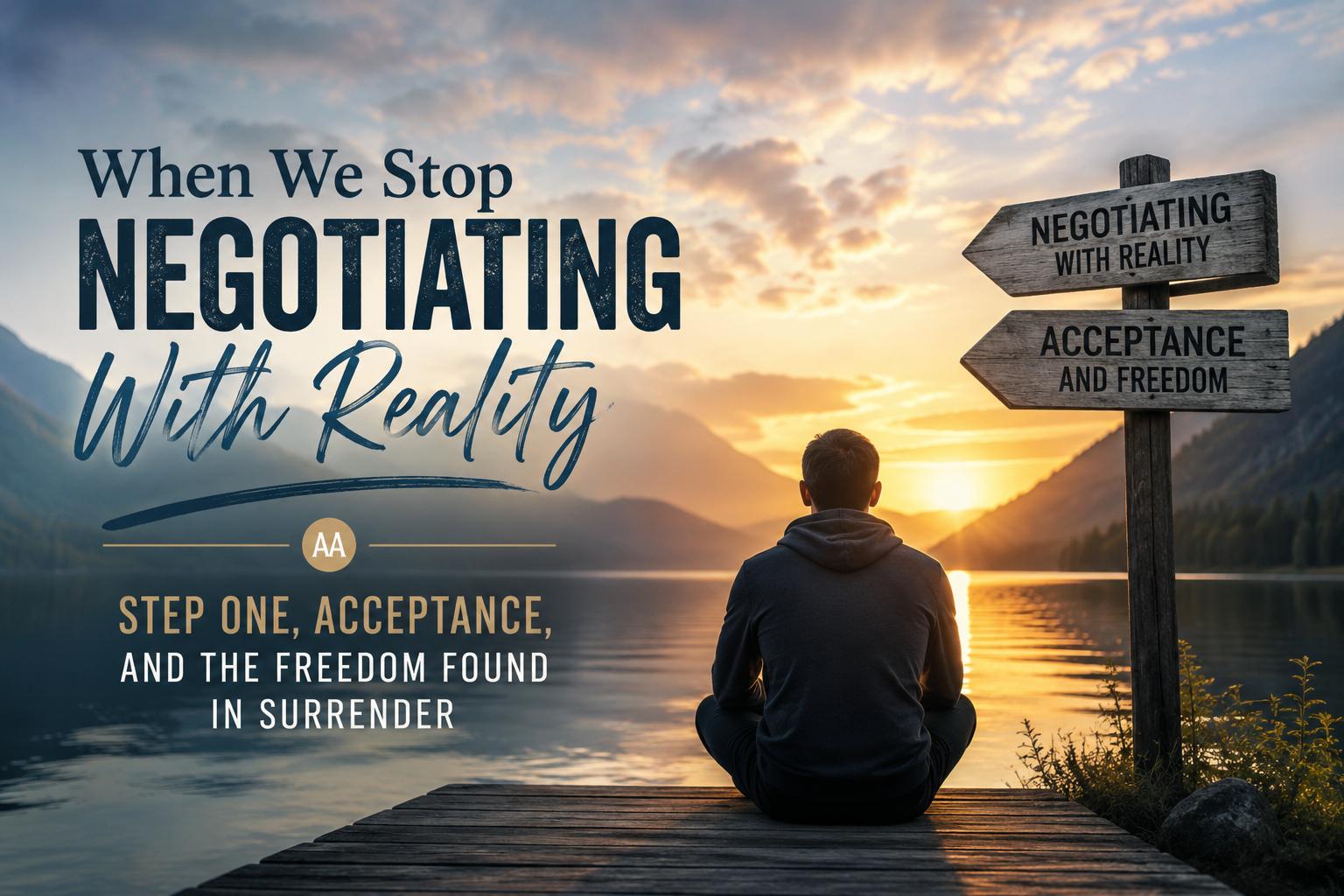
When We Stop Negotiating With Reality
Step One, Acceptance, and the Freedom Found in Surrender
One of the most exhausting things an alcoholic ever does is negotiate with reality.
We negotiate with consequences. We negotiate with truth. We negotiate with our own patterns, our own pain, our own powerlessness. We say things like:
- “Maybe this time will be different.”
- “I can manage it better now.”
- “I just need more discipline.”
- “I’m not as bad as they are.”
- “If people would just change, I’d be okay.”
And perhaps the most dangerous negotiation of all: “I still think I can control this.”
Step One interrupts that negotiation. Not gently. Not theoretically. But honestly.
In The Prep Steps, Step One is described as “the preparation for all action” because until reality is accepted, meaningful change cannot begin. The core question of Step One is simple but devastating: “Am I willing to stop negotiating with reality?”
That question reaches far beyond alcohol. It reaches into the way we fight our thoughts, resist our emotions, deny our fears, manage our image, and cling to the illusion that self-will can eventually save us if we just try harder. Many of us spent years believing recovery was primarily about stronger effort. More control. More discipline. More management. But A.A. eventually teaches us something deeper: Willpower alone cannot heal a spiritually exhausted person (remember, ours is a spiritual malady).
That is why acceptance is so foundational in recovery. Acceptance does not mean approval. It does not mean passivity. It does not mean resignation. Acceptance simply means we stop arguing with what is already true. And that changes everything.
In the rooms of A.A., we hear the phrase, “What we resist persists.” The harder we fight certain thoughts or feelings, the more energy we accidentally give them. Fear grows stronger when denied. Resentment deepens when justified. Shame expands when hidden. Many alcoholics approach recovery the same way they approached drinking: trying to force themselves into change through pressure, fear, or self-condemnation.
But the program offers another path. Instead of beginning with resistance, we begin with honesty. Instead of saying, “I shouldn’t feel this,” we learn to say, “This is what’s happening in me right now.” Instead of trying to dominate the mind, we begin observing it.
That is where emotional sobriety begins.
The meditation in Chapter One of The Prep Steps captures this beautifully: “Help me stop fighting what is already true. Help me name my powerlessness without shame and see my unmanageability without denial.”
For many alcoholics, the greatest relief of Step One is not defeat, it is exhaustion finally ending.
- We become tired of managing appearances.
- Tired of pretending.
- Tired of trying to hold life together through force.
- Tired of performing strength while quietly falling apart inside.
Step One exposes what the book calls “the illusion of control.” And the illusion is often subtle. Control frequently disguises itself as responsibility, intelligence, independence, or determination. But eventually we begin to notice something painful: despite all our effort, we cannot consistently live according to our own intentions.
That realization hurts. But it also liberates. Because once we stop negotiating with reality, we can finally begin responding to reality.
This applies not only to alcoholism, but to our thoughts and emotions as well. Recovery teaches us that we do not have to believe every thought we think, nor do we have to wage war against every uncomfortable feeling. Thoughts are information, not identity. Feelings are experiences, not commands.
- When fear arises, we can ask: “What is this revealing?”
- When resentment surfaces: “What wound is underneath this?”
- When shame appears: “What truth have I been avoiding?”
- The goal is not perfect thinking. The goal is increasing awareness.
A.A. never promises that we will stop being human. It promises that we can stop being ruled by self-deception.
One of the most powerful ideas in The Prep Steps is the concept of “the death of alternatives.” This is the moment when the alcoholic quietly realizes there are no more successful negotiations left to make. The backup plans fail. The rationalizations weaken. The exhausting search for a loophole finally collapses.
Oddly enough, this is often where hope begins. Because when self-reliance is exhausted, openness becomes possible. And openness is the doorway to Step Two.
The book says it this way: “Step 1 does not give us hope, but it makes hope possible.” That may be one of the most important truths in all of recovery. Hope rarely enters while we are still defending ourselves against reality. Hope arrives when we finally stop arguing long enough to listen. When we stop trying to control every outcome. When we become willing to admit, “My way isn’t working.”
That surrender is not weakness. It is alignment. And alignment with reality is where healing starts.
So today, perhaps the question is not whether we can manage life better. Perhaps the question is simpler:
- What reality am I still negotiating with?
- What truth am I resisting?
- What feeling am I fighting?
- What illusion am I defending?
- What outcome am I trying to control?
Because freedom often begins the moment we stop arguing with what is already true.
And for the alcoholic, that moment may be the first real breath of true recovery.
In love & service,
