


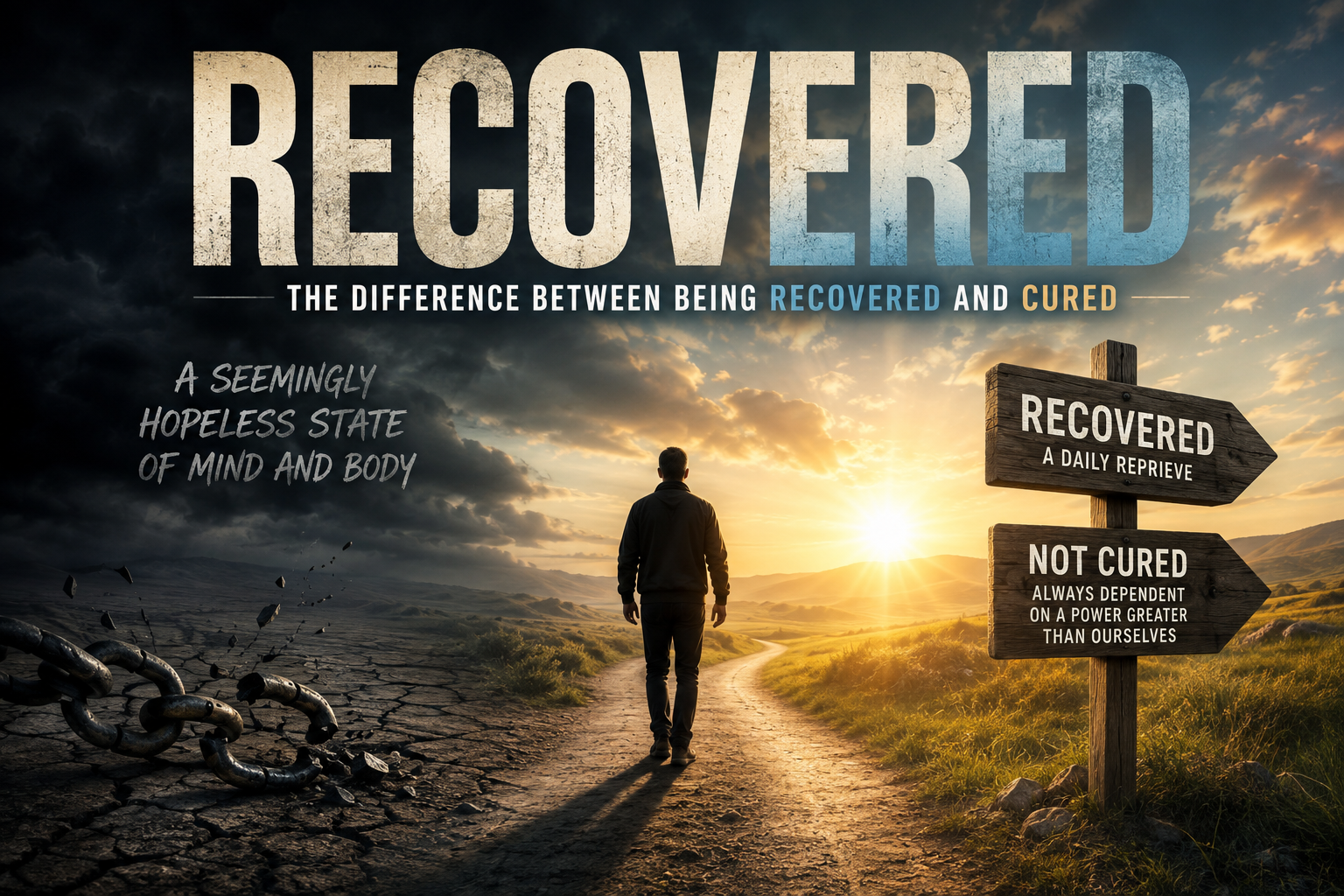
RECOVERED
Ok, fasten your seatbelts. This is gonna be a bumpy ride for some of you. And yes, I’m gonna go there.
There is a word in the Big Book that can make some people in an A.A. meeting uncomfortable. We talked about it tonight in my home group when reading page 29 in Into Action.
Recovered.
Let somebody introduce themselves by saying, “My name is ______, and I’m a recovered alcoholic,” and you can almost feel it happen. Somewhere in the room, somebody shifts in their chair. Somebody raises an eyebrow. Somebody else rolls their eyes. Recovered? Really?
Sometimes the reaction comes from humility. We know alcoholism too well to imagine ourselves permanently beyond its reach. Sometimes it comes from years of hearing the phrase “recovering alcoholic.” And sometimes, I think, it comes from a misunderstanding of what the Big Book actually means when it uses the word recovered.
Because the Big Book uses it. A lot. What the Big Book does not say is that we are cured. And that distinction matters.
The Book Says Recovered
The exact past-tense word “recovered” appears within pages 1–164 of the Fourth Edition of Alcoholics Anonymous. The word “cured” is never used to describe our condition.
If we include the front matter, the title page, prefaces, and forewords, the word appears additional times. The title page itself describes the Big Book as: “The Story of How Many Thousands of Men and Women Have Recovered from Alcoholism.”
The First Edition Foreword says: “WE, OF Alcoholics Anonymous, are more than one hundred men and women who have recovered from a seemingly hopeless state of mind and body.”
Interestingly, “recovering” appears only once in the main text, on page 113.
I am not suggesting that somebody who calls themselves a “recovering alcoholic” is doing A.A. wrong. Far from it. I am suggesting something much simpler: Maybe we should become curious about why the authors chose the word recovered so deliberately. Instead of arguing about the word, perhaps we ought to ask what they meant by it.
Recovered From What?
This may be the most important question in the entire conversation. When I say I am recovered, what exactly am I claiming to have recovered from? The Big Book answers that question for us: “We have recovered from a seemingly hopeless state of mind and body.” Notice what it does not say.
- It does not say that my alcoholism has been surgically removed.
- It does not say I can safely drink again.
- It does not say the physical allergy has disappeared.
- It does not say the alcoholic problem can never return.
And it certainly does not say: Cured.
The alcoholic described in our basic text has a twofold problem. Once alcohol enters the body, the physical phenomenon makes controlling the amount uncertain. But when alcohol is absent from the body, something equally dangerous remains: the alcoholic mind eventually produces the insane idea that drinking might work this time. That is the hopeless condition.
I cannot safely drink when I drink. And eventually, I cannot reliably keep myself from taking the first drink. If those are both true, where exactly is my way out? That is why the condition is seemingly hopeless. Recovery is the answer to that hopelessness.
Recovery Is Not Immunity
This is where recovered and cured part company. Cured would suggest that the underlying condition is gone. Recovered means that, through the spiritual solution outlined in the Twelve Steps, I have been restored to a condition in which alcohol no longer dominates my thinking and dictates my behavior. That is an enormous difference.
The Tenth Step promises in Into Action describe something remarkable happening after we have entered the world of the Spirit: “We will seldom be interested in liquor.” Then the book goes even further: “For by this time sanity will have returned.” That is recovery language. But then comes the warning: “We are not cured of alcoholism.” There it is. The Big Book actually makes the distinction for us.
And what follows may be even more important: “What we really have is a daily reprieve contingent on the maintenance of our spiritual condition.”
Recovered but not cured. Those ideas are not contradictory. They are complementary.
I Can Be 38 Years Sober and Not Be Recovered Today
This is where the conversation gets personal for me. I have been sober for 38 years. That is a lot of twenty-four-hours. But my sobriety date does not automatically guarantee my spiritual condition today. I can have 38 years without a drink and still become disconnected from the Power that made those 38 years possible.
- I can stop praying.
- I can stop examining myself.
- I can stop making amends.
- I can stop helping other alcoholics.
- I can become resentful, fearful, selfish, dishonest, controlling, judgmental, and spiritually complacent.
- I can remain abstinent while slowly moving away from recovery.
That ought to get my attention. Because the Big Book does not tell me that my daily reprieve is contingent upon the maintenance of my sobriety date. It says it is contingent upon: “the maintenance of our spiritual condition.”
Thirty-eight years does not change that sentence. I cannot bank yesterday’s spiritual condition and withdraw from it today.
- Recovery is not seniority.
- Recovery is not longevity.
- Recovery is not how many anniversaries I have celebrated.
- Recovery is a present-tense relationship with a Power greater than myself.
For me, that means remaining connected to a God of my own understanding and continuing to practice the disciplines that keep that connection alive. Take away that connection, and I may still be sober. But I should be very careful about assuming that sobriety alone means I am living in recovery.
Why Do People Roll Their Eyes?
I understand some of the discomfort around the phrase “recovered alcoholic.” Sometimes we have heard somebody use it almost like a graduation certificate: I did the Steps. I’m recovered. Done.
If recovered becomes a declaration that I have arrived, that I no longer need the Steps, that alcoholism poses no danger to me, or that I have somehow graduated from dependence upon God, then I think the eye-rollers have a legitimate concern. That isn’t what the Big Book describes.
But there is another possibility. Maybe we roll our eyes because we have heard recovering so many thousands of times that recovered sounds wrong—even though it is the language our basic text repeatedly uses.
Maybe we inherited an understanding without ever examining it. That happens in A.A. Something gets said in meetings long enough and eventually it begins to sound like it came directly from the Big Book. Sometimes it did. Sometimes it didn’t.
That is why returning to the text matters.
The answer isn’t to become the Recovered Police and start correcting everybody’s introduction at meetings. Please don’t. We have enough people policing A.A. vocabulary already.
The better response is curiosity.
- What does recovered mean?
- What are we recovered from?
- How does the Big Book say that happens?
- And what maintains that recovery?
Now we are having a conversation worth having.
The Newcomer Deserves That Conversation
This matters most when a newcomer walks through the door. Imagine being newly sober and hearing two apparently contradictory messages. One person says: “You’ll always be recovering.” Then you open the Big Book and repeatedly read: Recovered. Without explanation, that can be confusing.
Our responsibility isn’t merely to hand newcomers slogans. It is to help them understand the solution described in our basic text. We need to explain that recovered does not mean cured. We need to explain that the book isn’t promising them immunity from alcoholism. It is promising something far more practical and, frankly, far more astonishing: There is a way out of the hopeless condition.
The obsession can be removed.
Sanity can return.
A relationship with a Power greater than ourselves can accomplish what willpower, knowledge, consequences, promises, resolutions, and human resources could not accomplish. That is extraordinarily good news for the alcoholic who arrives believing there is no way out. Why would we gloss over it?
Maybe Someone Needs to Hear This
I don’t particularly care whether someone introduces themselves as an alcoholic, a recovering alcoholic, or a recovered alcoholic. The vocabulary is not the point. Understanding the solution is.
If someone says “recovering,” I don’t need to correct them. If someone says “recovered,” I don’t need to roll my eyes. Maybe I should listen. Because behind that word is one of the central promises of Alcoholics Anonymous: We do not have to remain in the hopeless condition in which we arrived. Something can happen to us. We can change.
The alcoholic mind that once told us drinking was the answer can be restored to sanity. The life organized around self can begin to be organized around God and service. The person who could neither safely drink nor reliably stay away from the first drink can be given a daily reprieve.
- Not because we became stronger.
- Not because we finally learned enough.
- Not because enough years accumulated on the calendar.
But because we found a Power greater than ourselves and began practicing a way of life that keeps us connected to that Power.
So perhaps the next time somebody says, “I’m a recovered alcoholic,” instead of rolling our eyes, we might listen long enough to find out what they mean. And perhaps when somebody says, “I’m a recovering alcoholic,” we extend exactly the same grace. Because this isn’t really an argument about which adjective belongs in our introductions. It is a conversation about whether we understand what happened to us.
I am not cured. I have no reason to believe that another drink would turn out any differently for me today than it would have 38 years ago.
But today, through the grace of a God of my own understanding and the continued practice of this program, I do not have to live in that seemingly hopeless state of mind and body. That is what I have recovered from.
And tomorrow? The Big Book doesn’t give me tomorrow. It gives me a daily reprieve. So tomorrow, God willing, I’ll get up and do it again.
Recovered? Yes.
Cured? No.
And understanding the difference just might change everything and change my life.
In love & service,
