


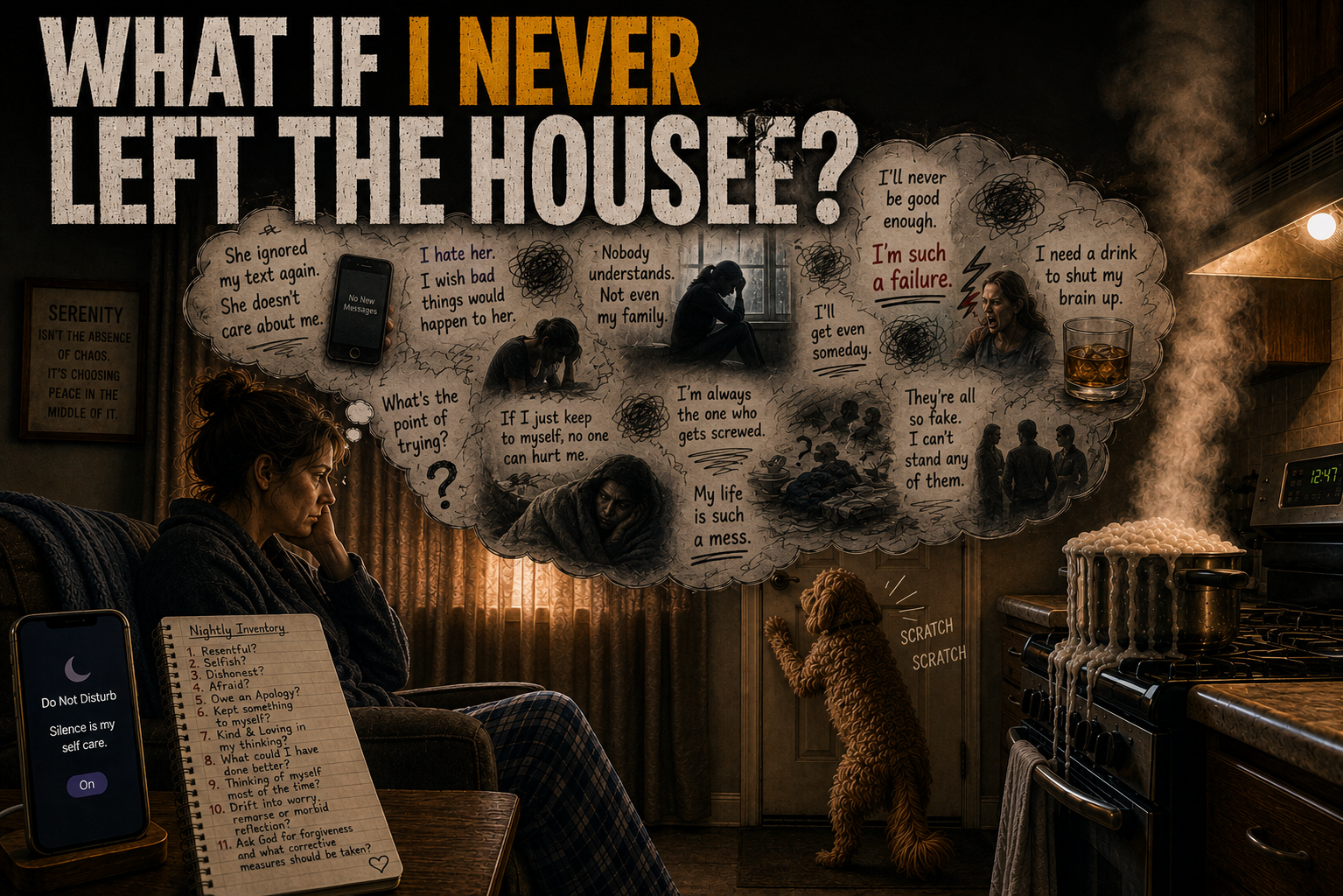
What If I Never Left the House?
Last night I was sitting in my home group when one of our members shared something that kind of made my head explode. You know those moments in an AA meeting when somebody says something and you immediately think: Wait. What did she just say?
This was one of those moments.
She was talking about the nightly inventory found in the chapter Into Action. It is part of the Eleventh Step directions in the Big Book, and if you have been around Alcoholics Anonymous for any length of time, you have probably heard it before.
- When we retire at night, the Big Book tells us to “constructively review our day.”
- Were we resentful, selfish, dishonest, or afraid?
- Do we owe an apology?
- Have we kept something to ourselves that should be discussed with another person?
- Were we kind and loving toward all?
- What could we have done better?
- Were we thinking mostly about ourselves, or were we thinking about what we could do for others and what we could “pack into the stream of life”?
Then comes an important warning: don’t turn the inventory into worry, remorse, or morbid reflection. That only diminishes our usefulness to others.
Finally, we ask God’s forgiveness and ask what corrective measures should be taken.
I’ve read that paragraph hundreds of times. But last night I heard it differently.
But I Didn’t Do Anything Today
Our home group member told us about a conversation she had with her sponsor. She was doing her nightly inventory and said something like: “I never even walked out my front door today. I didn’t have contact with anybody outside my home. How could I have done any of these things?” Makes sense, doesn’t it?
If I didn’t argue with anybody, maybe I don’t owe an apology. If I didn’t gossip, maybe I wasn’t dishonest. If I didn’t snap at anybody, maybe I wasn’t unkind. If I spent the whole day alone, who could I possibly have harmed?
Sounds like a pretty clean inventory. Her sponsor apparently saw it differently. Her sponsor took those familiar inventory questions and added a few words:
- Were you resentful, selfish, dishonest, or afraid in your thinking?
- Were you kind and loving toward others in your thinking?
- What could you have done better in your thinking?
- Were you thinking about yourself most of the time?
- Did you drift into worry, remorse, or morbid reflection in your thinking?
And after looking at all of that: Did you ask God what corrective measures should be taken?
BAM!
When she shared that, I was dumbfounded. Not because I had never considered the importance of my thinking. Of course I have. But I don’t know that I had ever heard the nightly inventory explained quite that way. And it stayed with me all night and throughout the day today.
Because suddenly the question wasn’t simply: What did I do today? It was also: Where did I live today, in my head?
I Don’t Have to Leave the House to Get in Trouble
I can spend an entire day alone and have arguments with people who aren’t even there. And, strangely enough, I usually win every one of them.
- I can replay something somebody said three weeks ago.
- I can decide what they really meant.
- I can assign motives to them without ever asking a question.
- I can imagine what I’m going to say the next time I see them.
- I can worry about something that hasn’t happened.
- I can create an entire future disaster in my head and then become afraid of the disaster I created.
- I can replay an old resentment until it feels brand new.
And I can do all of that without ever putting on my shoes. Maybe I didn’t hurt anybody today. But something was still happening inside me.
And eventually what happens inside me has a way of coming out.
Thoughts Have a Way of Becoming Actions
That’s what struck me about the sponsor’s observation. My actions don’t usually appear out of nowhere. They often begin with my thinking. I entertain a resentment. I feed it. I replay it. Pretty soon I’m treating somebody differently because of a conversation I’ve been having with them entirely inside my head. Fear can work the same way. So can selfishness. So can dishonesty.
Maybe the nightly inventory isn’t only about examining the wreckage I created today. Maybe it can also help me recognize the thinking that could create tomorrow’s wreckage. That’s a very different way of looking at it.
But This Isn’t About Policing Every Thought
There is an important distinction here. The Big Book doesn’t actually add the words “in your thinking” to every inventory question. That was a sponsor helping her sponsee apply the inventory differently. And I think we need to be careful with that. The purpose of the Eleventh Step isn’t to put myself on trial every night because some ridiculous thought crossed my mind.
Thoughts happen.
Getting angry isn’t the same as harming somebody. Feeling afraid doesn’t mean I’ve failed spiritually. Having a selfish thought doesn’t mean I need to make an amends.
Maybe the better question isn’t: Did I have the thought? Maybe it’s: What did I do with it?
Did I feed it? Did I rehearse it? Did I allow it to grow? Did I let it change the way I saw another person? Or did I recognize it, take it to God, and become willing to let it go?
Remember, the Big Book says we constructively review our day. This isn’t a spiritual beating. It’s an inventory.
Corrective Measures
I love how the paragraph ends. We don’t simply ask God to forgive us. We ask what corrective measures should be taken. That’s action.
- Maybe I need to apologize.
- Maybe I need to call my sponsor.
- Maybe I need to talk honestly with somebody.
- Maybe I need to stop rehearsing a resentment.
- Maybe I need to quit assuming I know somebody else’s motives.
- Maybe I need to do something useful for somebody.
Or maybe I simply need to recognize: I’ve spent half the day living in a situation that exists almost entirely inside my own head. That’s useful information. Because once I can see it, I can do something about it.
I’ll Hear the Questions Differently Now
One of the things I love about Alcoholics Anonymous is I can sit in meetings for decades and somebody can still say something that makes familiar words come alive again. That’s what happened to me last night. Tonight I’ll still ask the familiar questions: Was I resentful? Selfish? Dishonest? Afraid? Was I kind and loving? What could I have done better? Was I thinking mostly about myself, or about what I could do for others? But now I suspect another little phrase will sometimes follow those questions: “…in my thinking?”
Not so I can beat myself up for having imperfect thoughts. Not so I can crawl into bed carrying a fresh load of shame. But so I can pay attention to what I’ve been feeding. Because today’s thoughts have a funny way of becoming tomorrow’s attitudes. Tomorrow’s attitudes have a funny way of becoming tomorrow’s actions. And tomorrow’s actions have a funny way of becoming tomorrow night’s inventory.
Maybe sometimes the corrective measure can begin before any damage is done, right there, in the one room I never actually leave: the one between my left ear and my right ear.
In love & service,
