


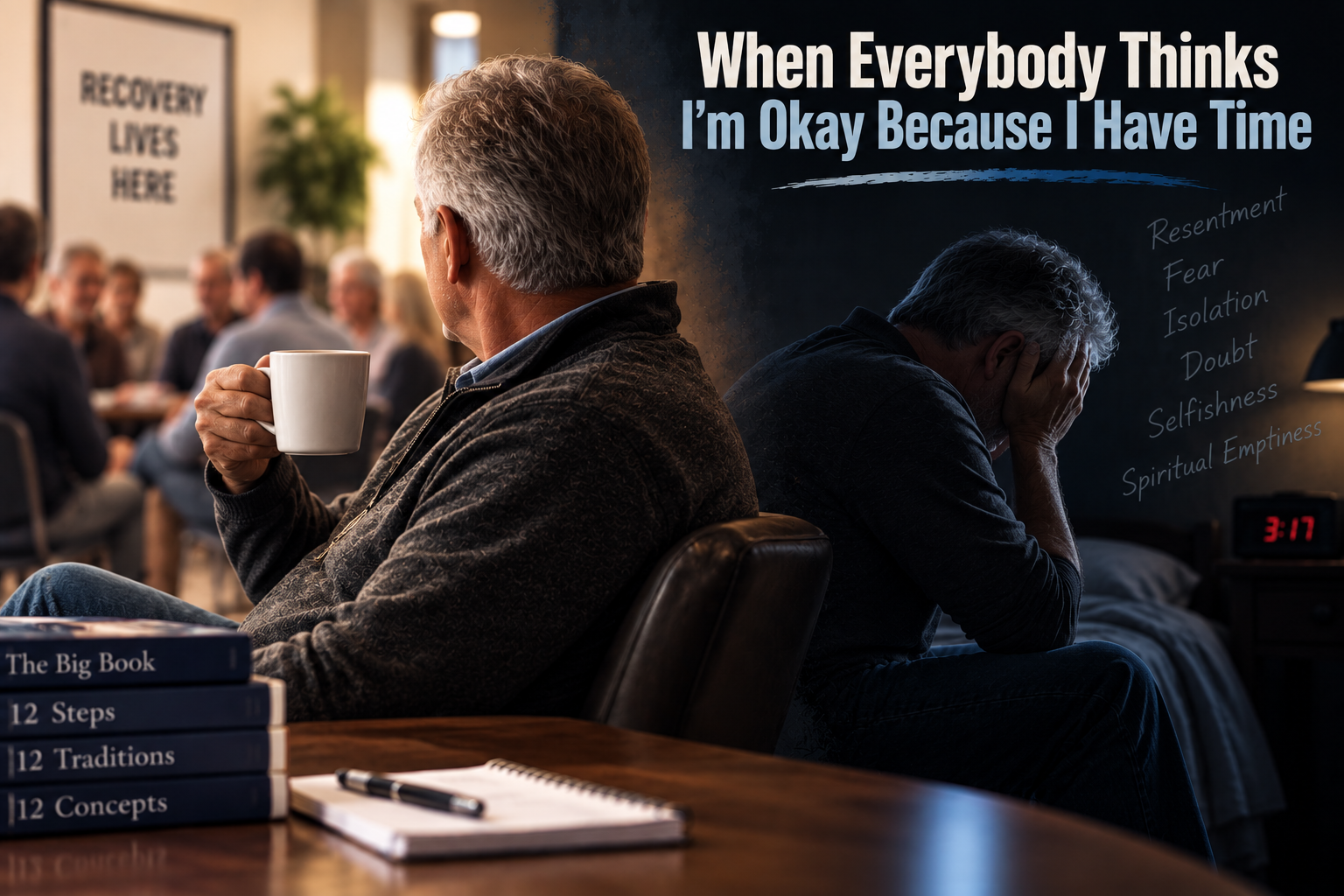
When Everybody Thinks I’m Okay Because I Have Time
There is a strange thing that can happen in Alcoholics Anonymous when you’ve been sober for a long time.
People stop asking if you’re okay. I understand why. You’ve been around. You know the Steps. You’ve sponsored people. You’ve probably held service positions, chaired meetings, made coffee, spoken at conventions, attended funerals, celebrated anniversaries, watched people come and go, and accumulated enough AA stories to fill a book (or a blog…lol).
You know what page it’s on. You know what the acronym means. You know when somebody is quoting the Big Book incorrectly. And somewhere along the way, people begin to assume: He’s okay. He’s got time.
That may be one of the most dangerous compliments we give each other. Because time is not spiritual fitness.
My Sobriety Date Tells You One Thing
My sobriety date tells you the last time I took a drink. That’s all!!! That is important. In fact, it is miraculous. Long periods of continuous sobriety represent an extraordinary amount of lived experience and evidence that the program can work. Time deserves respect, but it should never become a credential that exempts us from today’s work.
It doesn’t necessarily tell you anything about my spiritual condition today. It doesn’t tell you whether or not:
- I woke up resentful this morning.
- fear has been running around inside my head for three days.
- I’m avoiding an amends.
- I’ve been praying.
- I’m secretly angry at God.
- I’ve isolated myself while convincing everyone—including myself—that I’m just “busy.”
- I’m sponsoring anybody honestly or simply dispensing 38 years’ worth of AA knowledge.
- I’m still teachable.
And it certainly doesn’t tell you whether I’m spiritually fit.
It only tells you I haven’t had a drink. Those are not the same thing.
Longevity Can Become Camouflage
Early in sobriety, everybody watches you.
- “How are you doing?”
- “Did you call your sponsor?”
- “Have you been to a meeting?”
- “Where are you on your Steps?”
- “Are you praying?”
- “What’s going on with you?”
Sometimes you wish everybody would leave you alone. Then you stay sober awhile. Five years. Ten. Twenty. Thirty. And something changes. People start coming to you with those questions instead of asking them of you. That feels good. Until it doesn’t.
Because eventually I can become the person everybody thinks has the answers while quietly becoming afraid to admit that I’m struggling with the questions. That is where longevity can become camouflage. I can hide behind experience, service. sponsorship, and my knowledge of the literature. I can even hide behind my sobriety date. And the frightening part is that nobody may notice.
I remember in early sobriety, my sponsor at the time took me to hear a man speak with 30+ years and after he spoke, we got in the car and before she started the car, she looked at me and said, “So, what did you think?” “About what” “About that speaker.” “Can I tell the truth?” “Please!” “If that’s what 30 years of sobriety gets me, take me to the nearest bar now. I don’t want anything that man has.”
The Old-Timer Trap
There is a particular kind of pressure that comes with long-term sobriety that we don’t talk about enough. The longer I stay sober, the more I can begin to believe that I’m supposed to be okay.
After all, what am I going to say? “I’ve been sober 38 years and I’m spiritually upside down right now”? Actually… Yes!! That may be exactly what I need to say.
Because somewhere along the way we can accidentally create an AA culture in which newcomers are allowed to struggle, but old-timers are expected to have graduated from struggling. We haven’t. At least I haven’t. Life still happens. People die. Relationships fall apart. Bodies age. Money gets tight. Plans fail. People disappoint us. We disappoint ourselves. God sometimes seems painfully quiet. And alcoholism doesn’t become impressed because my medallion has a large Roman numeral on it.
The Big Book does not promise me immunity from being human. It offers me a way of living while being human. There is a difference.
I Can Know the Program Without Practicing It
This may be the part that scares me most. After enough years, I can become very good at talking about recovery without actually doing much recovering. I know what inventory is. But did I take one? I know what an amends is. But is there one I’m avoiding? I know what Step Eleven says. But did I actually pray this morning? I know what Step Twelve means. But when was the last time I sat across from a frightened alcoholic and listened without turning the conversation into a lecture?
Knowledge can become a substitute for action if I’m not careful. And Alcoholics Anonymous has never been primarily a knowledge-based program. It is an action-based program. I don’t get spiritually fit because I know what to do. I become spiritually fit by doing it. Again. Today.
Thirty-Eight Years Doesn’t Stack
I sometimes think we unconsciously imagine sobriety like money in a retirement account. Put enough years into it and eventually there is enough accumulated spiritual capital to live off the interest. But I don’t think recovery actually works that way.
- Yesterday’s prayer doesn’t automatically cover today’s fear.
- Last month’s inventory doesn’t remove today’s resentment.
- An amends I made twenty years ago doesn’t excuse the one I owe today.
- The alcoholic I helped in 1997 doesn’t replace the alcoholic standing in front of me now.
Thirty-eight years of sobriety doesn’t stack up somewhere and create a protective wall around me. I still get today. That’s it. And today I either participate in this way of life or I don’t.
Maybe We Should Ask the Old-Timer Too
Perhaps we need to get better at checking on the people we assume don’t need checking on. Not because we should be suspicious of them. Because they’re human.
Maybe occasionally instead of asking the old-timer for advice, we should ask: “How are you doing?” And then wait long enough for the real answer. Maybe ask the sponsor if he has talked to his sponsor lately. Ask the person who is always doing service whether anybody is serving them. Ask the person everybody depends upon whether they’re tired. Ask the person who seems spiritually grounded whether God feels close right now. And perhaps those of us with time need to become willing to answer honestly.
Not with the polished AA answer, with the share we’ve given 400 times, or with what we think somebody with our amount of sobriety is supposed to say. The truth.
Newcomers Need to See This Too
There is another reason this matters. The newcomer is watching.
I remember once when I was living in Nashville, TN, my sponsor saw me at a meeting, walked up to me and asked, “Are you happy to be sober?” I was kinda dumbfounded by such a silly question. I sort of indignantly said, “Well, of course I am.” He immediately responded, “Well, then tell your face!!!! Newcomers are watching.” I will never forget that.
If I pretend long-term sobriety means I no longer experience fear, resentment, grief, selfishness, confusion, loneliness, or doubt, I may unintentionally give them a completely false picture of recovery. They may think the goal is to become someone who no longer struggles. I don’t believe that’s the goal.
The goal is to become someone who knows what to do when the struggle comes. There is enormous hope in watching someone with decades of sobriety say: “I’ve got a resentment and I need to deal with it.” “I was wrong.” “I need to call my sponsor.” “I owe somebody an amends.” “I haven’t been spiritually fit lately.” “I need help.” That doesn’t diminish long-term sobriety. I think it demonstrates it. Because maybe one of the greatest signs of spiritual maturity isn’t needing less help. Maybe it’s becoming less ashamed to ask for it.
Don’t Let My Time Fool You
I am enormously grateful for every sober day I’ve been given. Every one of them. But please don’t confuse the number with the condition. Don’t assume that because someone has 20, 30, 40, or 50 years sober that they no longer need the Fellowship. Don’t assume they don’t need encouragement. Don’t assume they don’t get lonely. Don’t assume they don’t become afraid. Don’t assume they aren’t carrying something heavy.
And those of us with time shouldn’t make that assumption about ourselves either.
My sobriety date may tell you how long I’ve been on this road. It doesn’t tell you where I AM on the road today. For that, you’re going to have to ask me. And I’m going to have to be willing to tell you the truth.
Because perhaps the most dangerous assumption in long-term sobriety isn’t that everybody else thinks I’m okay because I have time, it’s when I start thinking it too.
In love & service,

P.S. – For those of you who read this and thought, “OMG! What’s wrong with Rick?” Take a beat! I’m good. It was just something that came up in conversaiton the other day with some AA folks and I thought I’d share on it, but thank you, if you thought that. xoxo