


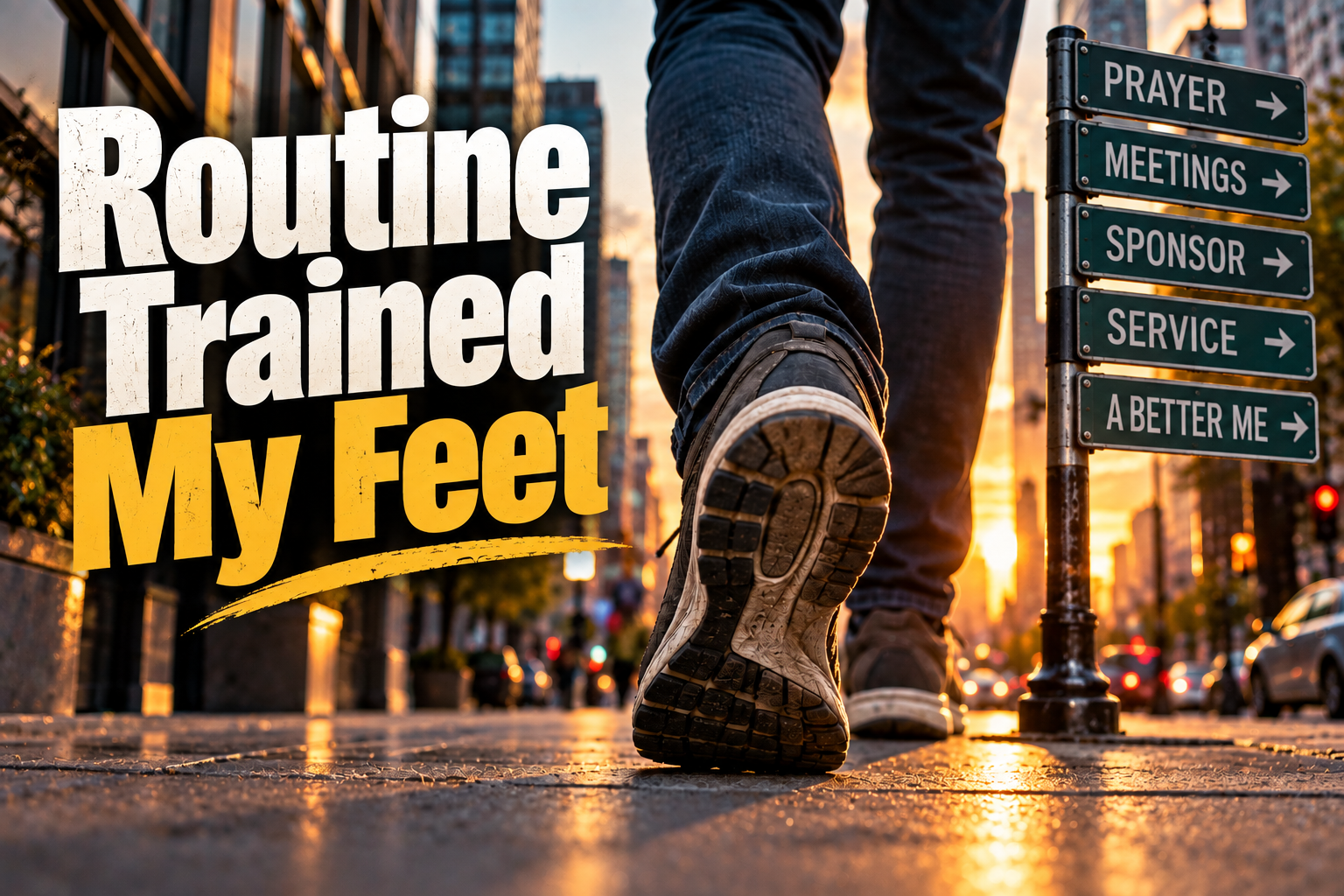
Routine Trained My Feet
Tonight, the man chairing the discussion meeting at my home group picked what I initially thought was a rather obscure topic: Routine.
I have been sitting in A.A. meetings for a long time, and I honestly can’t remember routine coming up very often as the actual topic of a meeting. We talk about resentment. Fear. Acceptance. Surrender. Honesty. Willingness. Sponsorship. Service. Prayer. Meditation. The Steps.
But routine? It almost sounds too ordinary for Alcoholics Anonymous.
Yet something interesting happened tonight. Once people started talking, this seemingly obscure topic became incredibly relatable to the drunks in the room.
People talked about getting up at a certain time. Morning prayer. Reading the Big Book. Calling another alcoholic. Going to the same meetings every week. Having coffee with the same people. Showing up for a service commitment. Going to work. Making the bed (that’s a big one for me). Going to bed at a decent hour.
Nothing particularly dramatic. The chair mentioned a phrase I use frequently, he talked how his feet were trained right from the beginning. THAT… I could relate too. My feet were trained to go places my head sometimes didn’t want to go. And that got me thinking about something I love exploring: The Big Book between the lines.
It Never Says “Develop a Routine”
There are things the Big Book tells us explicitly, and then there are things it teaches us without necessarily naming them. Routine is one of those things. You can search the Big Book looking for a chapter called “Developing a Healthy Routine,” and you aren’t going to find it. But look at the directions.
- On awakening, we think about the twenty-four hours ahead. We consider our plans. We ask God to direct our thinking.
- Before beginning the day, we pray.
- Throughout the day, when we become agitated or doubtful, we pause and ask for the right thought or action.
- At night, we constructively review our day.
That sure sounds like routine to me.
Then consider Step Ten. The Big Book tells us to “continue to watch” for selfishness, dishonesty, resentment and fear. When these crop up, we take specific actions.
- Continue.
- Watch.
- Admit.
- Ask.
- Discuss.
- Make amends.
- Help somebody.
- Then do it again tomorrow.
Maybe the Big Book doesn’t use the word routine because it doesn’t need to. The instructions themselves create one.
My Feet Sometimes Know Before My Brain Does
One of the great gifts of routine is that eventually I don’t have to renegotiate every good decision. That matters for an alcoholic like me. If every morning I have to decide whether I’m going to pray, I have already given my mind an opportunity to vote. If every week I have to decide whether I’m going to my home group, I’ve opened negotiations. If every time a sponsee calls I have to determine whether I feel like answering, eventually I’m going to come up with a perfectly reasonable explanation for why today isn’t convenient.
Alcoholic thinking can be incredibly persuasive. Routine takes some of those decisions off the table. My feet just know where to go.
I have some personal experience with this. My mom, who I loved more than anyone on the planet, passed away just three months ago on Friday, July 10, 2026 at 10:03am. I had the incredible privilege of being by her side when she passed that morning. I was devastated. I spent the day in tears. But at 7:30pm that night, I was sitting in my home group. I didn’t go to that meeting, my feet took me there.
Conversely, there have been plenty of nights when I didn’t particularly feel like going to a meeting. I was tired. I had other things to do. Maybe I wasn’t in the mood to hear one more person talk about acceptance. But it was meeting night after all. So I went. And how many times have we heard some version of this?
“I didn’t want to come tonight, but I knew where I was supposed to be.”
That’s routine training our feet.
Routine Builds Character
We often think character is revealed in the big moments. Sometimes it is. But I think character is mostly built in thousands of very small ones.
- Showing up when nobody is keeping score.
- Keeping a commitment when it has become inconvenient.
- Calling when you said you would call.
- Doing the inventory when you’d rather go to sleep.
- Getting to the meeting early because you agreed to make coffee.
- Answering the phone when somebody needs help.
- Praying when you don’t feel particularly spiritual.
Routine teaches diligence because diligence is simply doing what needs to be done consistently. Routine teaches commitment because commitment eventually has to survive feelings. Anybody can be committed when they’re enthusiastic. The real test comes when enthusiasm leaves.
Routine says: We’re doing it anyway.
And somewhere in all those ordinary repetitions, character begins forming.
Routine Can Breed Comfort
There is another gift in routine that I don’t think we talk about enough. Comfort. Not complacency. Comfort. Those are different things.
Early sobriety can feel chaotic. For many of us, chaos was normal long before we ever walked into A.A. We didn’t know what tomorrow was going to look like because we weren’t particularly good at managing today. Then recovery begins giving our lives rhythm.
- I know where I’m going Tuesday night.
- I know who I’m calling tomorrow morning.
- I know where I’ll be Friday evening.
- I know what I do when resentment shows up.
- I know what I do when fear takes over.
- I know what I do before making an amends.
- I know what I do when my thinking starts getting crispy.
There is enormous comfort in that. Routine begins replacing chaos with rhythm. And rhythm can become a form of safety.
The Meeting Nobody Talks About
Imagine a newcomer sitting in a meeting hearing everybody talk about spiritual awakenings, surrender and conscious contact with God. He’s thinking: I’m just trying to remember to brush my teeth and get to work on time.
Then somebody says: “When I got sober, my sponsor told me to get up every morning, make my bed, pray, read something from the Big Book, call another alcoholic and get on with my day.”
The newcomer may think, That’s it? No. That isn’t it.
But it may be the beginning of something enormously important. Because six months later, he may notice that his life has acquired structure. A year later, people may start trusting him again because he shows up when he says he will. Three years later, somebody may describe him as dependable. He may think recovery magically changed his character. Maybe. Or maybe character was being built every morning when nobody was watching.
Routine trained his feet.
There Is a Danger Here
Routine isn’t automatically spiritual. It can become mechanical. I can attend meetings without participating in recovery. I can read a page of the Big Book without allowing a single word to challenge me. I can say prayers while thinking about what I’m having for lunch. I can even turn recovery into a checklist.
- Meeting? Check.
- Sponsor? Check.
- Prayer? Check.
- Service? Check.
And still avoid God, honesty and change. So routine cannot become the destination. Routine is the container. The spiritual life is what we put inside it. That distinction matters.
The purpose of my morning routine isn’t to say I completed my morning routine. The purpose is to consciously connect myself with God and prepare myself to be useful. The purpose of going to meetings isn’t attendance. The purpose is participation in a Fellowship whose primary purpose is carrying the message. The purpose of calling my sponsor isn’t checking another box.
It is remaining teachable.
Maybe Routine Isn’t So Obscure After All
By the end of tonight’s meeting, that supposedly obscure topic didn’t seem obscure anymore. It seemed foundational. Maybe we don’t talk about routine much because it isn’t exciting. Nobody comes into A.A. hoping to become more consistent. We come in because our lives are falling apart. We want relief, the obsession removed, and the pain to stop. Then recovery quietly begins teaching us something we didn’t know we needed.
How to live Tuesday. And then Wednesday. And Thursday. And Friday. One day at a time eventually becomes thousands of ordinary days filled with ordinary actions practiced over and over again. Maybe that’s another piece of the Big Book between the lines.
Recovery isn’t only found in those extraordinary moments when God dramatically changes the direction of my life. Sometimes recovery looks remarkably ordinary.
- Wake up.
- Pray.
- Read.
- Ask for direction.
- Go to work.
- Help somebody.
- Go to the meeting.
- Take inventory.
- Make it right.
- Go to bed.
- Get up tomorrow and do it again.
After enough years, I look back and realize those routines did far more than organize my calendar. They taught me diligence, commitment, gave me comfort when life was chaotic, helped build my character, and perhaps most importantly, on those days when my head couldn’t be trusted to tell me where I needed to go… routine had already trained my feet.
In love & service,
