


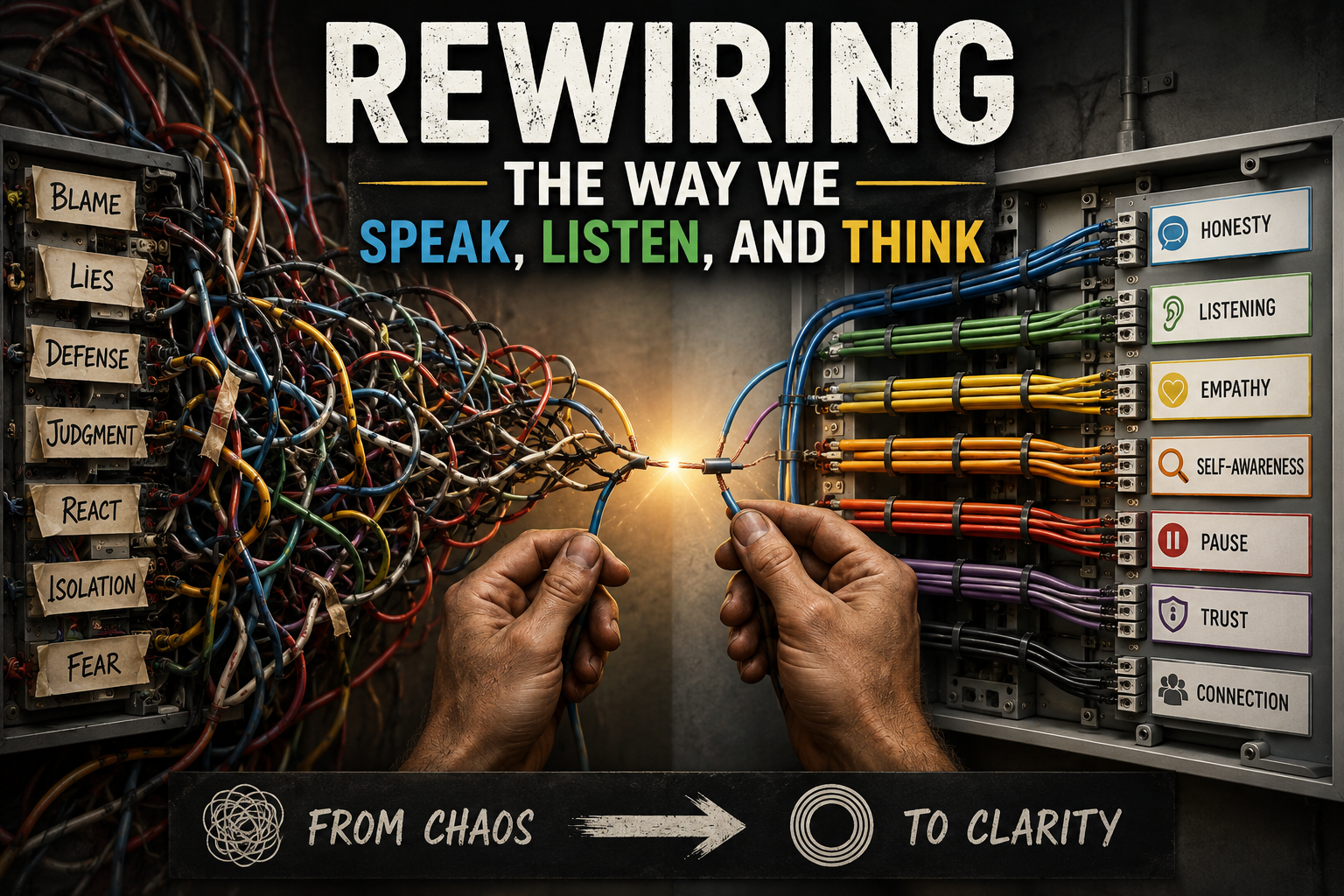
Rewiring the Way We Speak, Listen, and Think
Sobriety Didn’t Just Change What I Said, It Changed How I Communicate.
How Recovery Rewired the Way I Speak, Listen, and Think
One of the most overlooked miracles of recovery has very little to do with alcohol. Most of us came to Alcoholics Anonymous because drinking had become unmanageable. We stayed because we discovered something much deeper: alcoholism had affected nearly every relationship in our lives. Not just our relationships with family, employers, spouses, and friends. It had also affected our relationship with communication itself.
Many of us arrived in A.A. believing our problem was alcohol. What we eventually discovered was that alcohol was often the symptom. Underneath it existed fear, resentment, self-centeredness, dishonesty, insecurity, pride, shame, and a host of other defects that shaped the way we interacted with the world.
Recovery doesn’t just simply remove alcohol, it can, if we let it (and God), change the way we communicate.
The Language of Survival
Before recovery, many of us developed a communication style designed for survival rather than connection. We learned to:
- Deflect responsibility
- Hide uncomfortable truths
- Control conversations
- Manipulate outcomes
- Defend ourselves at all costs
- Listen only long enough to prepare our response
Communication became a tool for protection. The irony is that while these habits may have helped us survive, they often prevented us from truly connecting with other people. The Twelve Steps begin dismantling these patterns almost immediately.
Learning to Speak Differently
One of the first communication shifts many alcoholics experience is moving from blame to ownership. Instead of: “You made me angry.” Recovery encourages: “I became angry.” That may seem like a small change, but it is profound.
The Big Book repeatedly directs me toward personal responsibility. Inventory work teaches me to stop focusing exclusively on what others did and begin examining my own reactions, motives, fears, and behaviors. I gradually move away from statements that assign fault and toward statements that accept ownership. I stop saying: “They ruined my day.” and begin asking: “Why did I allow this to affect me so deeply?”
That shift changes conversations. More importantly, it changes relationships.
Learning to Tell the Truth
Active alcoholism often involves a complicated system of half-truths, omissions, rationalizations, and sometimes, outright lies. The Fourth and Fifth Steps begin dismantling that system. For perhaps the first time, many alcoholics learn what rigorous honesty actually feels like. Not brutal honesty. Not weaponized honesty. Just honesty.
I begin saying what I mean. I stop managing my image. I stop editing every conversation to make myself look better. The result is a communication style that becomes increasingly clear, direct, and authentic.
People begin trusting me because my words and my actions start matching.
Learning to Listen
Listening may be one of the most underrated skills in recovery. Many of us spent years hearing people without actually listening to them. We listened to:
- Find flaws
- Build counterarguments
- Defend ourselves
- Prove we were right
Recovery introduces me to a completely different approach. Sit quietly in enough A.A. meetings and something begins to happen. I start hearing myself in other people’s stories. I stop listening for differences and begin listening for similarities. The question changes from: “How are they different from me?” To: “What can I learn from this?” This simple shift develops empathy. #teachablemoments
It reminds me that beneath different circumstances, many alcoholics share the same fears, insecurities, hopes, and struggles.
The Most Important Conversation of All
Perhaps the greatest communication change happens in a place nobody else can hear, inside my own head (‘Danger Will Robinson – Danger!’ 🤣). Many alcoholics arrive in recovery carrying an exhausting internal dialogue. Some hear a constant critic. Some hear a victim. Some hear a perfectionist. Some hear a judge.
For years that internal voice may have told me:
- “You’re not enough.”
- “You’ll never change.”
- “Nobody understands.”
- “It’s everyone else’s fault.”
The inventory process begins exposing those narratives. As I take the Steps, I learn something remarkable: Just because a thought enters my mind does not make it true. Step Ten encourages me to pause. Step Eleven encourages me to reflect. Instead of automatically reacting to every thought or emotion, I learn to create space between stimulus and response.
That space often becomes the birthplace of wisdom.
A Recovery Acronym Worth Remembering
Recently, while studying communication principles in another spiritual setting, I encountered an acronym that immediately reminded me of the principles we practice in Alcoholics Anonymous:
RESPECT
While not an A.A. acronym, it aligns remarkably well with many of the communication principles embedded throughout the Twelve Steps.
R — Responsibility
Take responsibility for what I say and feel without blaming others. This sounds very much like inventory work. Recovery teaches me to examine my side of the street rather than endlessly focusing on someone else’s.
E — Empathetic Listening
Try to understand how the other person feels. A.A. teaches me to identify rather than compare. Empathy grows when I stop looking for differences and start recognizing shared humanity.
S — Sensitive
Be sensitive to differences in communication styles. Every alcoholic arrives with a unique story. Age, culture, personality, upbringing, education, and experience all shape how people communicate. Sensitivity allows me to hear the message without becoming distracted by the packaging.
P — Ponder
Ponder what I hear and feel before I speak. Many of us (including yours truly) spent years prior to coming into A.A. reacting (and when I’m not connected to God still can today). Recovery teaches me to respond. There is a difference. Reaction is often immediate, emotional, and ego-driven. Response usually begins with a pause. That pause has saved many alcoholics from saying things they later regretted.
E — Examine
Examine my own assumptions and perceptions. The Big Book frequently reminds us that self-deception is one of our greatest challenges. Examining my assumptions helps me avoid judging motives I cannot possibly know. It allows me to practice discernment without slipping into judgment (fine line there).
C — Confidential
Keep confidential what others share. Trust is essential in recovery. People share deeply personal experiences because they believe they are in a safe environment. Protecting that trust strengthens the entire Fellowship.
T — Tolerate
Tolerate what others have to say. Tolerance does not require agreement. A.A. thrives because people with vastly different opinions can sit in the same room and pursue a common solution. Remember, unity does not require uniformity.
Communication as a Spiritual Practice
The longer I stay sober, the more convinced I become that communication is far more than a social skill. It is a spiritual practice.
- Every inventory improves communication.
- Every amends improves communication.
- Every sponsorship conversation improves communication.
- Every meeting teaches communication.
The alcoholic who once hid behind dishonesty learns honesty. The one who once blamed learns accountability. The one who once reacted learns to pause. The one who once isolated learns connection.
The result is not merely better conversations. The result is a different way of living.
Perhaps one of the clearest signs that recovery is working is not found in what I say during meetings. It is found in how I communicate with my family, my coworkers, my clients, my friends, my sponsor, my sponsees, and even myself. Sobriety transformed my life and God first transformed my ability to connect with another human being.
In love & service,
