


Is Tradition Seven Really About Money?
Spiritual Principle: Responsibility
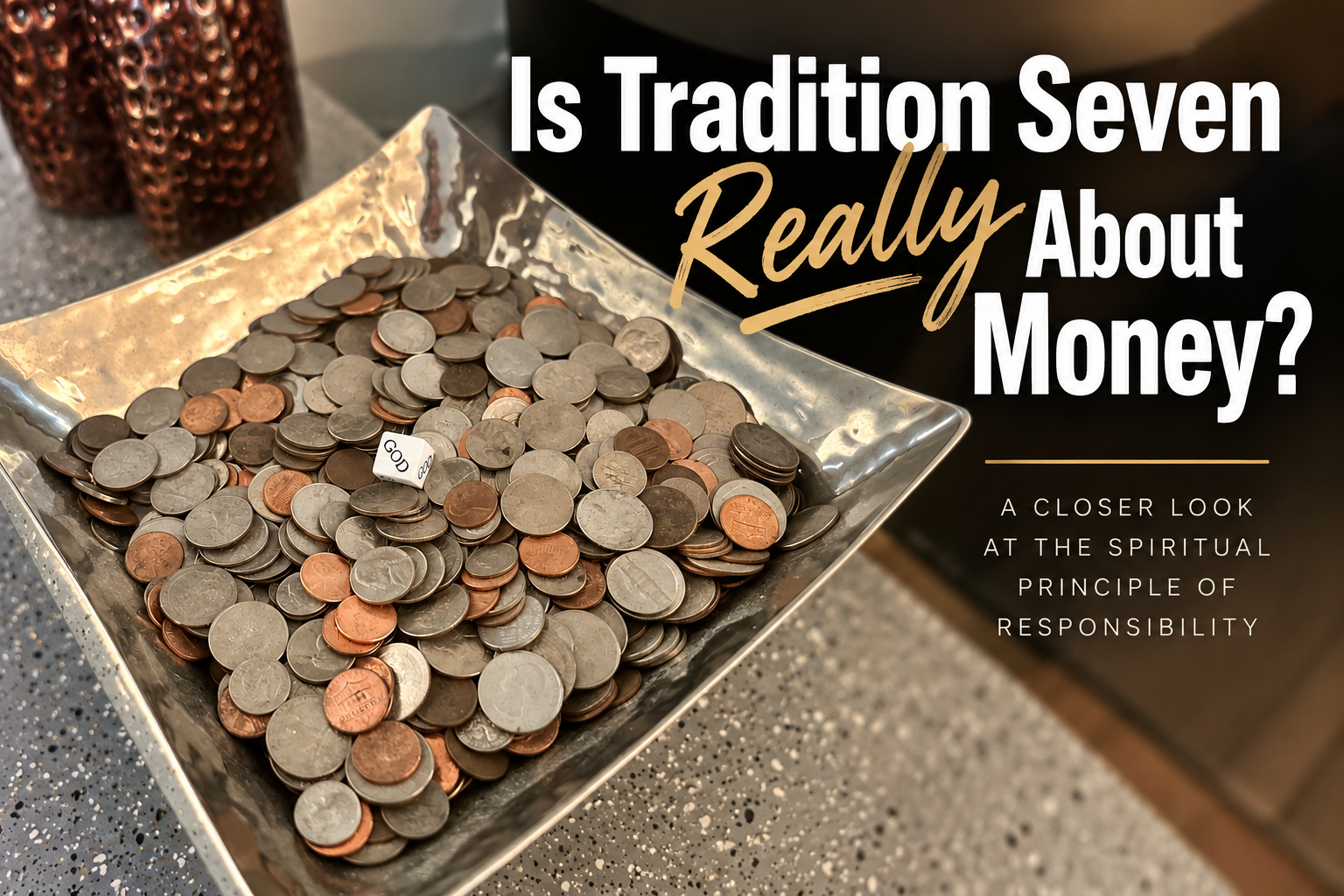
There is a bowl that sits in my home filled with loose change. Pennies. Nickels. Dimes. Quarters. Nothing particularly impressive. It’s just where I toss the change that accumulates in my pockets. But sitting right in the middle of all those coins is a little die with one word printed on it: GOD.
Years ago, I put it there intentionally.
It reminds me that every penny I have ultimately came to me through gifts, opportunities, abilities, people, circumstances, work, grace, and, as I understand it, God. But here’s the interesting part: Believing that what I have is a gift from God doesn’t relieve me of responsibility for it. It increases my responsibility for it. And that little bowl has become, for me, a pretty good picture of Tradition Seven.
Because while Tradition Seven certainly talks about money, I’m beginning to think the money may be pointing me toward something much bigger. Responsibility.
What Tradition Seven Actually Says
Most of us probably first encounter Tradition Seven when somebody passes the basket at an A.A. meeting.
The Short Form says:
“Every A.A. group ought to be fully self-supporting, declining outside contributions.”
Pretty straightforward. We pay our own way.
But take a look at the Long Form:
“The A.A. groups themselves ought to be fully supported by the voluntary contributions of their own members. We think that each group should soon achieve this ideal; that any public solicitation of funds using the name of Alcoholics Anonymous is highly dangerous, whether by groups, clubs, hospitals, or other outside agencies; that acceptance of large gifts from any source, or of contributions carrying any obligation whatever, is unwise. Then, too, we view with much concern those A.A. treasuries which continue, beyond prudent reserves, to accumulate funds for no stated A.A. purpose. Experience has often warned us that nothing can so surely destroy our spiritual heritage as futile disputes over property, money, and authority.”
Suddenly, this sounds like something considerably bigger than putting a couple of bucks in the basket. Tradition Seven is talking about money, yes. But underneath the money are questions about independence, obligation, power, freedom, participation and responsibility.
Why Was Bill So Concerned About Money?
A.A. learned fairly early that money could become dangerous. Not because money itself is bad. But because money has an interesting way of bringing influence, obligation and control along with it. There’s an old saying: “He who pays the piper calls the tune.” If somebody outside A.A. financially supports A.A., sooner or later that support can create expectations. Maybe the donor never intended that. Maybe the recipient never expected it. But money can change relationships.
That’s why the Long Form doesn’t merely say we shouldn’t accept outside contributions. It warns against public solicitation, large gifts, contributions carrying obligations, and even A.A. groups accumulating excessive funds without a stated A.A. purpose.
And then comes that remarkable warning:
“Experience has often warned us that nothing can so surely destroy our spiritual heritage as futile disputes over property, money, and authority.”
Notice those last three words: Property. Money. Authority.
Those three things have caused enormous trouble in plenty of organizations. A.A. decided it would rather remain relatively poor and free than wealthy and beholden. But that decision created another question: If outsiders aren’t going to support Alcoholics Anonymous, who will?
We will.
And there, I think, is where the spiritual principle of responsibility begins to emerge.
So, Is Tradition Seven Really About Money?
Yes. We shouldn’t spiritualize the Tradition so much that we erase its actual purpose. Tradition Seven is very specifically about A.A. supporting itself financially and declining outside contributions. But I don’t think that’s where its spiritual usefulness ends. Because the money teaches us something.
If something matters to me, or feeds me spiritually, I have some responsibility for supporting it.
That’s true of my A.A. group. It’s also true of my relationships, my work, my spiritual life and my relationship with God. Tradition Seven asks me to stop standing outside my own life waiting for somebody else to finance it, fix it, manage it or take responsibility for it.
That’s a very different understanding of self-support.
At Home: Stop Making Other People Pay My Emotional Bills
Self-support at home isn’t primarily or necessarily just about money. Sometimes it means becoming emotionally self-supporting.
That does not mean becoming emotionally isolated or pretending I don’t need other people. Human beings need one another. Recovery itself teaches me that. Asking for help isn’t a violation of Tradition Seven. But there is a difference between asking someone to walk with me and expecting someone else to carry what belongs to me. For instance:
- I can expect another person to make me happy.
- Fix my mood.
- Validate me.
- Reassure me constantly.
- Manage my disappointment.
- Change their behavior so I don’t have to deal with my feelings.
At some point, somebody else is then paying my emotional bills. Responsibility asks me instead: What part of this belongs to me?
- Maybe I need to communicate.
- Maybe I need to apologize.
- Maybe I need to set a boundary.
- Maybe I need to examine a resentment.
- Maybe I need to call my sponsor.
- Maybe I need to pray.
- Or maybe I simply need to sit with an uncomfortable feeling without demanding that somebody else remove it.
That’s emotional self-support. Not independence from others. Responsibility within relationship.
At Work: Own What Has My Name on It
Tradition Seven translates remarkably well into work life. If I make a commitment, I own it. If I miss something, I acknowledge it. If I make a mistake, I don’t spend fifteen minutes explaining why it technically wasn’t my fault. If something falls within my responsibility, I take care of it. That’s not particularly glamorous spiritual work.
But neither is putting five dollars into an A.A. basket.
Responsibility is often spiritually important precisely because nobody applauds it. Reliability builds trust. Accountability builds character. And doing what I said I would do, especially when nobody is watching, is one way I practice integrity.
In A.A.: Whose Fellowship Is This?
Tradition Seven becomes wonderfully concrete inside Alcoholics Anonymous. It’s ours. Not the government’s. Not some wealthy benefactor’s. Not a treatment center’s. Not a corporation’s. Ours. Which means we support it.
And again, that means considerably more to me than money.
- Someone has to make the coffee.
- Someone has to open the meeting.
- Someone has to clean the room.
- Someone has to buy literature.
- Someone has to attend the business meeting.
- Someone has to represent the group.
- Someone has to carry the message.
- Someone has to sponsor the newcomer.
- And yes, somebody has to put money in the basket.
Tradition Seven eventually asks me a question that can make me a little uncomfortable: Am I merely consuming A.A., or am I helping support it?
I can sit in the same chair every week, drink the coffee, use the literature, listen to everyone else’s experience, benefit from the meeting and go home. Or I can recognize: This is my Fellowship, too.
The basket is simply one visible expression of something much larger. I have received something here. Now I participate in sustaining it. That’s belonging. And that’s responsibility.
With God: The Little Die in the Change Bowl
This is where Tradition Seven becomes particularly personal for me. I keep that little GOD die in my change bowl because I need the reminder. I can very easily begin thinking: My money. My house. My abilities. My time. My sobriety. My opportunities. My life. And that little die sitting among those pennies and quarters interrupts me.
Are you sure all of this is entirely yours?
For me, the answer is no. I believe what I have has been entrusted to me. And stewardship is different from ownership. If I believe God has provided something, then my responsibility isn’t simply to be grateful for it. My responsibility is to ask:
- What am I going to do with it?
- How will I use my money?
- How will I use my time?
- How will I use my experience?
- How will I use my sobriety?
- How will I use whatever abilities I’ve been given?
- How will I use my relationships?
- How will I use my voice?
- How will I use another day?
For me, Tradition Seven becomes less about: “God will provide for me.” And more about: “God has provided. Now what am I going to do with what I’ve been given?”
That distinction matters to me.
Because trusting God doesn’t relieve me of responsibility. Trusting God gives me something to be responsible for.
Maybe the Basket Isn’t Just About the Money
Every time that basket gets passed around an A.A. meeting, perhaps we’re participating in something much bigger than collecting enough money to pay the rent. We’re saying: This matters to us, so we will take responsibility for it. Nobody outside the Fellowship has to rescue us, gets to buy influence over us, or owns us because they financed us. We accept responsibility for maintaining what has been freely given to us. And perhaps that’s why responsibility makes so much sense to me as the spiritual principle behind Tradition Seven. Responsibility isn’t punishment. It isn’t burden. It isn’t grim obligation.
Responsibility is participation.
It means: I have a stake in this. I belong here. I’ve received something worth preserving. And now I get to help preserve it for somebody who hasn’t even walked through the door yet.
What’s Sitting in My Bowl?
That bowl of change probably isn’t worth very much. But the little die sitting in the middle of it makes it priceless to me as a spiritual reminder. GOD.
Everything surrounding that word reminds me of provision. Everything surrounding that word also reminds me of responsibility. And maybe that’s the balance Tradition Seven is trying to teach me:
- Receive gratefully.
- Use responsibly.
- Give willingly.
- Trust God.
So perhaps the inventory question isn’t simply: “Am I self-supporting?” Maybe the deeper question is: “Am I taking responsibility for what God has already placed in my hands and am I using it in the best way I can to carry a message of love and hope?”
For me, that’s Tradition Seven.
Yes, it’s about the money.
But maybe the money isn’t really the point.
In love & service,
