


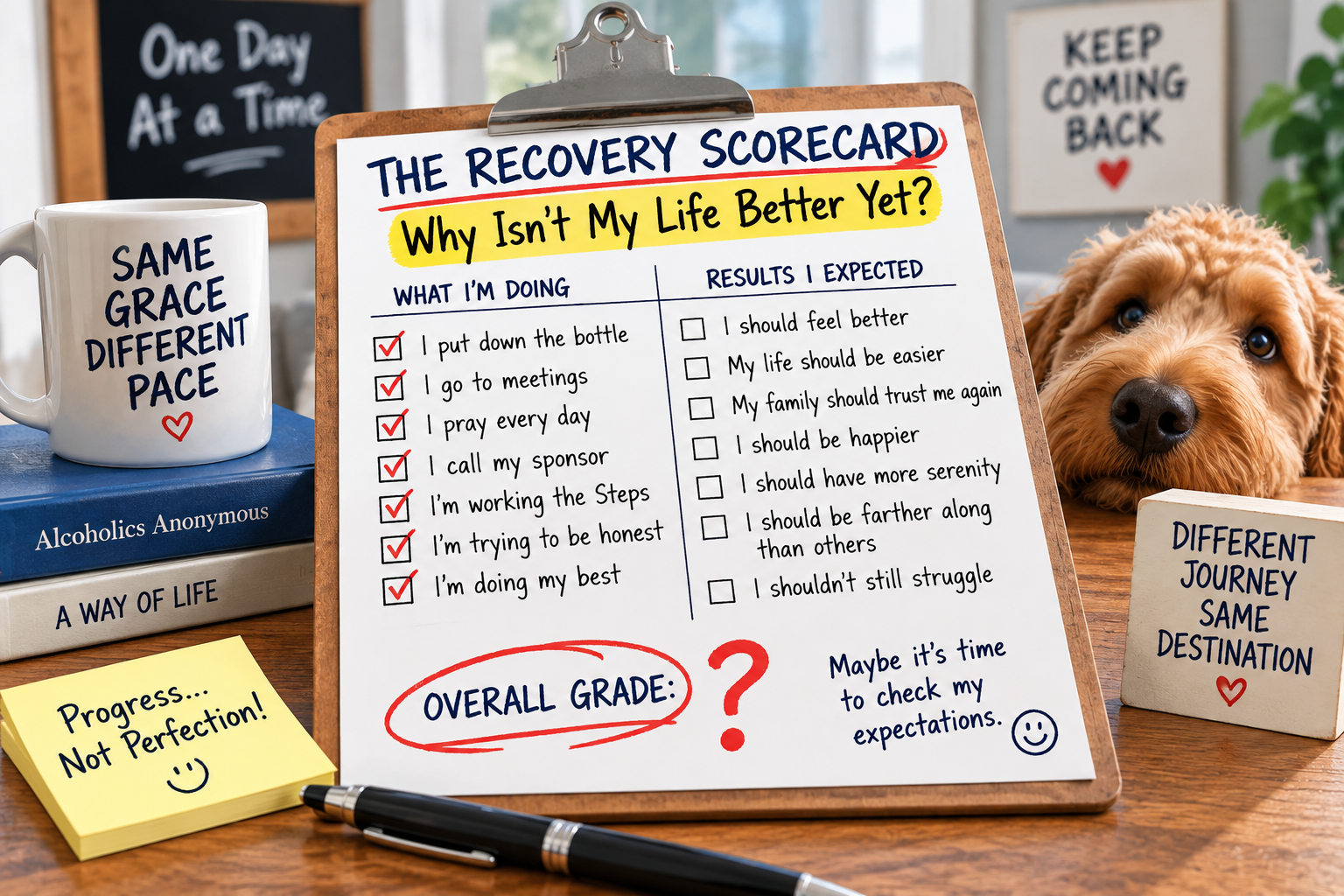
The Recovery Scorecard: Why Isn’t My Life Better Yet?
I’ve heard some version of this from newcomer sponsees more times than I can count: “I put down the bottle. I’m praying every day. I’m going to meetings. I’m calling you. Why don’t I feel better? Why isn’t my life getting better? And why am I not farther along than some of these other people?” It’s a fair question.
Especially when somebody is doing everything that’s been suggested of them to do. They stopped drinking. They’re showing up. They’re praying. They’re calling their sponsor. They’re doing all the things.
And yet they’re still anxious. Still angry, afraid, their marriage is still a mess, the bills didn’t disappear, their family still doesn’t trust them, they’re lying awake at three in the morning with a mind that simply will not shut up.
Then they look around the meeting. That guy came in around the same time and already seems happy. She has six months and is talking about serenity. Somebody else got their family back. Another person found a great job. Somebody is chairing meetings, laughing, making friends, and talking about how wonderful sobriety has become.
Meanwhile, they wonder, “I’m doing everything I’m supposed to be doing and I’m still miserable.” What am I doing wrong?
Maybe nothing. But perhaps they’ve created a recovery scorecard without even realizing it. And maybe that scorecard is worth an inventory.
I Stopped Drinking. Why Isn’t That Enough?
First, putting down the bottle is enormous. Let’s just get that straight. For an alcoholic, it may be the difference between life and death.
But the Big Book never suggests that simply removing alcohol automatically removes the problem. In The Doctor’s Opinion, Dr. Silkworth describes alcoholics as “restless, irritable and discontented” unless they can again experience the sense of ease and comfort that comes from drinking. That description matters. Because when I stop drinking, the alcohol is gone. But what about the restless? What about the irritable? What about the discontented?
Those may still be sitting right there. In fact, without alcohol, I may suddenly feel them more clearly than I have in years. Alcohol was killing me, but it was also doing something for me. It changed how I felt.
So when I remove it, I haven’t necessarily removed everything that made me want to change how I felt in the first place. Now what?
Meetings Aren’t a Magic Bullet
Yes, Meetings matter. Fellowship matters. Calling another alcoholic matters. Prayer matters. A sponsor matters. But none of those things were intended to become substitutes for actually taking the Steps.
I can sit in a meeting every day and remain furious at my family. I can call my sponsor every morning and still manipulate my coworkers. I can pray every night while spending the entire day trying to control everybody around me. I can have a Big Book on my nightstand, three meeting apps on my phone, and fifty AA numbers in my contacts and still be terrified of what other people think about me.
And I can quietly start keeping score:
- Meeting today? Check.
- Called sponsor? Check.
- Prayed? Check.
- Didn’t drink? Check.
Then comes the expectation: So why don’t I feel better?
Without realizing it, I may have turned recovery into a transaction. I did these things. Therefore, I should get these results. Except that’s not quite what the Big Book says.
Maybe “Why Don’t I Feel Better?” Is an Inventory Question
When we reach Step Four, the Big Book doesn’t simply tell us to make a list of all the terrible things we’ve done. It starts investigating us. We look at resentment, fear, our relationships, and conduct.
Eventually the attention turns away from everybody else and comes back toward us.
- Where had I been selfish?
- Where had I been dishonest?
- Where had I been self-seeking?
- Where had I been frightened?
Those questions begin uncovering something that simply putting down the bottle cannot uncover. The why. Why am I so angry? Why does that person’s opinion of me matter so much? Why do I need everybody to behave the way I think they should? Why am I terrified of losing this relationship? Why do I constantly need reassurance? Why can’t I stand being alone? Why am I resentful when nobody recognizes everything I’m doing? Why am I praying, but still trying to control the answer?
And perhaps: Why do I need to be farther along than that person?
Now we’re getting somewhere.
There Is No Leaderboard in Alcoholics Anonymous
Comparison can become particularly sneaky in recovery. I see somebody smiling at a meeting and assume they’re serene. I hear somebody give a beautiful share and assume they’ve figured this thing out. Someone announces ninety days and sounds happier than I feel at nine months. Someone gets their marriage back while mine is ending. Someone gets a job while I’m still cleaning up financial wreckage.
And suddenly I’m not simply recovering. I’m grading my recovery. Worse yet, I’m grading it against somebody else’s. But there is no leaderboard in Alcoholics Anonymous.
Their recovery isn’t my assignment.
My inventory is.
Their timetable isn’t my timetable. Their circumstances aren’t my circumstances. Their consequences aren’t my consequences. Their relationship with God isn’t mine. And I really don’t know what’s happening inside the person sitting across the room from me anyway. I may be comparing my insides to their outsides.
The more time I spend looking sideways to see how I’m doing, the less time I spend looking inward to understand why it matters so much to me.
What’s Actually on My Scorecard?
This may be where inventory gets particularly interesting. If I believe recovery isn’t working, what evidence am I using? Maybe my scorecard says:
- My family should trust me again.
- My kids shouldn’t still be angry.
- My finances should be better.
- I shouldn’t still have anxiety.
- I shouldn’t still get resentful.
- I should feel closer to God.
- I should be happier.
- I should have more serenity.
- I should be farther along by now.
- I should be doing better than that person.
Notice how many times one word appears: Should. Who wrote those rules? Did Alcoholics Anonymous promise me those things on my timetable? Did the Big Book say that after a certain number of meetings my family would trust me again? Did God agree that if I prayed every morning my consequences would disappear? Or did I quietly create a scorecard and then become disappointed because my recovery wasn’t following it?
That’s worth looking at.
The Bottle May Have Been the Symptom I Could See
A newcomer understandably thinks alcohol was the problem. And alcohol certainly created enormous problems. But once the drinking stops, something surprising happens. Life is still life.
The wreckage doesn’t disappear because I got sober. My family may still be angry. My finances may still be damaged. My health may still need attention. My employer may still have reasons not to trust me. My children may still be waiting to see whether this version of me is going to last. And I may still be carrying years of resentment, fear, shame, dishonesty, selfishness, and damaged relationships.
Putting down the bottle didn’t erase those realities.
It simply means I now have the opportunity to face them sober. That doesn’t always feel like getting better. Sometimes, initially, it feels worse. Because now I’m awake for it.
“But I’m Praying!”
Good. Keep praying. But prayer isn’t necessarily a request that God make my circumstances comfortable. The Eleventh Step prayer in the Big Book asks for “knowledge of His will for us and the power to carry that out.” That’s considerably different from: God, please make everything go my way now that I’ve stopped drinking.
I can unknowingly approach recovery like a bargain. Okay, God. I quit drinking. I’m going to meetings. I’m calling my sponsor. I’m praying. I’ve held up my end. When do You fix my life? Inventory may expose that bargain too.
Maybe beneath “Why isn’t my life getting better?” is another question: What did I expect sobriety to give me?
- Relief?
- Approval?
- A repaired marriage?
- Financial security?
- My family’s immediate forgiveness?
- Peace?
- Happiness?
- Recognition?
- Control?
There is nothing wrong with wanting those things. But if I require them in order to believe recovery is working, I may be measuring recovery with a scorecard AA never gave me.
Maybe Something Is Already Getting Better
When someone tells me nothing is getting better, I sometimes want to ask them:
- Are you sober today?
- Did you wake up without having to figure out what you did last night?
- Did you tell the truth about something you used to lie about?
- Did you call somebody instead of isolating?
- Did you sit through an uncomfortable feeling without drinking over it?
- Did you apologize without defending yourself?
- Did you recognize fear underneath your anger?
- Did you discover a resentment you didn’t know you had?
- Did you ask God for direction before deciding what everybody else needed to do?
Because maybe your life is getting better. It just doesn’t look the way you thought “better” would look. Maybe recovery isn’t failing the scorecard.
Maybe the scorecard itself needs to go. All I need to do is look at the ashes behind me.
The Steps Don’t Fix My Life. They Change How I Live It.
That distinction has become increasingly important to me. Alcoholics Anonymous does not promise me a trouble-free life. The Big Book says, “We are sure God wants us to be happy, joyous, and free.”
But freedom isn’t the same thing as getting everything I want. Recovery gradually gives me a different way of walking through whatever happens. Inventory helps me recognize what is happening inside me.
- Step Five gets it out into the light.
- Steps Six and Seven begin addressing the things that keep tripping me up.
- Steps Eight and Nine turn me toward the damage I’ve caused.
- Steps Ten and Eleven give me a way to continue watching, correcting, praying, and growing.
- And Step Twelve turns my attention toward somebody else.
That’s a lot more than simply not drinking.
So Why Isn’t My Life Better Yet?
Maybe because you’re just beginning. Maybe because consequences don’t disappear when drinking stops. Maybe because trust takes time to rebuild. Maybe because your idea of “better” needs another look. Maybe because feelings aren’t always reliable measurements of spiritual progress. Maybe because you’re comparing your journey with somebody else’s.
And maybe, just maybe, the discomfort you’re experiencing isn’t evidence that AA isn’t working. It may be revealing the very things the Steps are going to help you see.
So when a newcomer tells me: “I’m not drinking. I’m praying. I’m going to meetings. I’m calling you. Why don’t I feel better? Why isn’t my life getting better? Why am I not farther along than everybody else?” I don’t want to dismiss those questions. I want to get curious about them.
- Because underneath “Why don’t I feel better?” may be: What is going on inside me that I spent all those years trying not to feel?
- Underneath “Why isn’t my life getting better?” may be: What did I expect sobriety to fix for me?
- And underneath “Why am I not farther along than them?” may be: Why do I need their journey to tell me whether mine is okay?
Those aren’t accusations. They’re inventory questions.
And perhaps one of the most revealing questions of all is this: Who wrote the recovery scorecard I’m using to decide whether I’m okay?
Because maybe recovery doesn’t begin when I finally get enough checkmarks. Maybe it begins when I become willing to put down the scorecard and let the Steps uncover why I needed recovery in the first place.
In love & service,
