


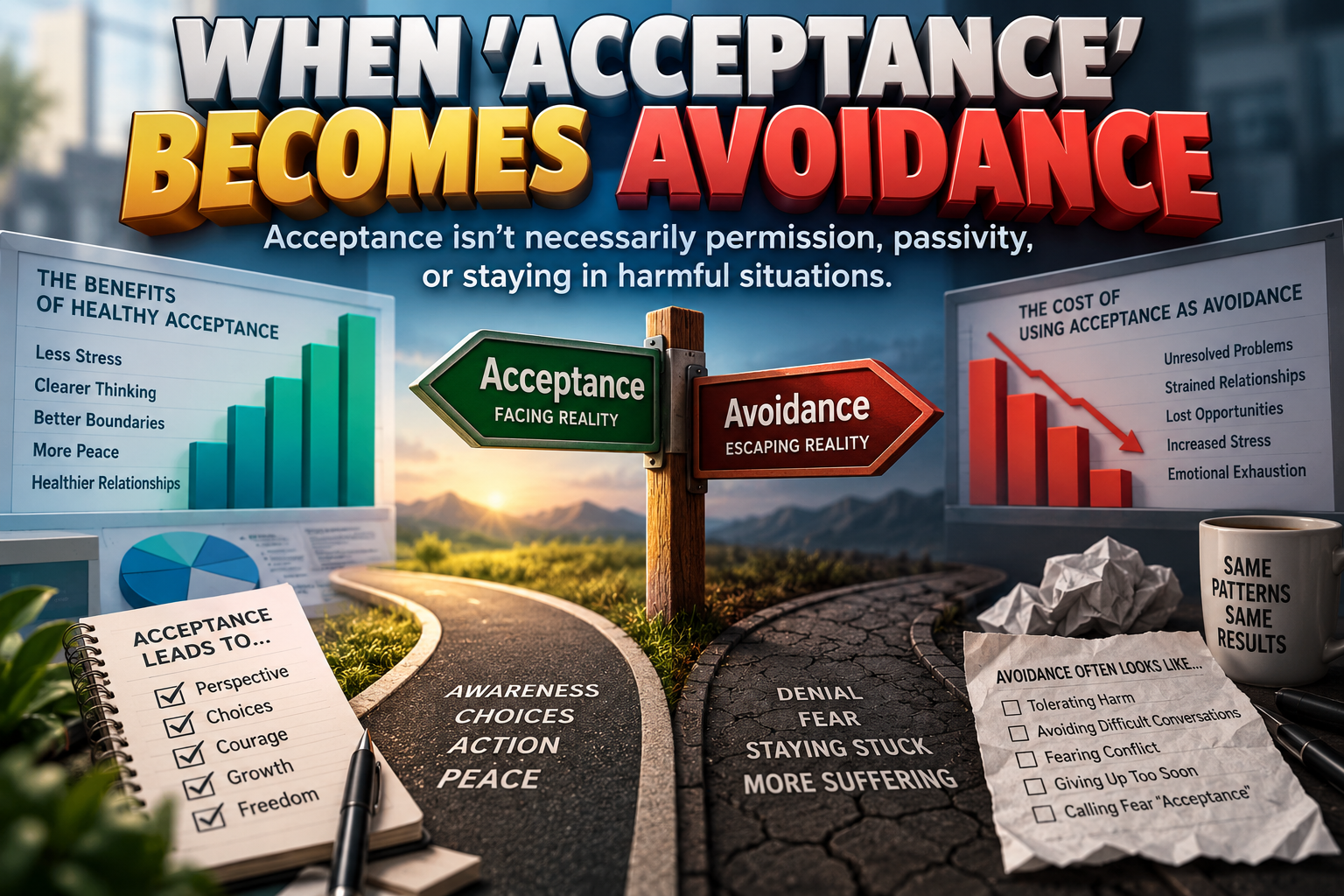
When “Acceptance” Becomes Avoidance
I’ve heard some version of this countless times in Alcoholics Anonymous: “I just need to accept it.” And sometimes that is exactly right.
I need to accept that I cannot control another person. I need to accept that the past has already happened. I need to accept that people may not behave the way I think they should. I need to accept reality instead of continually demanding that reality rearrange itself to suit me.
Acceptance has saved me from a lot of unnecessary suffering. But I’ve also discovered something else.
Sometimes what I call acceptance is really avoidance wearing spiritual clothing.
There have been times when “I need to accept this” actually meant:
- I don’t want to confront this.
- I’m afraid to set a boundary.
- I don’t want someone to be angry with me.
- I don’t want to make a difficult decision.
- I’m hoping that if I tolerate this long enough, somehow it will fix itself.
That isn’t necessarily acceptance. Sometimes that’s fear. And learning to tell the difference can be an important part of recovery.
Acceptance Starts With Reality
One of the most quoted passages in AA comes from the story “Acceptance Was the Answer” in the Fourth Edition of the Big Book:
“And acceptance is the answer to all my problems today.”
That sentence has helped countless alcoholics, including me. But like almost anything we repeat often enough, we can eventually turn it into something it never intended to be.
Acceptance does not mean I must approve of everything that happens. It does not mean harmful behavior suddenly becomes acceptable. It does not mean I surrender my ability to make choices. And it certainly doesn’t mean I am required to remain indefinitely in circumstances that are damaging me or someone else.
Acceptance begins with acknowledging reality. This is what is happening. Not what I wish were happening. Not what I think should be happening. Not what might happen someday if everybody finally gets their act together. This. Right here. Right now.
And once I accept reality, another question appears: What, if anything, am I responsible for doing about it?
That question changes everything.
A Story I Heard in a Meeting
I heard someone share something in a meeting once that has stuck with me. I’ve changed the details here, but the point of the story is what mattered.
A woman talked about her relationship with her adult son. He had been creating chaos in her life for years. He would disappear for weeks and then suddenly call needing money. He had lost jobs. He had wrecked cars. He had borrowed money he never repaid. Occasionally he would show up at her house needing somewhere to stay. And she always helped.
She said that somewhere along the way she had convinced herself that this was what acceptance looked like. I have to accept him the way he is.
So she accepted the late-night phone calls, the unpaid loans, the broken promises, him showing up unexpectedly, the chaos. Until one day her sponsor asked her a question: “Are you accepting him or are you accepting his behavior?”
She said the question stopped her cold.
Because those were two entirely different things. She realized she could accept the reality that her son was exactly where he was. She could love him. She could stop demanding that he become the person she desperately wanted him to be. But none of that required her to finance the chaos.
So she stopped giving him money. The next time he called asking for it, she told him she loved him, but the answer was no. He became furious. He accused her of abandoning him. He told her she had changed. He said that if she really loved him, she would help him. And this is where her story became especially powerful for me. She said: “For the first time, I had to accept not only who my son was. I had to accept that he might be angry with me for finally accepting who he was.”
There it is. Acceptance worked when she stopped trying to change him.
Acceptance became avoidance when she used it as the reason she couldn’t change her own behavior. And when she finally did change her behavior, acceptance became necessary all over again because she couldn’t control his reaction to it.
That is the part I think we sometimes miss. Acceptance isn’t a single decision that magically produces serenity. Sometimes it comes in layers.
- I accept who you are.
- I accept that I cannot change you.
- I accept that I may need to change how I respond to you.
- And then I accept that you may not like the change I make.
That last one can be the hardest.
Acceptance and Action Aren’t Opposites
We sometimes talk about acceptance as though its opposite is action. I don’t think it is. The opposite of acceptance is denial.
I can completely accept reality and still act. If I discover my roof is leaking, acceptance means acknowledging that the roof is leaking. It would be rather strange to sit underneath it with water dripping on my head saying, “Well, I’m practicing acceptance.” Acceptance allows me to stop arguing with the fact that the roof leaks. Then I can call the roofer.
Recovery works much the same way. I can accept that someone is angry with me and still decide their behavior toward me is inappropriate. I can accept that someone I love has a drinking problem without rescuing them from every consequence. I can accept that a relationship has become unhealthy and decide to leave it. I can accept that someone may never understand my position and still speak honestly. I can accept that another person has the right to make their own decisions while recognizing that I have exactly the same right.
Acceptance doesn’t eliminate choice. It clears away enough denial for me to see my choices more clearly.
“That’s Just How They Are”
Here’s another sentence worth examining: “That’s just how they are.” Maybe.
But notice how easily that observation can become permission. Someone repeatedly behaves badly, violates boundaries, manipulates, intimidates, lies, or creates chaos, and I tell myself: I have to accept them as they are. Actually, I probably do. But accepting them as they are may be the very thing that tells me I need to change how I interact with them. If I keep waiting for someone to become different before I make a decision, I’m not accepting reality at all. I’m negotiating with fantasy.
Acceptance may sound like: This person has consistently shown me who they are. I cannot change them. I cannot manage them. I cannot force them to behave differently. And then comes the uncomfortable part: So what am I going to do?
That is where acceptance can require courage rather than passivity.
The Serenity Prayer Has Three Parts
Maybe this is why the Serenity Prayer is so useful. We often emphasize:
“God grant me the serenity to accept the things I cannot change…”
Absolutely. But the prayer doesn’t stop there. It immediately asks for:
“courage to change the things I can…”
Acceptance without courage can become resignation. Courage without acceptance can become control. And then comes perhaps the most difficult request:
“and wisdom to know the difference.”
There’s the work.
I cannot change another person. But I can change my participation. I cannot control what someone says. But I can decide what conversations I remain in. I cannot make someone respect a boundary. But I can decide what I will do when that boundary is crossed. I cannot control whether someone approves of my decision. But I can examine my motives, seek guidance (from God and my sponsor), make the best decision I can, and accept their reaction.
Sometimes I have been trying to “accept” something God may actually be asking me to have the courage to change.
But There’s Another Trap
There is a danger on the other side too.
I can decide that anything making me uncomfortable is “harmful” and therefore something I should immediately remove from my life. That isn’t necessarily recovery either.
- Sometimes people irritate me.
- Sometimes my sponsor tells me something I don’t want to hear.
- Sometimes relationships require uncomfortable conversations.
- Sometimes I have obligations I would rather escape.
- Sometimes I need to forgive.
- Sometimes I need to stay in the room long enough to hear something difficult.
And sometimes the problem really is me. I don’t want to weaponize “boundaries” any more than I want to weaponize “acceptance.” That’s why inventory matters. What am I afraid of? What am I trying to control? What am I avoiding? What is my responsibility? What belongs to someone else? Am I staying because acceptance is genuinely called for, or because I’m afraid to act? Am I leaving because leaving is appropriate—or because I’m unwilling to be uncomfortable?
And perhaps most importantly: What would I do here if fear weren’t making the decision?
Those are questions worth taking to God and, when appropriate, discussing with a sponsor or another trusted person.
What Is Mine to Do?
I once thought acceptance meant learning to become comfortable with circumstances I couldn’t change. Today I think it’s bigger than that.
Acceptance means becoming willing to see reality without demanding that it first become something else. Sometimes seeing reality produces serenity, grief, forgiveness, boundaries, an amends, or a difficult conversation. And sometimes acceptance means recognizing that something I desperately wanted to work simply isn’t working.
Maybe that woman’s story from the meeting gives us a pretty good test. She could not change her son.
Acceptance. She could change whether she continued financing his behavior.
Courage. She couldn’t control how he reacted when she stopped.
Acceptance again. And figuring out which was which?
Wisdom. Sounds a lot like the Serenity Prayer to me.
So perhaps the spiritual question isn’t merely: “Can I accept this?” Maybe there’s another question sitting right beside it: “Now that I accept that this is actually the way things are, what is mine to do?”
Because acceptance isn’t necessarily permission. It isn’t necessarily passivity. It isn’t pretending that something harmful is harmless. And it isn’t a spiritual excuse for being afraid to make a decision. Sometimes acceptance means staying exactly where I am and changing my attitude. Sometimes acceptance means realizing the person who needs to change is me. And sometimes genuine acceptance is precisely what finally gives me the courage to move.
The wisdom is knowing the difference.
In love & service,
