


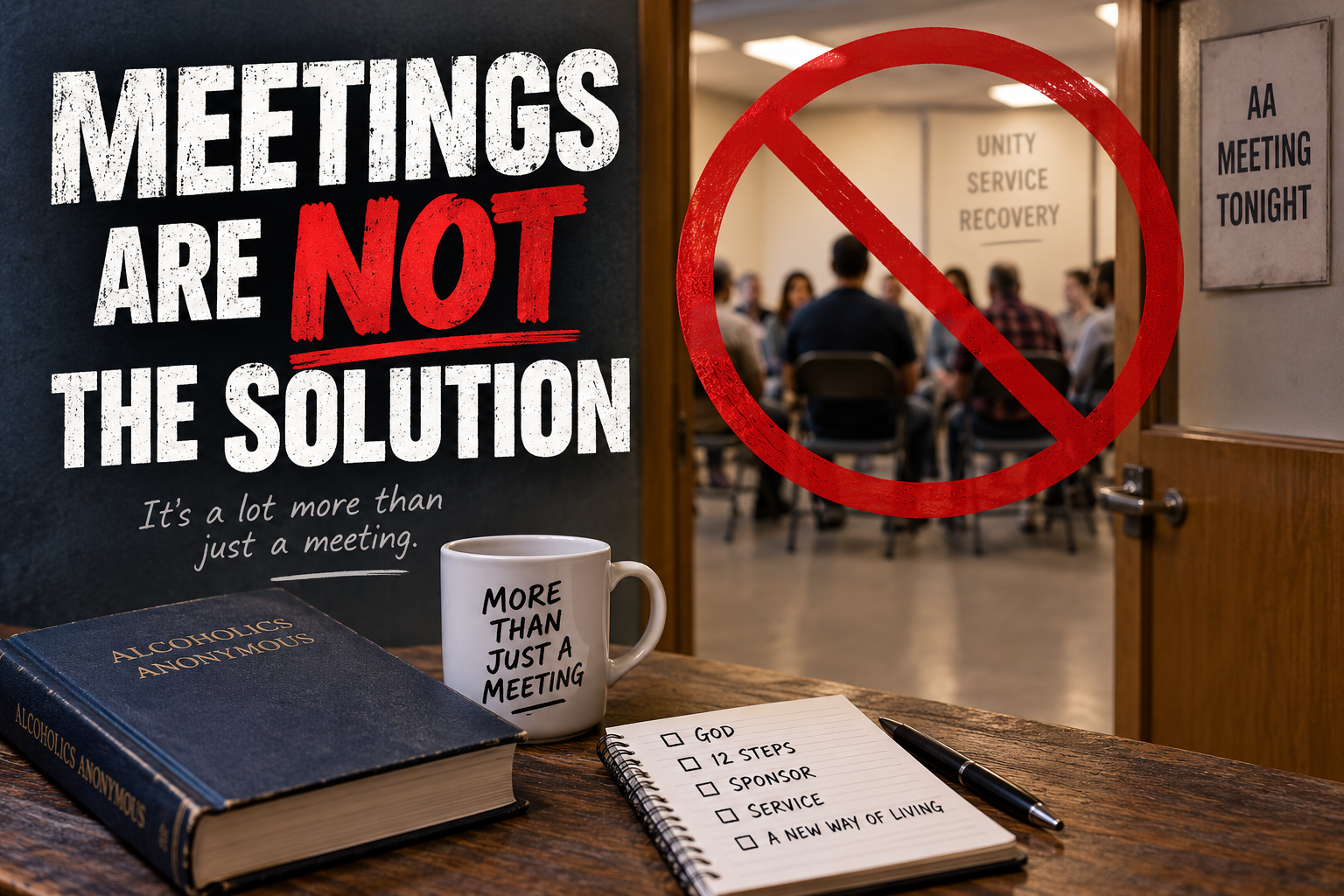
Meetings Are NOT the Solution
There. I said it.
Meetings are NOT the solution.
I realize that may sound like a strange thing to say in Alcoholics Anonymous. After all, I go to meetings. I love meetings. I have a home group. Some of the most important moments of my recovery have happened in AA meetings. I have heard things in meetings that changed the direction of my life.
Meetings matter enormously.
But meetings are not the solution to alcoholism. Neither is my sponsor. Neither is service. Neither is having a home group, making coffee, chairing a meeting, going to conventions, collecting phone numbers, knowing the Big Book backward and forward, or having decades without a drink.
Those things can become incredibly important parts of my life in Alcoholics Anonymous. But if I begin confusing the things that support my recovery with the Source and process of my recovery, I may eventually find myself in trouble.
The Big Book tells us where the solution is headed very early in our journey:
“We had to find a power by which we could live, and it had to be a Power greater than ourselves.”
And then it tells us:
“Here are the steps we took, which are suggested as a program of recovery.”
That seems pretty clear to me.
“Get Yourself to a Meeting!”
I understand why we say it. Somebody calls and says, “I’m having a terrible day.” We say, “Get to a meeting.” Somebody is thinking about drinking. “Get to a meeting.” Someone’s marriage is falling apart. “Go to a meeting.” Someone is angry, frightened, lonely, resentful, or overwhelmed. “Sounds like you need a meeting.” And maybe they do.
A meeting can interrupt isolation. A meeting can put me around people who understand alcoholism. A meeting can remind me that my thinking isn’t always trustworthy. A meeting can introduce me to someone who has experienced exactly what I’m experiencing and found a way through it.
But the meeting itself isn’t the solution.
The meeting should keep pointing me toward the solution. There is a difference.
If my car runs out of gas, sitting in the gas station parking lot may put me in exactly the right location, but eventually I have to put something in the tank.
I Tried Recovery by Osmosis
I know something about simply attending meetings because that’s pretty much what I did in the beginning. I sat there. And I waited. Apparently, I thought recovery worked through osmosis.
I would sit in a folding chair while y’all did the heavy lifting. Y’all could read the book, work the Steps, pray, make coffee, set up chairs, greet newcomers, clean up afterward, sponsor people, and practice these principles. I would be over here waiting for recovery to seep into me.
That’s how lazy I could be. In fact, when I looked at those Twelve Steps hanging on the wall and saw the first word of Step One: “We…” I apparently translated Bill’s “we” into Texas: “Y’all.”
- Y’all admitted you were powerless.
- Y’all came to believe.
- Y’all made a decision.
- Y’all took inventory.
- Y’all admitted your wrongs.
- Y’all made amends.
- And somehow I would reap the benefits.
Funny thing. It didn’t work. I began receiving the deeper benefits of recovery when “we” finally included me. I had to participate.
What About “Meeting Makers Make It”?
We’ve probably all heard the expression: “Meeting makers make it.” It is often understood to mean: People who attend lots of meetings stay sober.
There may certainly be wisdom in frequent meeting attendance, especially for someone who is new (Don’t get me started on “90 meetings in 90 days”). But I think there’s another interpretation of that phrase that is far more challenging and far more useful.
What if a “meeting maker” isn’t merely the person who makes it to the meeting? What if it is the person who helps make the meeting happen? That’s an entirely different picture.
- The person unlocking the door.
- The person making the coffee.
- The person arranging the chairs.
- The person greeting the frightened newcomer standing outside wondering whether to walk in.
- The secretary.
- The treasurer.
- The person washing the coffee pot afterward while everybody else is already halfway home.
- The member who notices the newcomer sitting alone and walks over.
Those people aren’t merely attending AA. They are participating in it. And that reminds me of something I heard years ago that has stuck with me ever since:
The measure of an AA group’s success in carrying the message isn’t necessarily what happens between the time the meeting starts and the time the meeting ends. It’s what happens between the time the meeting ends and the next meeting begins.
Think about that.
The real test may begin when we turn off the lights and lock the door. Did somebody call the newcomer the next morning? Did the person who shared about struggling get a phone call? Did a sponsor sit down with a sponsee and open the Big Book? Did somebody make an amends? Did somebody take an inventory instead of nursing a resentment? Did somebody pray when fear showed up? Did somebody answer the phone when another alcoholic called? Did somebody carry the message to an alcoholic who hadn’t found us yet? What happened because we had the meeting?
That’s a much different measurement than how many people were sitting in the chairs. Maybe a healthy AA meeting isn’t primarily producing better meeting attenders. Maybe it’s producing alcoholics who leave the room and practice Alcoholics Anonymous. And that distinction matters. Not because service itself magically treats alcoholism. It doesn’t. Service can become another activity I hide behind if I’m avoiding the Steps.
But service moves me from: “What am I getting?” toward: “What can I give?” That movement is woven throughout our program.
Even Service Isn’t the Solution
This is where I need to be careful. If I say meetings aren’t the solution and then replace meetings with service, I’ve merely created another magic bullet. I can be the busiest person in Alcoholics Anonymous (even an Area Delegate) and still be spiritually sick. I can hold every service position available and still carry resentment. I can sponsor fifteen people while refusing to take my own inventory. I can make coffee while hating everybody drinking it. I can know Robert’s Rules, the Traditions, the Concepts, the conference structure, and exactly where every comma appears in the Big Book—and still be running my life on self-will.
Activity is not necessarily recovery.
The Steps are designed to bring about something much deeper.
Sobriety and Recovery Aren’t Quite the Same Thing
There is another distinction I’ve come to appreciate. There are benefits of sobriety, and there are benefits of recovery. Sobriety gives me things simply because alcohol is no longer actively destroying them. I don’t wake up hungover. I’m not trying to remember what I did last night. I’m not constantly cleaning up disasters created while drinking. My finances may improve. Relationships may stabilize. My physical health may improve. People may begin trusting me again. Those are wonderful gifts. But I can experience many of those things simply because I stopped drinking.
Recovery goes deeper. Recovery begins changing the person who used to need the drink. The Big Book uses a word that sometimes makes people uncomfortable: Recovered. Not cured. Recovered. It describes alcoholics who “have recovered from a seemingly hopeless state of mind and body.” Later, when describing the result of the Steps, it says:
“Having had a spiritual awakening as the result of these steps…”
As the result of these Steps.
- Not as the result of sitting in enough meetings.
- Not because I finally found the perfect sponsor.
- Not because I accumulated enough service commitments.
The promised result is a spiritual awakening. And once that happens, Step Twelve immediately turns me outward: carry this message and practice these principles.
So Why Go to Meetings?
Because meetings are incredibly important.
- Meetings are where I found people who showed me what recovery looked like.
- Meetings are where I found a sponsor.
- Meetings are where I learned about the Steps.
- Meetings give me opportunities to carry the message.
- Meetings remind me that I am part of something larger than myself.
- Meetings give newcomers a place to find us.
And sometimes I need a meeting because I simply need to sit in a room with other alcoholics and hear the truth again. But a meeting should never become a substitute for doing the work. A meeting is not supposed to become the place where I repeatedly describe my problem while avoiding the solution. At some point, I have to get out of the chair. And perhaps that’s why that idea about what happens between meetings is so important.
If everything about my AA life happens during that one-hour meeting, I may be attending AA without actually practicing much AA. The Steps were never designed to be practiced from 7:00 to 8:00 on Monday night. They are a design for living.
From “Y’all” to “We”
Maybe that’s one of the great transformations of Alcoholics Anonymous. I arrive thinking: What are y’all going to do for me? Then something begins changing.
- I take the Steps.
- I develop a relationship with God as I understand God.
- I clean up the past.
- I begin taking daily inventory.
- I pray and meditate.
- I start looking for somebody I can help.
- I make coffee.
- I greet somebody at the door.
- I sponsor another alcoholic.
- I become part of my home group.
And eventually I realize that somewhere along the way, “y’all” became “we.” That is a very different way of living.
So please, go to meetings. Go often if that’s what you need. Get a sponsor. Join a home group. Make the coffee. Take a service commitment. Stay in the middle of Alcoholics Anonymous. But don’t confuse any of those things with the solution.
Meetings can point me toward the solution.
A sponsor can guide me through the solution.
Service gives me opportunities to live the solution.
The Fellowship surrounds me while I practice the solution.
But ultimately, Alcoholics Anonymous asks me to do something. To seek a Power greater than myself. To take the Twelve Steps. To undergo the spiritual awakening those Steps are designed to produce. And then to give away what I have received. Because perhaps the best evidence that Monday night’s meeting worked isn’t what happened Monday night. It’s what I did Tuesday morning. I spent enough time sitting in the chair hoping recovery would happen to me.
Turns out that first word really did mean “we.” And yes, that included me.
In love & service,
