


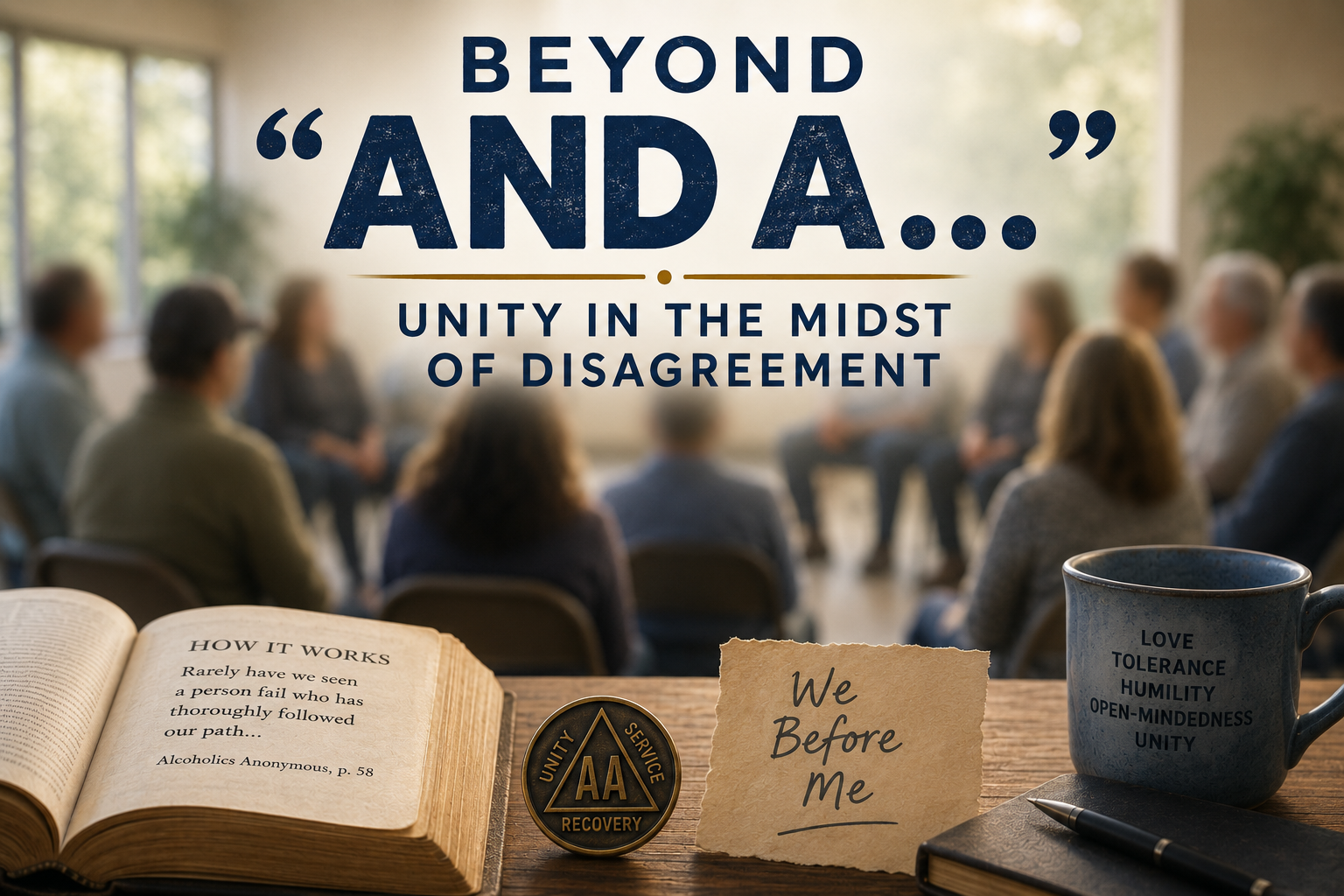
Beyond “And a…”: Unity in the Midst of Disagreement
Few topics in Alcoholics Anonymous seem capable of creating as much discussion, and sometimes as much tension, as the question of how members identify themselves in meetings.
Most of us have heard the phrase “and a…” at some point. A member introduces themselves as an alcoholic and something else. For some, this feels natural, honest and authentic. For others, it raises concerns about A.A.’s Singleness of Purpose, the clarity of its message, and the guidance found in our Traditions.
What often begins as a simple introduction can quickly become a much larger conversation. Unfortunately, it can also become a source of division. Before going any further, I want to be very clear about the purpose of this article.
A Brief Note Before We Continue
This article recognizes a reality that many people who come to A.A. have struggled with more than alcohol alone. Many members identify with multiple addictions, compulsive behaviors, or other life challenges that have affected them and their recovery deeply. The purpose of this article is not to minimize those experiences, nor to suggest that they are unimportant. Rather, this discussion is focused on how A.A. members navigate the question of personal identification within the context of A.A.’s Traditions, primary purpose, and group unity. Wherever a person ultimately lands on the issue, it is my hope that this conversation remains grounded in respect, humility, and a shared commitment to helping the suffering alcoholic.
There are thoughtful, sincere, and spiritually grounded A.A. members who hold differing views. This article is not intended to persuade anyone to adopt a particular position. Instead, it is an invitation to explore the issue thoughtfully, consult widely, consider the spiritual principles involved, and perhaps better understand why reasonable people sometimes arrive at different conclusions.
More importantly, it is an opportunity to ask whether there is a way to discuss difficult topics without sacrificing the unity that makes recovery possible.
The Reality of the Conversation
Whether we like it or not, the “and a…” discussion has existed in A.A. for decades.
It is discussed in meetings, before meetings, after meetings, at service events, at conferences, and among sponsors and sponsees. Some groups have established customs. Others have not. Some members feel strongly one way or the other. Others wonder why the issue receives so much attention in the first place.
The fact that the conversation continues suggests that it touches something important. But what exactly is that something?
- Is it a question of identity?
- Is it a question of inclusiveness?
- Is it a question of carrying a clear message?
- Is it a question of Tradition?
- Or is it some combination of all of these?
The answers often depend upon who is being asked.
What About Tradition Ten?
One of the Traditions that sometimes enters the discussion is Tradition Ten:
“Alcoholics Anonymous has no opinion on outside issues; hence the A.A. name ought never be drawn into public controversy.”
Some members believe this Tradition means the subject itself should not be debated because it involves matters beyond alcoholism. Others believe the issue is not an outside issue at all because it concerns what happens inside A.A. meetings and how A.A. carries its message.
The important point is that sincere members can read the same Tradition and arrive at different conclusions. That alone should probably encourage humility.
Tradition Ten may not provide a universally accepted answer to the question, but it does remind us of something important: controversy has the potential to distract us from our primary purpose.
Perhaps the greater danger is not disagreement itself, but allowing disagreement to become more important than helping the next suffering alcoholic.
What About Tradition Three?
Tradition Three states:
“The only requirement for A.A. membership is a desire to stop drinking.”
Many members point to this Tradition when discussing questions of membership and belonging. The beauty of Tradition Three is that it leaves the door open. No one is required to meet educational standards, moral standards, financial standards, or social standards to become a member of A.A.
The requirement is simple. A desire to stop drinking.
Yet Tradition Three does not necessarily answer every question about language, meeting formats, group customs, or introductions. Different members often draw different conclusions from the same Tradition. Again, what becomes evident is not necessarily certainty, but complexity.
Group Conscience and Group Autonomy
Tradition Four tells us:
“Each group should be autonomous except in matters affecting other groups or A.A. as a whole.”
This introduces another important dimension to the discussion. A.A. groups have considerable freedom to conduct their affairs according to their own group conscience. As a result, members may encounter different practices in different meetings. Some groups may encourage one approach. Other groups may encourage another. Still others may not address the issue at all.
That diversity can sometimes feel uncomfortable, especially when we are looking for universal answers. Yet group autonomy has been one of the strengths of A.A. from the beginning.
The Spiritual Question Beneath the Question
As I have listened to these conversations over the years, I have become increasingly curious about something. The issue itself may not be the most important question. The more important question may be how we behave while discussing it.
- Can we disagree without becoming disagreeable?
- Can we listen without immediately preparing a rebuttal?
- Can we hold strong convictions while remaining humble enough to acknowledge that our understanding might be incomplete?
- Can we place unity ahead of our need to be right (my favorite Tradition One shorthand: “We Before Me”)?
The Big Book reminds us repeatedly that resentment, fear, pride, and self-righteousness can create barriers between ourselves and others.
Those spiritual liabilities are not limited to any particular side of an argument. They can show up anywhere. Including in us.
What Does Unity Actually Require?
Unity does not require uniformity. Let me say that again, unity does not require uniformity. A.A. members disagree about many things.
We come from different backgrounds, different cultures, different generations, different political perspectives, different religious beliefs, and different life experiences. Yet somehow, we gather in the same rooms and share a common solution.
The miracle of A.A. has never been that we all think alike. The miracle is that we can stay connected despite our differences. Tradition One reminds us:
“Our common welfare should come first; personal recovery depends upon A.A. unity.”
That statement may be worth considering whenever discussions become heated. The issue is not whether members should agree. The issue is whether our discussions strengthen or weaken the unity upon which recovery depends.
Creating Space Rather Than Taking Sides
Perhaps the most helpful thing we can do is create space for thoughtful exploration.
- Space where members can examine the Traditions.
- Space where members can study A.A. history.
- Space where members can listen to one another.
- Space where members can remain curious.
- Space where nobody feels required to win.
The longer I stay sober, the more I appreciate that many important questions in A.A. are not resolved through debate. They are explored through inventory, prayer, discussion, service, and humility.
Sometimes understanding grows not because someone convinced us, but because we became willing to see the issue from another perspective.
Questions for Reflection
Rather than ending with conclusions, perhaps it is better to end with some personal questions for ourselves:
- What does A.A. literature clearly say about this issue?
- What does it leave to individual members and groups?
- Am I listening to understand, or listening to defend my position?
- Has this issue strengthened unity in my home group or weakened it?
- What spiritual principle is most needed here: tolerance, humility, patience, love, or open-mindedness?
- When discussing this topic, am I more focused on being right or being helpful?
- How can I contribute to a conversation that reflects the spiritual principles A.A. has taught me?
The question may not be whether members should agree on the “and a…” issue.
The question may be whether we can discuss it in a way that reflects the very spiritual principles we claim are essential to our recovery.
In love & service,
