


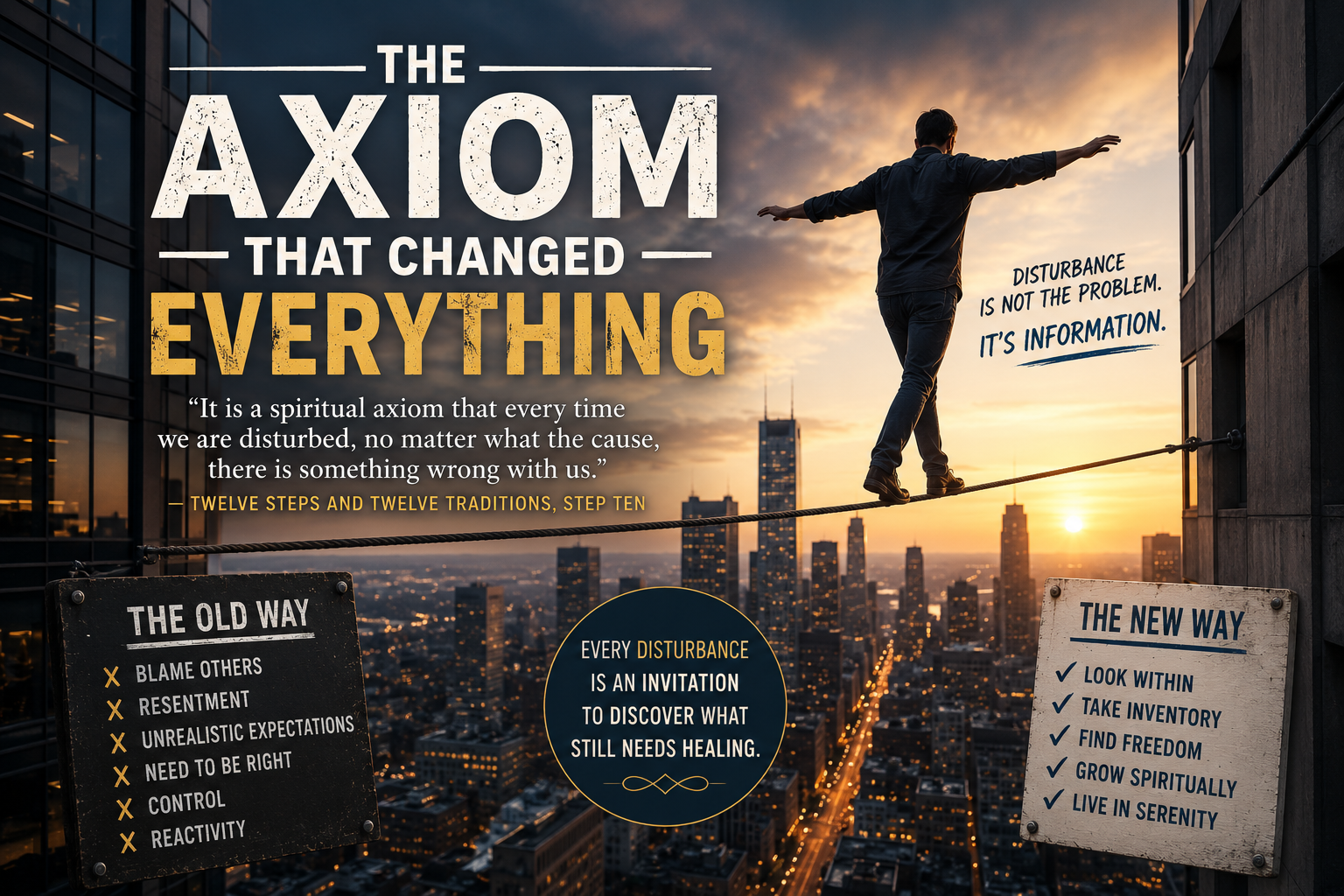
The Axiom That Changed Everything
One sentence in the Twelve Steps and Twelve Traditions has probably caused more discussion, disagreement, confusion, and self-examination than almost any other:
“It is a spiritual axiom that every time we are disturbed, no matter what the cause, there is something wrong with us.” — Twelve Steps and Twelve Traditions, Step Ten
The first time I heard that statement, I didn’t like it. Actually, that’s not quite true, the first time I heard it, I REALLY didn’t like it.
- Someone cuts me off in traffic?
- Something wrong with me.
- Someone lies to me?
- Something wrong with me.
- Someone betrays my trust?
- Something wrong with me.
- Someone acts selfishly?
Something wrong with me? Really? That didn’t seem right.
Then I got hung up on the word axiom. For years, I thought an axiom was some kind of pivot point, turning point, or catalyst. It wasn’t until much later that I actually looked up the definition. One definition of an axiom is:
A statement generally accepted as true, even if it cannot be formally proven.
In other words, an axiom is something that has proven itself so consistently through evidence that people eventually stop arguing about it and simply recognize it as true. That made me stop and think. Because the Twelve and Twelve isn’t presenting this statement as a theory. It is being presented as an observation. Something the author had repeatedly seen in themselves and others.
Wait A Minute…
The passage does not say: “Every time we are disturbed, the other person is innocent.” It does not say: “Every time we are disturbed, nobody harmed us.” It does not say: “Every time we are disturbed, we should approve of what happened.” That’s not what Bill appears to be saying. People can be wrong. People can be dishonest. People can be cruel. People can be irresponsible. Life can be unfair.
The axiom isn’t about them. The axiom is about us.
The Hidden Assumption
Most of us assume our disturbance comes from what happened. The Twelve and Twelve challenges that assumption. What if the disturbance isn’t coming from the event? What if it’s coming from what the event touched inside us? Think about it. Two people can experience the exact same event. One is devastated. The other shrugs and moves on. Same event. Different reaction.
Why?
Because the disturbance isn’t living in the event. The disturbance is living in the relationship between the event and my alcoholic mind. The event merely exposed something that was already there.
- Fear.
- Pride.
- Self-centeredness.
- Control.
- Unrealistic expectations.
- The need for approval.
- The need to be right.
- The need for life to unfold according to our plans.
- The event didn’t create those things.
It revealed them.
The Smoke Alarm
For years I viewed disturbance as the problem. Today I increasingly view disturbance as information. Imagine a smoke alarm going off in your house. The alarm isn’t the fire. The alarm is simply alerting you that something requires attention. Disturbance works much the same way.
When I become disturbed, something inside me is asking to be examined. Maybe it’s fear, resentment, wounded pride, an expectation I didn’t even know I had. The disturbance itself becomes a clue. A spiritual diagnostic tool. An invitation to inventory.
The Part Nobody Likes
Here’s the uncomfortable part. If every disturbance contains information about me, then I lose one of my favorite hobbies. Blaming.
As long as my discomfort is entirely your fault, I don’t have to do anything. I can wait for you to change. I can wait for you to apologize. I can wait for life to become fair. I can wait forever.
The spiritual axiom removes that option. It redirects my attention from what is wrong with the world to what is happening within me. That doesn’t mean others have no responsibility. It simply means my recovery begins when I stop making their behavior the primary focus.
The Unexpected Freedom
At first glance, this axiom feels harsh. But over time I discovered something surprising. It’s actually liberating. Because if my serenity depends entirely on other people behaving correctly, I’m in trouble.
- People are going to disappoint me.
- Traffic is going to happen.
- Employers are going to make mistakes.
- Family members are going to be human.
- Life is going to be life.
The spiritual axiom offers another path.
Instead of asking: “How do I get everyone else to stop disturbing me?” It invites a different question: “What is this disturbance trying to teach me?” That question changes everything. One question leads to frustration. The other leads to growth.
The Real Miracle
The miracle of recovery is not that difficult people disappear. The miracle is that we gradually become less controlled by them. We begin to see disturbance differently. Not as proof that the world is broken. But as an opportunity for greater awareness. A chance to discover what still needs healing.
- A chance to grow closer to God.
- A chance to practice spiritual principles.
- A chance to become more free.
Perhaps that’s why Bill called it a spiritual axiom. Not because they could prove it. But because he had lived it. Again and again.
And perhaps the next time I become disturbed, instead of immediately asking: “What’s wrong with them?” I might ask a different question. “What is this disturbance trying to show me about me?”
That’s usually where the real work begins.
In love and service,
