

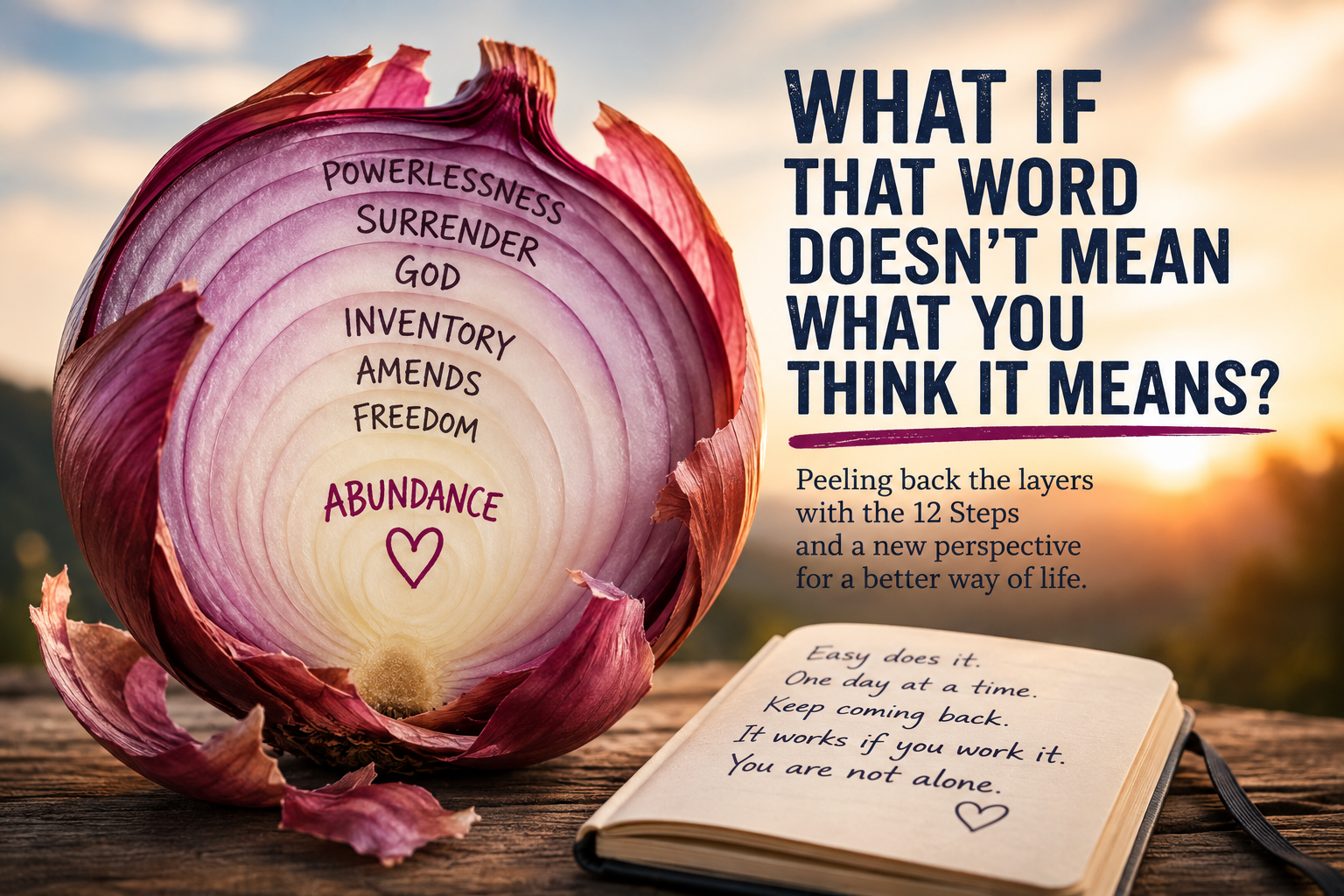
What If That Word Doesn’t Mean What You Think It Means?
Sometimes a single word can shut down an entire conversation.
- Powerless.
- Surrender.
- God.
- Inventory.
- Amends.
Say one of those words in an A.A. meeting and almost everybody in the room already has an idea about what it means. We don’t wait for the rest of the sentence. We hear the word, reach into our mental filing cabinet, pull out the definition we’ve been carrying around, and assume we understand.
But what if we don’t?
What if one of the things recovery asks us to do is take some of those old definitions off the shelf, dust them off, and look at them again?
I was thinking about this after watching a video one of my spiritual advisors posted this morning. She was talking about abundance.
When most of us hear that word, we probably think about money. Having plenty. Having more than enough. Financial security. But she challenged that definition. Abundance, she suggested, is much bigger than finances. It can be a mindset, a lens through which we see life. She described abundance as believing that you haven’t met all the people who are going to love you yet. You haven’t experienced everything wonderful that still awaits you. You haven’t learned everything that will someday enrich your life.
That got my attention.
Because isn’t that exactly what Alcoholics Anonymous has been asking us to do from the beginning? To reconsider what we think we already know?
Alcoholism Gave Me a Dictionary
Before recovery, I had definitions for almost everything.
- Powerlessness meant weakness.
- Surrender meant losing.
- Dependence meant failure.
- Inventory meant cataloging everything wrong with me.
- Amends meant apologizing.
- God came loaded with whatever experiences, teachings, disappointments, resentments, fears, and assumptions I had accumulated along the way.
And freedom? Freedom meant doing whatever I wanted.
Then I came to Alcoholics Anonymous and discovered something inconvenient: Maybe some of my definitions were wrong.
The Big Book of A.A. describes our problem this way in There Is a Solution:
“The fact is that most alcoholics, for reasons yet obscure, have lost the power of choice in drink.”
That required a radically different understanding of powerlessness. Powerlessness wasn’t saying I was a powerless human being incapable of doing anything worthwhile. It was identifying a very specific truth about my relationship with alcohol.
That distinction matters.
Because once I could peel back that first layer of the proverbial onion, powerlessness stopped looking quite so much like humiliation. Eventually, it started looking like honesty.
Surrender Isn’t Losing
Then there was surrender. I don’t know many alcoholics who arrive at A.A. excited about surrendering.
- We fight.
- We manage.
- We manipulate.
- We negotiate.
- We try harder.
- We develop another plan.
- We tell ourselves that this time will be different.
The Big Book captures the futility of all that effort in More About Alcoholism:
“The delusion that we are like other people, or presently may be, has to be smashed.”
That’s surrender. But notice what happens when we peel back the word. Surrender in A.A. doesn’t mean lying on the battlefield while someone stands over us in victory. It means I stop fighting reality. I stop insisting that alcohol should work differently for me than it actually does. I stop demanding that enough intelligence, discipline, experience, knowledge, or willpower ought to solve something they have repeatedly failed to solve.
Suddenly surrender isn’t defeat. Surrender becomes the doorway to freedom.
Same word. Deeper meaning.
Maybe God Is Another One
For many people coming into A.A., few words carry more baggage than God.
- Some hear the word and immediately think of church.
- Others think of judgment.
- Some think of childhood.
- Some think of hypocrisy.
- Others think of rules, theology, religion, disappointment, or unanswered prayers.
Again, the word arrives before the conversation has even begun. But the Big Book does something fascinating in We Agnostics. It asks us to loosen our grip on what we think the word has to mean:
“When, therefore, we speak to you of God, we mean your own conception of God.”
That doesn’t settle every theological question. It isn’t supposed to. It opens a door. Maybe the question isn’t simply, “Do I believe in God?” Maybe a better starting question is: “What do I believe the word God means, and where did that definition come from?”
That’s peeling the onion. And sometimes what we discover is that we haven’t rejected God nearly as much as we’ve rejected a particular conception of God. Those aren’t necessarily the same thing.
Inventory Isn’t About Proving I’m Terrible
Consider another loaded word: inventory. When some people approach Step Four, they hear:
Make a list of everything that’s wrong with you.
No wonder we’re terrified. But that’s not how a real inventory works. A business doesn’t take inventory to prove that the business is terrible. It takes inventory to determine what it has, what it needs, what is useful, what isn’t moving, what’s damaged, and what needs attention. The Big Book says in How It Works:
“Therefore, we started upon a personal inventory.”
And then it gives us a process. We examine resentments. Fear. Conduct. Relationships. Our own mistakes. Our patterns. Not so we can declare ourselves worthless, but so we can begin seeing clearly. Once again, the word changes when we go deeper. Inventory isn’t condemnation. Inventory is information.
And information, honestly examined, gives us something we never had while drinking: the possibility of change.
Even Freedom Needed a New Definition
Perhaps one of the greatest reversals for me has been the meaning of freedom. There was a time when freedom meant nobody telling me what to do.
I could drink if I wanted. Go where I wanted. Say what I wanted. Live however I wanted. That sounded like freedom.
Except eventually I couldn’t reliably choose whether I would drink. That’s quite a definition of freedom, isn’t it? A.A. introduced me to another kind.
The Big Book says in Into Action:
“We are going to know a new freedom and a new happiness.”
New freedom. That word new matters. Maybe the freedom promised by recovery isn’t simply getting my old freedom back. Maybe it’s discovering that what I used to call freedom wasn’t freedom at all. Today freedom can mean not having to drink.
- Freedom from the obsession with self.
- Freedom from carrying resentments everywhere I go.
- Freedom to admit I’m wrong.
- Freedom to make amends.
- Freedom to ask for help.
- Freedom to be useful.
- Freedom to live according to principles instead of impulses.
That is a much bigger word than the one I started with.
Recovery Requires More Than Positive Thinking
There is an important caution here. We can turn all of this into a clever exercise in semantics if we’re not careful. Recovery isn’t about finding prettier definitions for uncomfortable words. I can’t redefine surrender and never surrender. I can’t develop an enlightened understanding of inventory and never write one. I can’t appreciate the beauty of amends while refusing to make them. I can’t talk endlessly about a Higher Power while continuing to act as though I am the highest power in my life. The Twelve Steps aren’t merely asking me to think differently. They’re asking me to live differently.
The thinking changes partly because the living changes. The Big Book makes this remarkably practical in Into Action:
“Faith without works is dead.”
We don’t just contemplate a new way of life. We practice one.
Keep Peeling
Maybe that’s one of the gifts of long-term recovery: discovering that words we thought we understood still have layers.
- Honesty gets bigger.
- Surrender gets bigger.
- Service gets bigger.
- Love gets bigger.
- God gets bigger.
- Freedom gets bigger.
Even sobriety gets bigger. At first, sobriety may mean one thing: Don’t drink today. And thank God for that beginning. But keep peeling.
Eventually sobriety can become much more than the absence of alcohol. It can become Presence. Responsibility. Relationship. Integrity. Usefulness. Spiritual growth. The ability to show up for another human being without constantly asking what I’m going to get in return.
The Big Book tells us in A Vision for You:
“Life will mean something at last.”
Maybe that’s abundance in A.A. Not an abundance of possessions. An abundance of meaning. An abundance of people we haven’t met yet. An abundance of opportunities to be useful that haven’t presented themselves yet. An abundance of truths we haven’t learned yet. An abundance of ways we haven’t grown yet. An abundance of experiences we haven’t had yet. And, perhaps most importantly, an abundance of God that we haven’t discovered yet.
After all these years, perhaps one of the most dangerous sentences I can say is:
“I already know what that means.”
Because maybe I only know the first definition. Maybe there’s another layer underneath it. And another underneath that. The Twelve Steps invite us to keep peeling. Because sometimes changing our lives begins by becoming willing to look at an old word with new eyes.
In love & service,
