


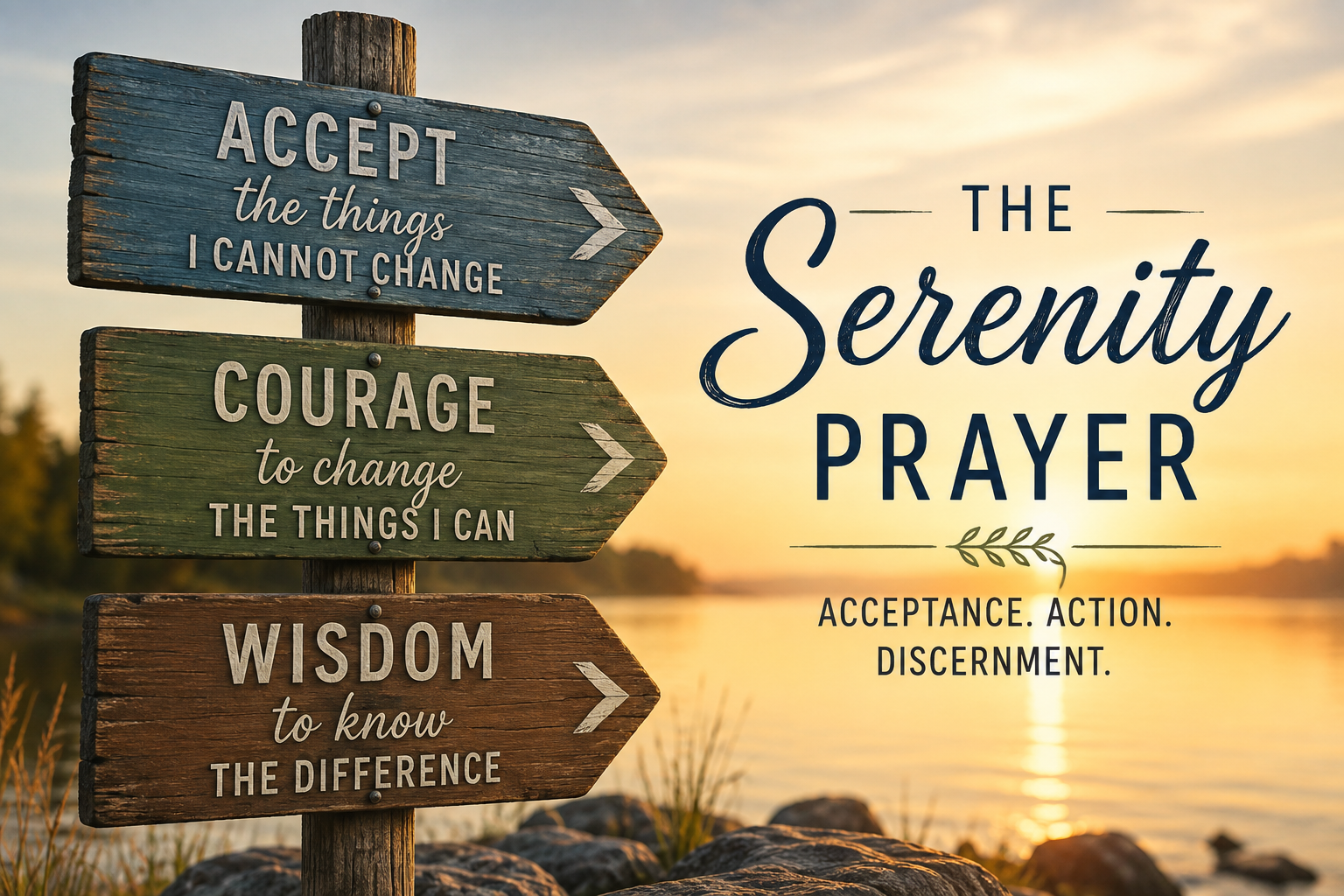
The Prayer We Know by Heart but Forget to Hear
There may be no prayer more closely associated with Alcoholics Anonymous than the Serenity Prayer.
We say it at meetings. We say it before difficult conversations. We say it when life isn’t going our way. We say it when we’re afraid, angry, confused, or simply trying to get through the next five minutes without making matters worse.
Many of us can recite it without thinking:
God, grant me the serenity to accept the things I cannot change,
courage to change the things I can,
and wisdom to know the difference.
And maybe that’s the problem. We can say it without thinking.
Something that once stopped us in our tracks can eventually become a collection of familiar words. Our mouths know what comes next before our minds have considered what we are actually asking God to do.
But the Serenity Prayer isn’t merely something to recite. It’s something to practice. In fact, I think there are three very distinct movements within this little prayer. Each asks something different of us.
Acceptance. Action. Discernment.
And if I get them out of order, serenity becomes considerably harder to find.
Part One: Accept the Things I Cannot Change
The prayer begins: God, grant me the serenity to accept the things I cannot change.
That’s a pretty big ask for an alcoholic. Acceptance doesn’t come naturally to many of us. We are fixers, managers, arrangers, controllers, persuaders, manipulators, and sometimes highly skilled directors of other people’s lives.
- We know how things ought to be.
- We know what other people should do.
- We know how circumstances should turn out.
And when reality refuses to cooperate with our plans, we suffer.
One of the most frequently quoted passages in A.A. literature appears on page 417 of the Fourth Edition of Alcoholics Anonymous, in the personal story “Acceptance Was the Answer”:
“Acceptance is the answer to all my problems today.”
The writer goes on to describe the problem of being disturbed by some person, place, thing, or situation and the need to accept reality as it is before serenity can return. There is enormous wisdom there. But there is also a danger in misunderstanding it.
Acceptance does not mean approval.
It doesn’t mean something is good, fair, just, desirable, or even permanent. It doesn’t mean I shouldn’t grieve it. It doesn’t mean I can’t have feelings about it.
Acceptance simply means that I stop arguing with the fact that right now, this is what is. I stop arguing or trying to negotiate with reality.
- I cannot change yesterday.
- I cannot make another person think differently.
- I cannot control someone’s reaction to me.
- I cannot force another alcoholic to get sober.
- I cannot make someone forgive me.
- I cannot prevent every disappointment, illness, loss, rejection, or change that life will bring.
Yet look at how much energy we can spend trying. Sometimes my greatest source of unrest isn’t the thing that happened. It’s my insistence that it shouldn’t have happened.
Acceptance ends the argument with reality. That doesn’t necessarily make reality pleasant. But it makes reality workable.
Part Two: Courage to Change the Things I Can
Then comes the second movement:
Courage to change the things I can.
This is where the Serenity Prayer stops being passive. And that’s important because acceptance can become a hiding place if we’re not careful. “I just have to accept it” can sound wonderfully spiritual while allowing me to avoid doing something difficult.
There are things I cannot change. But there are also things I can.
- I can change my behavior.
- I can make an amends.
- I can tell the truth.
- I can stop participating in something unhealthy.
- I can ask for help.
- I can call my sponsor.
- I can go to a meeting.
- I can take an inventory.
- I can admit when I’m wrong.
- I can change how I respond even when I cannot change what someone else has done.
That is why the word courage matters.
The prayer doesn’t say: God, grant me the knowledge to change the things I can. Most of the time, I already know. The problem isn’t information. The problem is willingness.
A.A. is an action program. Our Big Book doesn’t tell us to think our way into a new life. Again and again, it gives us things to do.
- Write.
- Share.
- Pray.
- Make amends.
- Help another alcoholic.
- Take inventory.
- Practice these principles.
The Steps move us from awareness into action. It’s relatively easy to identify someone else’s character defects. It takes courage to face my own. It’s easy to recognize the amends someone owes me. It takes courage to make mine. It’s easy to pray for God’s will. It takes courage to act differently when I begin to understand what God’s will might require of me.
Sometimes serenity isn’t waiting for me on the other side of acceptance. Sometimes it’s waiting on the other side of action.
Part Three: Wisdom to Know the Difference
Then we arrive at the final line:
And wisdom to know the difference.
This may be the most important part of the entire prayer. Because without wisdom, I can get the first two completely backward. I can spend enormous energy trying to change something I have absolutely no power over while “accepting” something about myself that I actually have the responsibility to change.
Think about that.
I may try desperately to change you while accepting me exactly as I am. And then wonder why I have no serenity. That’s the trap.
The crucial question isn’t simply: What needs to change?
It’s: Whose is it to change?
That question can save me an extraordinary amount of suffering.
Someone else’s behavior may need to change but that doesn’t mean I have the power to change it. A relationship may need to change and my part may be setting a boundary rather than changing the other person. A situation may be painful and my responsibility may be accepting it rather than manipulating it. Or I may be calling something “acceptance” when what I’m really doing is avoiding responsibility.
This is why we ask for wisdom. Not intelligence. Not certainty. Wisdom. Wisdom requires discernment. And discernment usually requires something alcoholics aren’t famous for: slowing down long enough to question our first conclusion.
Maybe the Prayer Is Also a Diagnostic Tool
I’ve begun to think the Serenity Prayer isn’t simply a prayer for comfort. It’s a diagnostic tool.
When I’m disturbed, I can run the situation through three questions:
- What about this situation is outside my control and therefore requires acceptance?
- What part actually belongs to me and therefore requires action?
- Am I being honest about which is which?
That third question is the uncomfortable one. Because sometimes I know the difference perfectly well. I just don’t like the answer. I want courage when God may be asking for acceptance. Or I want acceptance when God may be asking for courage. I want God to change the other person when God seems considerably more interested in changing me (lol). And perhaps that’s why wisdom comes last.
Acceptance and courage require discernment before either can be properly applied.
Serenity Isn’t Getting My Way
For years, I think I unconsciously understood serenity as the feeling I would finally experience when everything around me settled down.
- When the problem was solved.
- When the person changed.
- When the uncertainty disappeared.
- When things worked out.
- When life became manageable again.
But that’s not serenity, at least to this alcoholic. That’s favorable circumstances. Serenity is something deeper.
Serenity is the ability to be spiritually grounded even when circumstances remain unresolved.
That’s why page 417 continues to resonate with so many of us. The principle isn’t that life eventually becomes exactly what I want. The principle is that my serenity is directly connected to my willingness to stop demanding that reality conform to my expectations before I can be okay.
And here’s the paradox: Once I accept what I cannot change, I have considerably more energy available to change what I can. Acceptance isn’t surrendering my agency. It clarifies it.
Three Lines, Three Responsibilities
Maybe we should occasionally stop racing through the Serenity Prayer and actually hear ourselves saying it.
- The first line asks me to release.
- The second asks me to act.
- The third asks me to discern.
Acceptance: This isn’t mine to control.
Courage: This is mine to change.
Wisdom: God, help me know the difference.
And perhaps that last part is where serenity really begins. Because much of my suffering comes from confusing my responsibilities. I pick up things that belong to God. I pick up things that belong to other people. And sometimes I hand God things that actually belong to me. Then I wonder why I’m exhausted.
The Serenity Prayer invites me to put everything back where it belongs. What I cannot change, I accept. What I can change, I act upon. And when I cannot tell which is which, I don’t have to pretend that I know. I can ask for wisdom.
Maybe the next time we stand in a circle, join hands, and begin those familiar words, “God, grant me the serenity…” we can resist the temptation to simply recite them.
Slow down. Listen to what we’re asking.
Because the Serenity Prayer isn’t asking God to arrange the world so that we can finally be peaceful. It’s asking God to change our relationship with the world as it actually is.
Accept what isn’t mine to change.
Change what is mine to change.
And seek enough wisdom to know which is which.
That’s not just a prayer for serenity. That’s a way of living.
 Wanna Here a Really Cool Serenity Prayer Song? Click Here
In love & service,
