


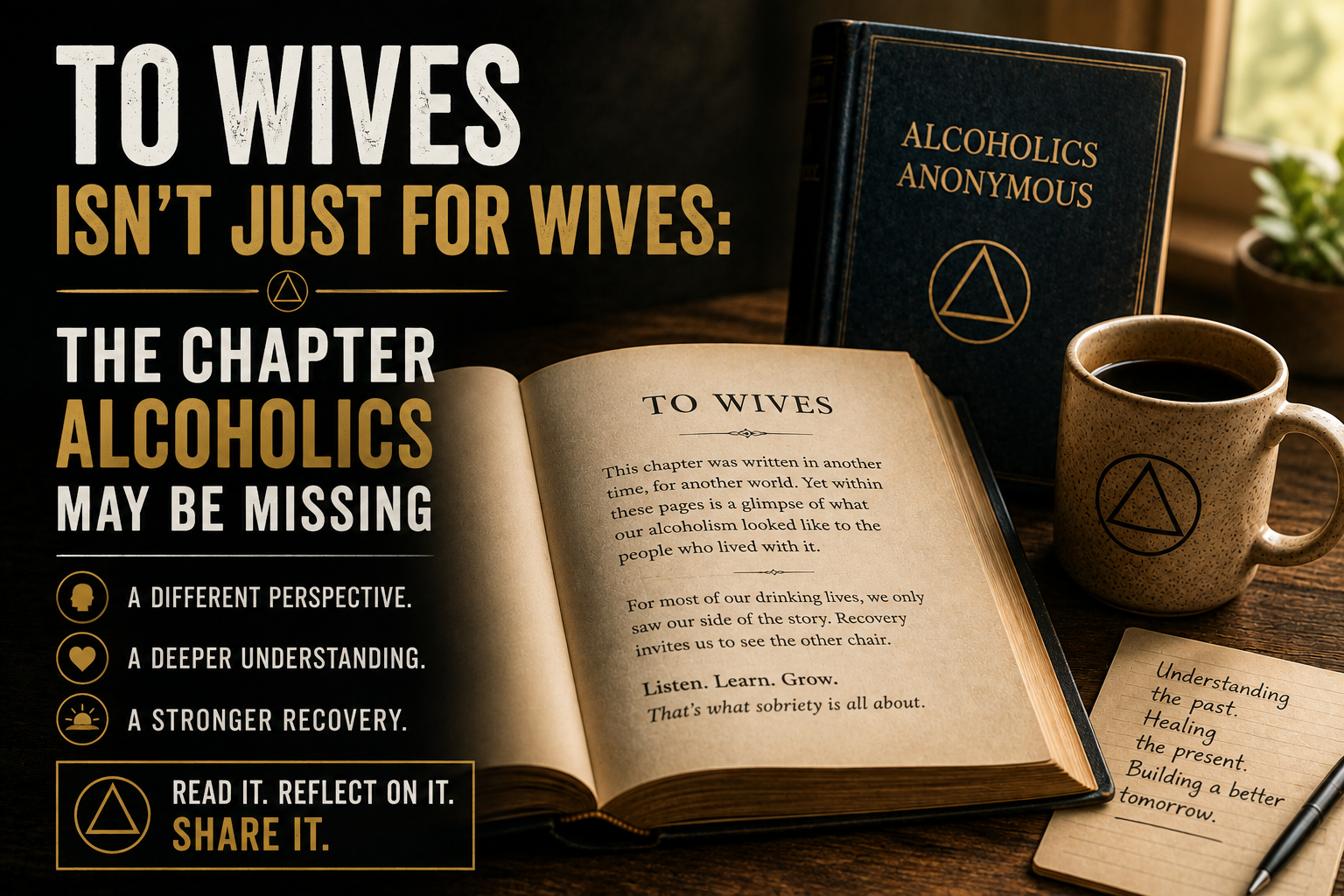
To Wives Isn’t Just for Wives
The Chapter Alcoholics May Be Missing
I’ve heard it more times than I can count. “I hate To Wives.” “I skip that chapter.” “It’s outdated.” “Bill had no business writing it.” And I understand some of the criticism.
The language belongs to another era. The assumptions about marriage, gender, and family life reflect 1939, not 2026. And there is an unavoidable awkwardness in knowing that Bill Wilson, an alcoholic husband, wrote a chapter speaking in the voice of the wives of alcoholics. We don’t have to pretend that isn’t problematic. But here’s where I think we alcoholics may be making a mistake.
What if we have been so busy arguing about who wrote To Wives that we have failed to notice what Bill wrote?
Because hidden in plain sight in those pages is something I believe every alcoholic ought to read. Not as advice for our spouses. Not as instructions for the people who have had to live with us.
But as a mirror. And mirrors can be uncomfortable.
The first time I sat down and REALLY read it with a different set of eyes, I was amazed at how this chapter really had something to say TO me ABOUT me. I had done some journaling about it back then and so I took it out, dusted it off and tweaked it a bit.
Read It Differently
When I first came into Alcoholics Anonymous, much of the Big Book invited me to identify with the alcoholic. Bill’s Story told me what alcoholism looked like from inside Bill. There Is a Solution explained what was wrong with people like me. More About Alcoholism described the peculiar mental twists that precede the first drink. How It Works told me what I had to do.
But then we arrive at To Wives.
Suddenly the camera turns around. For several chapters, I’ve been looking through the alcoholic’s eyes. Now I get to see the alcoholic through somebody else’s. That’s a very different experience.
And perhaps that’s exactly why I need it.
What Was It Like to Live With Me?
There is a question buried underneath To Wives that I don’t particularly enjoy asking: What was it like to be around me when I was drinking?
- Not what did I intend?
- Not whether I was really a good person underneath it all.
- Not whether I had reasons for drinking.
- Not whether other people hurt me too.
What was the actual experience of living with me? That is a Fourth Step question if I’ve ever heard one.
Alcoholism is remarkably effective at making me the central character in every story. I know what happened to me. I know what people did to me. I know why I was angry. I know why I drank. I know how misunderstood I felt. But To Wives quietly asks me to move out of the center of the story. For a few pages, I have to sit in the audience and watch myself.
That changes things.
They Were Living With the Disease Too
One sentence in this chapter has always stopped me:
“Under these conditions we naturally made mistakes.”
Think about what that means for the alcoholic. The people around us didn’t always respond perfectly to our alcoholism. Of course they didn’t. They were confused. They were frightened. They were angry.
They tried controlling us. They covered for us. They argued with us. They believed promises they probably shouldn’t have believed. Sometimes they stopped believing promises we desperately wanted them to believe. They made mistakes.
So did we.
But then comes an even more provocative thought: had they understood the nature of alcoholism better, they might have behaved differently. Maybe. But I think the alcoholic needs to be very careful with that sentence. Because my alcoholic mind could turn it into:
See? If you had understood me better, you wouldn’t have treated me that way.
That’s not what I need to take from this chapter. The better question is:
Had I understood what my alcoholism was doing to you, might I have behaved differently?
Now we’re getting somewhere.
The Chapter Describes Our Wake
A boat moving through water leaves a wake behind it. The boat doesn’t have to turn around and watch the wake. It just keeps moving. Alcoholism can be like that.
We move through families, marriages, friendships, workplaces, and communities focused almost entirely on the next drink, the consequences of the last drink, or figuring out how we’re going to manage everything well enough to keep drinking. Behind us is a wake.
- Fear.
- Confusion.
- Broken promises.
- Financial uncertainty.
- Embarrassment.
- Anger.
- Loneliness.
- People wondering which version of us is coming home.
- People changing their behavior because of our behavior.
- People learning how to read the room before we even walk into it.
Then we get sober. And one of the dangers of recovery is thinking that because the boat has stopped, the wake immediately disappears.
It doesn’t.
To Wives gives the alcoholic a glimpse of the wake.
This Is Why Amends Matter
Read To Wives again after working Steps Eight and Nine. It hits differently. The Eighth Step asks me to become willing to face the people I have harmed. But how can I fully understand harm if I only define it from my side of the street?
- I may remember an argument.
- My spouse may remember fear.
- I may remember being late.
- My child may remember waiting.
- I may remember making a promise.
- Someone else may remember learning not to trust my promises.
- I may remember saying something cruel and apologizing the next morning.
- Someone else may remember wondering whether the cruel thing I said was what I really thought.
Same event.
Completely different experience. That doesn’t mean I accept responsibility for every feeling another human being has ever had. That’s not recovery either. But sobriety asks me to become capable of seeing consequences beyond my intentions.
“I didn’t mean to hurt you” is not the same thing as “I didn’t hurt you.”
That distinction matters enormously in recovery.
There Is Something Else Hidden Here
To Wives also contains something alcoholics desperately need to understand: The people who love us are powerless over our alcoholism too.
Think about that.
We eventually arrive at Step One and admit our powerlessness over alcohol. But many of the people around us had already discovered another kind of powerlessness. They couldn’t make us stop.
- Love couldn’t do it.
- Anger couldn’t do it.
- Logic couldn’t do it.
- Threats couldn’t do it.
- Promises couldn’t do it.
- Children couldn’t do it.
- Jobs couldn’t do it.
- Doctors couldn’t do it.
- Sometimes impending catastrophe couldn’t do it.
That ought to humble me.
Because when I finally surrendered and admitted that I couldn’t control my alcoholism, I was discovering something the people around me may have painfully learned years earlier:
They couldn’t control it either.
And Then Comes One of the Most Important Lessons
There is another reason I think alcoholics should read this chapter. It destroys one of our favorite fantasies. The fantasy goes something like this: Once I get sober, everything should be okay. But recovery doesn’t work that way. I can stop drinking today. Trust may take longer. I can make an amends today. Healing may take longer. I can change my behavior today. Someone who lived through years of my drinking may need considerable time before believing the change is real.
And they get to.
That can be difficult for alcoholics. We like immediate results. I said I’m sorry. I admitted I was wrong. I’ve been sober six months. What more do you want? Maybe nothing. Maybe they simply need time.
One of the quiet lessons of To Wives is that alcoholism doesn’t happen to an alcoholic in isolation. It happens inside a system of relationships. When one person becomes sick, everybody begins adapting to the sickness. When the alcoholic gets sober, those adaptations don’t magically vanish.
But Don’t Turn This Chapter Into Another Weapon
There’s a trap here too. An alcoholic can read To Wives and decide: “See? This is what my spouse needs to do.”
No.
Please don’t do that. If I finish To Wives with a list of things somebody else needs to change, I may have missed the most useful part of the chapter. The Big Book continually redirects me toward my own conduct.
- My inventory.
- My defects.
- My amends.
- My spiritual condition.
- My usefulness to others.
So perhaps the alcoholic’s question when reading To Wives shouldn’t be: Is this good advice for the wife of an alcoholic? The more spiritually useful question may be: What does this chapter reveal about me that I couldn’t see while I was drinking? That’s an entirely different reading.
Maybe Bill Shouldn’t Have Written It
I’ll even go this far. Maybe Bill wasn’t the ideal person to write To Wives. That’s a legitimate conversation.
We don’t have to canonize Bill Wilson to value Alcoholics Anonymous. Bill was a human being. Brilliant in some ways. Deeply flawed in others. Sometimes insightful. Sometimes painfully limited by his own personality and his time. That’s not particularly shocking.
So am I. But here is the strange irony.
Perhaps the very fact that an alcoholic wrote To Wives gives alcoholics another reason to read it.
Because underneath the dated language and awkward point of view is an alcoholic attempting to imagine the experience of the people affected by alcoholism. Isn’t that something recovery eventually asks all of us to do? To get outside ourselves? To see another person’s perspective? To recognize harm we couldn’t recognize before? To stop measuring everything by our intentions? To understand that other people had experiences while we were busy having ours?
That sounds a lot like recovery to me.
So I’m Going to Stop Skipping It
I don’t need to agree with every sentence in To Wives. I don’t. I don’t need to defend every assumption in it. I won’t. And I certainly don’t need to pretend that a chapter written in 1939 speaks perfectly to marriages, partnerships, families, gender, and relationships today. It doesn’t.
But I’m not throwing it away either.
Because buried inside To Wives is something I desperately need as an alcoholic: the view from the other chair. For most of my drinking life, alcoholism taught me to ask: What happened to me? Recovery slowly teaches me another question: What happened to you because of me? That’s a harder question. It is also a profoundly spiritual one.
So the next time your Big Book study reaches page 104 and somebody groans, rolls their eyes, or says, “Can we just skip To Wives?” maybe don’t. Try something different. Forget the title for an hour. Don’t read it as To Wives. Read it as:
To the Alcoholic: Here’s What It Was Like to Live With Us.
Then listen. Don’t defend yourself. Don’t explain yourself. Don’t critique Bill for a few minutes. Just listen. You might discover that one of the most uncomfortable chapters in the Big Book has been carrying a message for you all along. It was simply hidden in plain sight.
In love & service,
