


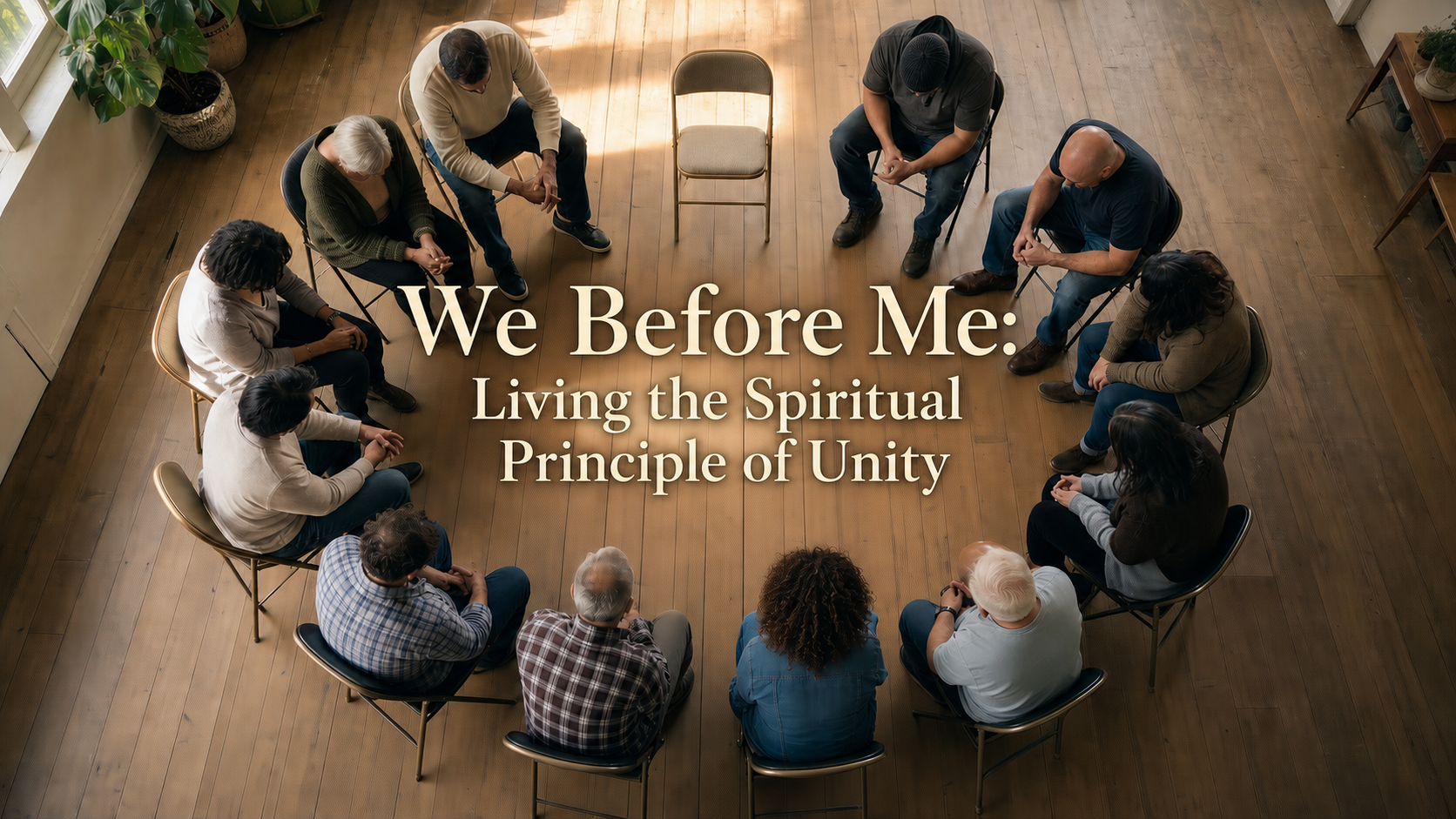
We Before Me: Living the Spiritual Principle of Unity
Tradition One—Short Form:
“Our common welfare should come first; personal recovery depends upon A.A. unity.”
Tradition One—Long Form:
“Each member of Alcoholics Anonymous is but a small part of a great whole. A.A. must continue to live or most of us will surely die. Hence our common welfare comes first. But individual welfare follows close afterward.”
Three simple words capture the heart of Tradition One: We Before Me.
That sounds straightforward until I am asked to practice it.
It is easy to support unity when everyone agrees with me. It is much harder when another person challenges my opinion, questions my motives, or wants something different. In those moments, Tradition One asks me to consider a question that did not come naturally before recovery:
What is best for the most?
The Lesson That Guided Every Vote
I had the privilege of serving the Fellowship in the General Service structure as a Panel 73 Delegate to the General Service Conference. Before attending my first Conference, I was worried. I understood the depth and weight of the responsibility I had been given, and I wanted to serve well, but I was not always sure how I would know what the “right” decision was.
The day before I left for New York for my first Conference, I was on the phone with my sponsor. He said something I remember to this day:
“Rick, this is easy. When you go to cast your vote on anything, vote for what is best for the most.”
That not only calmed my fears that day; it became the driving force behind every vote I cast at both the 73rd and 74th General Service Conferences.
My sponsor did not tell me to vote for what would make everyone happy. He did not tell me to vote for the most popular position or the one that would create the least controversy. He reminded me to look beyond my personal preference and ask what would best serve the whole.
That is the spiritual foundation of Tradition One.
The Traditions Teach Us How to Live Together
Any study of the Twelve Traditions is a spiritual and relational study, one that invites us to look honestly at how we show up in relationships: with ourselves, with other people, with our communities, and with God.
My sponsor taught me:
“If you want to learn how to be in a loving and healthy relationship with yourself and with God, take the Twelve Steps. If you want to learn how to be in loving and healthy relationships with the world around you, study and learn how to practically apply the Twelve Traditions in your life.”
The Twelve Steps help restore my relationship with God and give me a way to recover. The Twelve Traditions teach me how to carry that recovery into my relationships. They show me how to live sober alongside other imperfect people.
If you know anything about A.A. history, you know that the Traditions were not developed in a peaceful environment where everyone naturally agreed. They were born out of real conflict, real fear, real ego, and real pain.
In A.A.’s earliest days, Bill watched groups struggle under the weight of personality conflicts, power struggles, and competing visions. The Fellowship needed more than individual sobriety. It needed a spiritual way for people to remain together despite their differences.
The Traditions are spiritual principles disguised as guidelines. They teach us:
- How to belong without controlling
- How to lead without dominating
- How to love without conditions
- How to serve without ego
- How to speak without harming
- How to remain spiritually grounded in community
The Tradition One study at Take the 12 explains that unity begins with the individual and with our relationship to a Higher Power. When we find spiritual balance within ourselves, we become better able to participate in healthy relationships with others.
The Twelve Traditions teach us how to live sober together.
Unity Does Not Mean Uniformity
Tradition One does not require everyone to think alike. Unity is not uniformity.
Healthy unity leaves room for disagreement, honest questions, minority opinions, and a loving expression of conscience. It does not ask me to abandon healthy boundaries, tolerate harmful behavior, or remain silent when something needs to be addressed.
The Long Form tells us that our common welfare comes first, but it immediately adds that individual welfare follows close afterward. The individual matters. The group matters. Tradition One asks us to hold both truths while resisting the temptation to sacrifice the whole in order to get our own way.
Unity is not the absence of conflict. It is the decision to move through conflict without destroying one another, learning how to disagree without being disagreeable.
When I practice Tradition One, I can disagree without becoming divisive. I can speak honestly without being cruel. I can listen without preparing my rebuttal. I can support a group conscience even when the outcome is not the one I wanted.
That is difficult work. It is also transforming work.
Tradition One in A.A.
Within A.A., Tradition One reminds me that no single member, including me, is more important than the group.
My presence affects the spiritual safety of the room. The way I share, disagree, vote, and respond to others can either strengthen unity or weaken it. A newcomer may walk into our meeting carrying fear, shame, and one final thread of hope. Our personal disputes must never become more important than the life that may depend upon finding a safe and unified Fellowship.
I practice Tradition One when I:
- Share respectfully and leave room for others
- Honor the group conscience
- Avoid gossip and divisive behavior
- Address conflict directly and privately when appropriate
- Listen carefully to minority opinions
- Support the group after a decision has been made
- Remember why the meeting exists
When I am sitting in my home group’s business or conscience meeting, instead of voting only for what I want, I can ask what supports We Before Me.
What is best for the group? What will help us carry the message? What will preserve the opportunity for the next suffering alcoholic to recover?
Putting others before myself is hard. But either our common welfare matters, or it does not.
Voting for the greater good was not something I practiced before coming into the rooms. I generally did, and wanted, whatever seemed best for me. Recovery is teaching me that my personal welfare is inseparably connected to the welfare of the people around me.
The First Step tells me that I am powerless over alcohol and that my life has become unmanageable. Tradition One points toward a solution: I unite myself with A.A., because I cannot recover alone. The problem may reveal itself individually, but much of the healing happens together.
Tradition One at Home
At home, Tradition One asks me to choose connection over control.
It invites me to pause when conflict arises and ask whether my response will strengthen the relationship or fracture it. Will my next sentence create safety, or will it widen the distance between us? Am I listening to understand, or am I merely waiting for another opportunity to prove that I am right?
Unity in the home grows when:
- We prioritize emotional safety
- We listen to understand rather than to win
- We make room for one another’s needs
- We compromise without keeping score
- We remember that the relationship matters more than being right
This does not mean ignoring destructive conduct or giving up appropriate boundaries. Healthy unity requires honesty. Sometimes the most loving response is a clear and respectful “no.”
But Tradition One challenges me to examine my motive. Am I setting a boundary to protect health and dignity, or am I using silence, anger, or withdrawal to punish and control?
When practiced consistently, this Tradition can transform a home from a battleground into a shared place of healing.
Tradition One at Work
In the workplace, Tradition One invites me to place the shared mission of my company above my ego.
Healthy teams flourish through collaboration, not competition. This may mean supporting a decision I initially disagreed with, sharing credit, collaborating generously, or addressing conflict privately instead of creating a public spectacle.
At work, I can ask:
- Am I trying to help the team succeed, or am I trying to be recognized?
- Do I make room for the ideas of others?
- Can I disagree without undermining people?
- Am I contributing to trust or feeding division?
- What is best for the most?
Unity does not require every employee to have the same ideas. In fact, healthy disagreement often produces better decisions. But disagreement becomes destructive when protecting my status matters more than advancing our shared purpose.
When people place the company’s mission above personal recognition, trust grows, and productivity usually follows.
Tradition One With God
Spiritually, Tradition One calls me out of isolation and into relationship.
Alcoholism told me that I was separate: that I had to protect myself, manage everything, and depend upon my own thinking. Tradition One challenges that illusion. It reminds me that I am part of something larger than myself and that healing often takes place through connection rather than solitude.
Unity with God begins when I surrender the belief that I must control everything. It deepens when I become willing to seek God’s will instead of demanding that God approve mine.
I practice unity with God when I:
- Pause before reacting
- Seek guidance rather than confirmation
- Remain open to wisdom carried through other people
- Trust the process even when I cannot control the outcome
- Place love before ego
Choosing unity becomes an act of faith. I begin trusting that God works through relationships and that God’s will may be revealed through a group conscience, an honest conversation, a difficult compromise, or a loving correction.
A Tradition One Inventory
Tradition One becomes real when I stop examining everyone else and take my own inventory. The questions on the Take the 12 Tradition One inventory challenge us to consider whether we are healing and integrating people or divisive ones.
Today I can ask myself:
- Am I a healing, mending presence, or do I create division?
- Do I gossip while telling myself that I am only trying to help?
- Am I gentle with people who rub me the wrong way?
- Do I listen openly, or do I enter conversations determined to win?
- Do I use silence as a refuge—or as a punishment?
- Can I be flexible when I do not get what I want?
- Am I as considerate of others as I expect them to be of me?
- What can I personally do to create more unity in my relationships?
- In this situation, what is best for the most?
These questions move Tradition One from the wall of an A.A. meeting room into the ordinary moments of my life.
Becoming the Man I Was Created to Be
Recovery is not merely about abstinence. It is about transformation.
When practiced fully, the Traditions become a way of life. They allow us to experience greater peace, healthier boundaries, deeper connection, stronger spiritual grounding, and more authentic love.
I am grateful that I took the time to dig into the Twelve Traditions and let the experience of those who came before me teach me how to live. Tradition One has helped me become a better member of A.A., but its work has not stopped there. It could help me become a better partner, family member, friend, coworker, servant, and man.
It continues to help me become the man I was placed on this earth to become.
The principle is unity.
The practice is We Before Me.
And the question that continues to guide me is the same one my sponsor gave me before my first General Service Conference: What is best for the most?
In love & service,
