


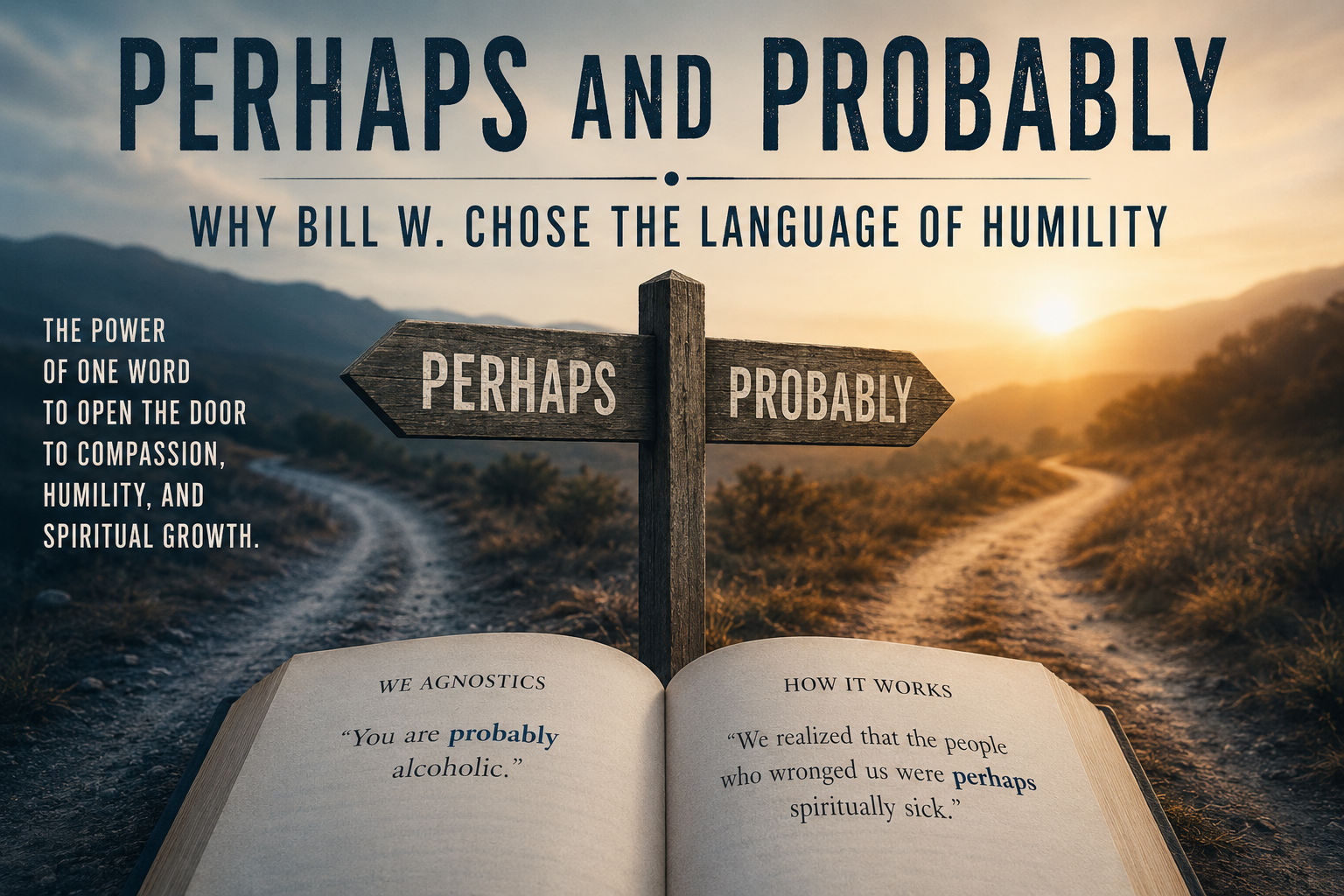
Perhaps and Probably
Why Bill W. Chose the Language of Humility
One of the most fascinating things about the Big Book is not just what it says, but how it says it. In Chapter Five, How It Works, in what members have come to call the Sick Man’s Prayer, we find this familiar passage:
“We realized that the people who wronged us were perhaps spiritually sick.”
That single word, perhaps, often slips by unnoticed. Yet during last night’s Big Book Lab meeting, it sparked an interesting discussion. Why didn’t Bill simply write, “The people who wronged us were spiritually sick”? Why add the qualifier? The same question arises in Chapter Four, We Agnostics, where Bill writes “If that be the case, you may be suffering from an illness which only a spiritual experience will conquer.” Earlier in the same paragraph, he says:
“You are probably alcoholic.”
Again, not definitely. Not certainly. Not without question. Perhaps. Probably.
Those words are worth looking at because they reveal something fundamental about both Alcoholics Anonymous and the spiritual life.
AA Rarely Demands Conclusions
One of the great strengths of AA is that it rarely insists upon conclusions. Instead, it invites investigation. Bill could have written: “You are alcoholic.” Instead, he wrote: “You are probably alcoholic.” The difference is profound. AA does not diagnose. AA presents evidence and invites us to draw our own conclusions. The same principle appears throughout the book. Rather than demanding belief, it continually invites consideration.
- “Perhaps.”
- “Probably.”
- “We think.”
- “We believe.”
- “We have concluded.”
The language leaves room for personal discovery.
This approach is especially important because alcoholics tend to resist being told what to think. We are often suspicious of authority, quick to argue, and eager to defend our positions. Bill understood that. Rather than cornering us, he opens a door and lets us walk through it ourselves.
The Word “Perhaps” Creates a Spiritual Pause
When someone has wronged me, my mind usually reaches a verdict long before my Higher Power gets a vote.
- They are selfish.
- They are inconsiderate.
- They are dishonest.
- They are wrong.
The resentment inventory reveals just how quickly we become judge, jury, and executioner. Then Bill inserts a single word: “Perhaps.” Suddenly certainty gives way to possibility.
- Maybe there is something I do not know.
- Maybe there is pain beneath the behavior.
- Maybe fear is driving the action.
- Maybe they are struggling in ways I cannot see.
- Maybe they are spiritually sick.
The word does not excuse harmful behavior. It simply challenges my assumption that I fully understand it. “Perhaps” introduces humility into the conversation.
Bill Was Writing From Experience, Not Infinite Wisdom
Another possibility is that Bill understood the limits of human judgment. The Big Book repeatedly reminds us that we are not God. When I decide exactly why another person behaves the way they do, I am often operating far beyond my actual knowledge. I can observe actions. I can experience consequences. But I rarely know motives with certainty. Bill’s use of “perhaps” acknowledges that limitation.
It is as if he is saying: “You may be right about them. Then again, you may not have the whole story.” That posture aligns perfectly with the inventory process itself. The Fourth Step asks us to examine our perceptions, not merely defend them.
“Perhaps” Protects Us From Spiritual Arrogance
I think there is another danger hidden in this passage. Many of us have used the phrase “sick man” as a way to look down on others.
- “They’re spiritually sick.”
- “He needs help.”
- “She’s the problem.”
Ironically, that attitude is itself a form of spiritual sickness. Notice Bill does not say: “We realized they were spiritually sick.” He says: “We realized they were perhaps spiritually sick.” The word keeps us from turning compassion into superiority. It reminds us that we are making an observation (discernment) , not issuing a diagnosis. And it immediately follows with a critical reminder: “They, like ourselves, were sick too.”
The point was never to classify others.
The point was to identify with them.
The Connection Between “Perhaps” and “Probably”
The relationship between these two words is striking. In We Agnostics, Bill says: “You are probably alcoholic.” In How It Works, he says: “They were perhaps spiritually sick.”
In both cases, the reader is being invited away from certainty and toward honest consideration. The alcoholic must become willing to consider: “Perhaps my drinking problem is bigger than I thought.” The resentful person must become willing to consider: “Perhaps this person is suffering too.” Both movements require the same spiritual principle: Humility. Humility is not thinking less of ourselves. It is being willing to admit we might not have all the facts.
Recovery Often Begins With a “Perhaps”
Many of us arrived in AA absolutely certain of a great many things. We were certain our drinking wasn’t that bad. We were certain our circumstances were unique. We were certain other people were the problem. We were certain we knew what would make us happy. Then recovery introduced a series of uncomfortable possibilities:
- Perhaps I’m alcoholic.
- Perhaps I don’t have all the answers.
- Perhaps my resentment is hurting me more than them.
- Perhaps God can do for me what I cannot do for myself.
- Perhaps there is another way to live.
Those possibilities eventually became convictions. But they started as questions. Maybe that is why Bill chose the word so carefully. Because spiritual growth rarely begins with certainty. It usually begins with a humble willingness to consider that there might be more truth available than we currently see.
A Few Questions for Reflection
- Where am I most convinced that I am right?
- Is there a resentment in my life that could benefit from the word “perhaps”?
- What assumptions am I making about another person’s motives?
- Where might “probably” or “perhaps” open the door to greater humility?
- What truth in my recovery began as a possibility before it became a conviction?
Perhaps those questions are worth sitting with.
After all, some of the greatest transformations in Alcoholics Anonymous begin with a single word that leaves room for God to work.
In love & service,
