


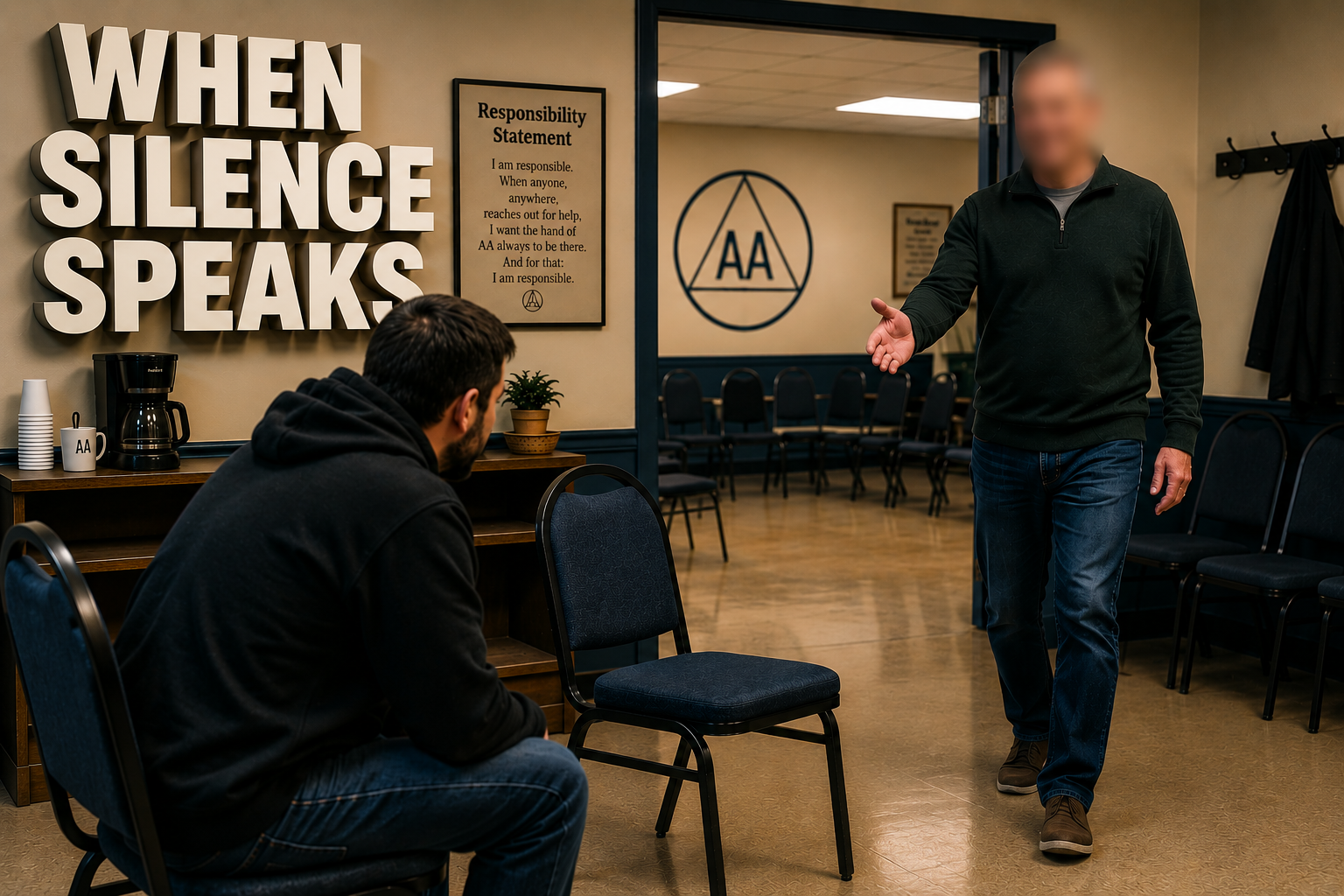
When Silence Speaks
Martin Luther King Jr. once said: “In the end, we will remember not the words of our enemies, but the silence of our friends.” It’s a haunting statement because most of us know exactly what he meant.
Many of us can recall moments when we were hurting, struggling, or lost and the people we expected to step forward simply didn’t. They said nothing, did nothing, remained silent.
Before recovery, that silence often became the foundation of resentment. We replayed it over and over. We built cases against people. We convinced ourselves that if they had only done what they were supposed to do (what I thought they should do), our lives would have turned out differently.
Then we arrived in Alcoholics Anonymous and encountered a program that asked a very uncomfortable question: “Referring to our list again. Putting out of our minds the wrongs others had done, we resolutely looked for our own mistakes. Where had we been selfish, dishonest, self-seeking and frightened?”
The Big Book doesn’t ask us to deny what happened. It doesn’t tell us that people always behaved appropriately. It doesn’t excuse neglect, abandonment, or indifference. But it does challenge us to look beyond what others failed to do and examine our own spiritual condition.
That creates an interesting way of looking at King’s quote. Perhaps the silence we should be examining first is not the silence of our friends.
Perhaps it is our own.
The Times I Should Have Spoken
How many times have I watched someone struggle and said nothing? How many times have I seen a newcomer sitting alone before a meeting and decided someone else would talk to them? How many times have I known a member was drifting away but never picked up the phone? How many times have I heard gossip, division, or character assassination and remained silent because confrontation felt uncomfortable?
The inventory process teaches me that omission can be just as revealing as commission. Sometimes my greatest spiritual failures are not things I did. They are things I failed to do.
The Twelfth Step calls me to carry the message. The Fifth Tradition reminds me that our primary purpose is to help the alcoholic who still suffers. The responsibility statement asks me to be there whenever anyone, anywhere reaches out for help.
Those principles require action. And action requires a voice.
The Difference Between Wisdom and Fear
Of course, recovery also teaches restraint. Not every situation requires my opinion. Not every disagreement requires correction. Not every conflict requires intervention.
Sometimes silence is wisdom, it’s patience and it’s trust that God is already working. The challenge is discerning whether my silence comes from spiritual principles or self-centered fear.
Am I staying quiet because God would have me listen? Or am I staying quiet because I don’t want to be uncomfortable? Am I remaining silent because humility is needed? Or because courage is missing?
Inventory helps me answer those questions honestly.
The Friend Who Didn’t Stay Silent
Every sober member can trace their recovery back to someone who refused to remain silent. Someone made the call, shared their story, extended an invitation, pulled out a chair, poured a cup of coffee or looked us in the eye and said, “You don’t have to live like this anymore.”
AA exists because one alcoholic chose not to stay silent with another alcoholic. Bill talked to Bob. Bob talked to someone else. The message traveled from one voice to another until it eventually reached us.
Our sobriety is the direct result of people who were willing to speak when silence would have been easier.
A Different Inventory
King’s quote asks me to remember the silence of me friends. The Big Book invites me to ask a different question:
Where has my silence affected others?
- Who needs a phone call from me?
- Who needs encouragement from me?
- Who have I been avoiding?
- Who might benefit from my experience, strength, and hope?
- Where have I allowed fear, comfort, or indifference to keep me from carrying the message?
Those questions move me from resentment to responsibility. And responsibility is where recovery grows.
Most of us can remember people who weren’t there when we needed them. But somewhere in our story there was also a person who was.
Someone who spoke.
Someone who reached.
Someone who cared.
Someone who carried the message.
The real challenge is not whether I remember the silence of my friends. The real challenge is whether I become the friend whose voice breaks the silence for someone else.
In love and service,
