
Working With Others

Working With Others

Working With Others

The Message Never Changes, But The Methods Do

One of the gifts of studying the Big Book with other alcoholics is discovering that sometimes the most interesting conversations happen in the tension between what the book says and how we experience recovery today.

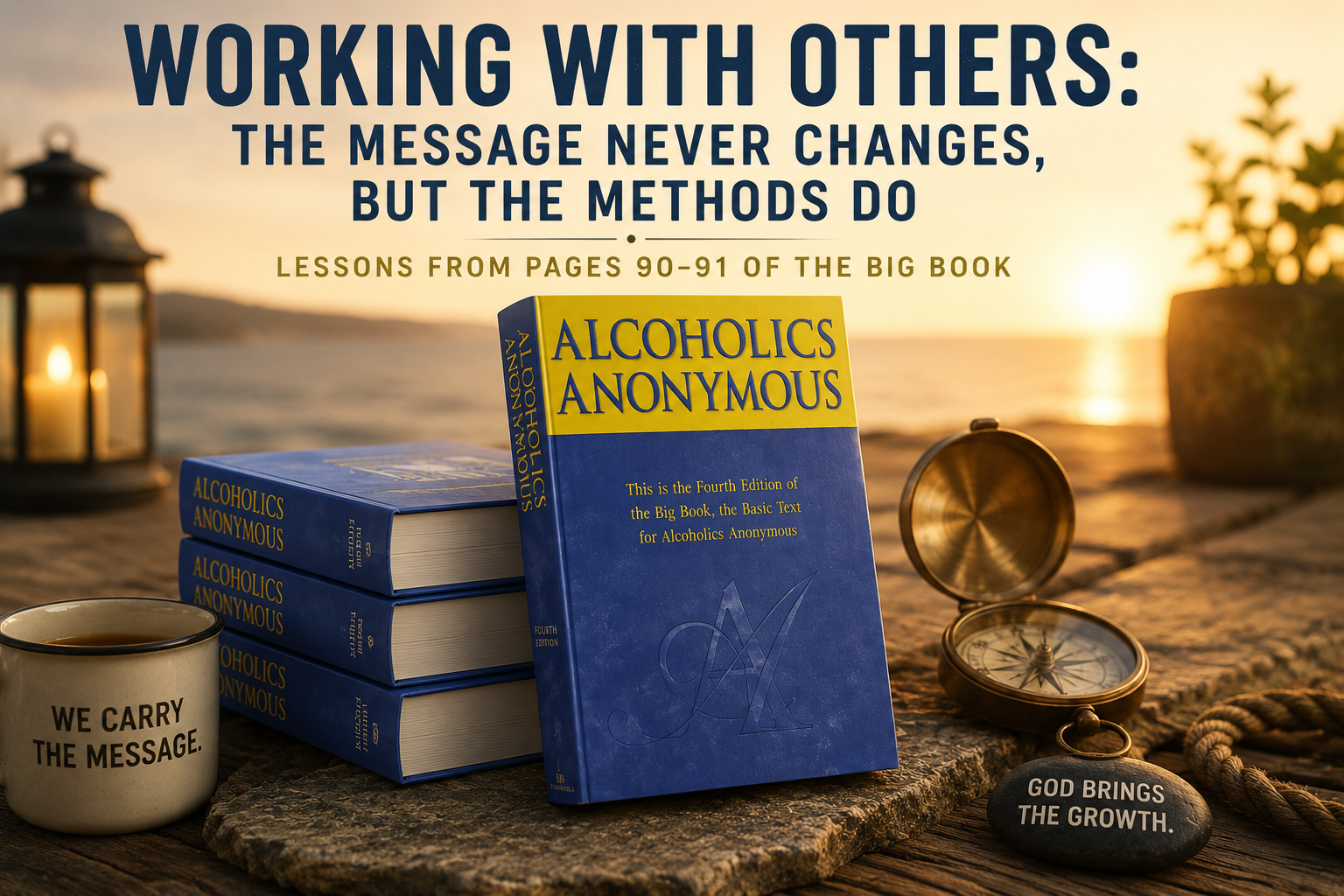
Tonight, I was in a Big Book study discussing pages 90-91 of Working With Others. The conversation centered around a passage many of us know well:

“If he does not want to stop drinking, don’t waste time trying to persuade him. You may spoil a later opportunity.”

At first glance, the instruction seems straightforward. If someone isn’t ready, move on.

Yet as the discussion unfolded, several members shared something interesting. They talked about people who stayed in touch with them before they were ready. Sponsors who kept calling. A.A. members who kept inviting them to meetings. Friends who refused to give up hope.

Some of them admitted they ignored those efforts at the time. But years later, they remembered them. Those people had planted seeds.

So which is it? Do we move on? Or do we stay engaged?

Perhaps the answer lies in understanding the difference between carrying the message and trying to control the outcome.

A Book Written For A Particular Time

One thing that is easy to forget is that the Big Book was written in 1939. The people described in Working With Others lived in a very different world.

  • There were no treatment centers.
  • There were no recovery podcasts.
  • There were no online meetings.
  • There were no text messages.
  • There were no sobriety apps.
  • In many places there weren’t even local A.A. meetings.

When a prospect was identified, members often physically went to visit them. The Big Book describes sitting in kitchens, talking with spouses, meeting alcoholics in hospitals, and making what became known as Twelfth Step calls.

When I got sober in 1987, I was still being taken on Twelfth Step calls with my sponsor and other men. We would drive across town to meet someone who had reached out for help. We would sit in living rooms, on front porches, or around kitchen tables sharing our stories.

That was simply how it was done.

Today, many alcoholics first encounter A.A. through a website, a podcast, a treatment center, a social media post, or an online meeting. The methods have changed dramatically. The spiritual principles have not.

What The Big Book Is Actually Warning Us About

When I read pages 90-91 today, I don’t hear the author telling me to stop caring about someone who isn’t ready. I hear them warning me not to become a salesman. There is a significant difference.

The Big Book repeatedly reminds me that I do not have the power to make someone sober. I believe:

  • We cannot argue someone into recovery.
  • We cannot lecture them into willingness.
  • We cannot shame them into surrender.
  • We cannot even love them enough to make them willing.

The book is possibly cautioning us against trying to force a spiritual awakening before a person is ready for one. When we cross that line, we often stop being helpful and start trying to play God. That rarely ends well.

The Difference Between Availability and Pursuit

Many of us can think of someone who helped us long before we were ready. But when we look closely, what did they actually do? Most of the time, they didn’t chase us. They didn’t corner us. They didn’t pressure us. They didn’t demand that we get sober. Instead, they remained available.

They answered the phone, extended invitations, shared their experience, and left the door open. In other words, they carried the message without carrying the alcoholic. That’s a very different thing.

The person who planted the seed in my life wasn’t responsible for making it grow. They were simply responsible for planting it. God handled the rest.

A Matter Of Balance

Like so many things in recovery, this becomes a matter of balance. On one side is indifference. “Well, he isn’t ready. Not my problem.” On the other side is obsession. “If I just say the right thing, call enough times, or work hard enough, he will get sober.” Neither position reflects the spirit of the Big Book.

If I’m honest, I often prefer life to be much simpler than that. My natural tendency is to see things in black and white. I want clear rules. I want definitive answers. I want to know exactly where the line is so I can stay safely on one side of it. But recovery has taught me that many of the most important spiritual lessons are found somewhere in the grey.

The alcoholic mind often wants certainty. We want a formula. We want to know whether we should keep calling or stop calling. Whether we should stay involved or walk away. Whether we should help or detach.

The program frequently responds with something less concrete: “It depends.”

  • It depends on the person.
  • It depends on the circumstances.
  • It depends on our motives.
  • It depends on whether we are being helpful or whether we are trying to control.

That can be uncomfortable because grey areas require discernment. They require prayer. They require humility. They require us to admit that there may not always be a single correct answer.

The longer I stay sober, the more I realize that spiritual maturity (emotional sobriety) is often learning how to live faithfully in that tension. The beauty of our program is not that it provides a black-and-white answer for every situation. The beauty is that it teaches us spiritual principles that help ,e navigate the grey areas of life.

The middle path here is to remain willing, available, compassionate, and honest while remembering that another person’s recovery does not belong to me.

My responsibility is to carry the message. Their responsibility is to decide what to do with it. God’s responsibility is everything else.

The Question For Me

Perhaps the real question isn’t whether I should stay in touch with someone who isn’t ready. Perhaps the question is why I am staying in touch.

Am I reaching out because I genuinely care?

Or because I need them to get sober?

Am I making myself available?

Or am I trying to manage their journey?

Am I carrying the message?

Or am I carrying the alcoholic?

The answer to those questions often reveals where the line is. The methods of A.A. have changed over the decades. Twelfth Step calls are less common. Technology has transformed how we connect. The pathways into recovery look different than they did in 1939.

But the spiritual principles found in Working With Others remain remarkably relevant.

  • Be helpful.
  • Be honest.
  • Be available.
  • Don’t play God.
  • Plant seeds when you can.
  • And trust that, when the time is right, the One who makes things grow will do what none of us ever could.

As I reflect on those discussions from our Big Book study tonight, I find myself grateful that A.A. rarely asks me to master a technique. Instead, it asks me to practice principles. Methods evolve. Culture changes. Technology advances. But the spiritual responsibility remains the same: offer what was freely given to me and leave the results in God’s hands.

That may be one of the hardest lessons in sponsorship, service, and recovery as a whole.

And it may also be one of the most freeing.

In love and service,

4 Comments

  1. JesseG

    Says June 18, 2026 at 3:41 pm

    Well put sir , and with a whopping 35+ years im quite confident that many new comers and not so new comers trust the insight you have . Being able have a blog will allow even the normies to get a perspective . This is a real question despite the simplicity. Was the big book study Group studying the actual AA Big book? Sometimes groups will study things like “Drop the rock” and say its part of the solution AA has to offer. Lol .
    But what about the real alcoholic, the one that can’t stay sober no matter what or who the meet. There is a certain type of alcoholic that is “beyond human aid” that will absolutely not be able to stay sober unless they can get some spiritual CPR fast. The one that by todays culture , gets fired from sponsors for “not being ready to take it seriously ?” There exists within humans sober or not sober, a pull towards selfishness no matter how many years . Its part of the system that governs humans . Its safe to say its written in the code of human interaction. In early recovery we hear the phrase H.O.W. so what year do we stop being a newcomer? When can we stop listening fot His guidance, trusting that we are no longer at risk of being lead astray by well meaning mentors.?
    Thank you for this blog you are facilitating a great topic. And im definitely on your side Rick. We should be doing exactly as “they” did things if we want the results “they” got ! The world has changed a bunch, Its a blessing to know and trust that the principals will never change. Another thing that will never change is that in life there will be certain uncomfortable lows , seeking a drunk or working with a struggling alcoholic, will produce an armor that will protect . Even elders forget that both newcomer and old timer are helped equally in the process.
    Sorry for the length . I really have gratitude for this manner of living that saved my life. If it weren’t for people like you Rick that refuse to let the still suffering alcoholic be mislead by someone that waited peacefully at the meeting hall, for a broken newcomer to stay sober awhile so the “fog can clear” before starting the work. Lol,lol. Still to this day you go find them because they are everywhere and many will never come to the rooms on their own they will die drunk undercarriage bridge in noone seeks them out. You are a good man .

    • Rick W.

      Says June 19, 2026 at 1:27 pm

      Greetings Jesse…

      Thank you for the thoughtful comment and for taking the time to share it.

      Yes, the Big Book meeting I was in studies the actual Big Book of Alcoholics Anonymous. We read it line by line, paragraph by paragraph, and try to stay grounded in what the book actually says rather than what we think it says. Other books can certainly be helpful, but our primary purpose there is to study the text that launched this whole thing.

      You raised a question that I think is worth reflecting on: When do we stop being newcomers? For me, the answer is simple, we never outgrow our need for God. Whether we’re 30 days sober or 30 years sober, the danger isn’t alcoholism so much as forgetting where our power comes from. The Big Book tells me I have a daily reprieve contingent on the maintenance of my spiritual condition. That sounds a lot more like a lifelong practice than a graduation certificate.

      I also agree with your point about the alcoholic who is beyond human aid. The book is very clear that there are some of us who cannot think our way into sobriety and cannot be talked into recovery. We need a spiritual awakening. Sponsors, meetings, and fellowship matter tremendously, but they are channels, not the source.

      And yes, working with others helps both people. One of the great paradoxes of A.A. is that the newcomer often thinks they’re receiving the gift, while the old-timer knows they’re receiving one too.

      I appreciate your passion for carrying the message. The Fellowship needs people who are willing to go find the suffering alcoholic rather than simply wait for them to arrive. Thankfully, there is room in A.A. for both the welcoming hand at the meeting hall and the person willing to walk out and search for the one who hasn’t made it through the door yet.

      Grateful you’re part of the conversation, my friend.

  2. Member of A.A.

    Says June 19, 2026 at 12:51 pm

    Why the Big Book Should Be Read as an Instruction Text

    The Big Book of Alcoholics Anonymous is more than a collection of inspiring stories, opinions, or general ideas about sobriety. It is a record of experience from a large group of people who suffered from alcoholism, tried many different solutions, and discovered that when they took certain specific actions, they were able to stay sober.

    The importance of the book is not simply that these people recovered. The importance is that they explained what they did so that others could follow the same course of action.

    For that reason, the Big Book should be read as an instruction text. It does not merely describe alcoholism; it presents a practical program of recovery. The early members identified a sequence of actions that produced results: admitting the problem, becoming willing to accept help, taking inventory, sharing honestly, becoming willing to change, making amends, continuing personal inventory, developing a spiritual life, and helping other alcoholics.

    These actions were not presented as abstract philosophy. They were presented as things to be done.

    Many circumstances have changed since the book was first published. Society has changed. Treatment methods have changed. Language has changed. Family structures, technology, employment, medicine, and attitudes toward addiction have all changed. However, the internal condition described in the book—the alcoholic’s inability to remain sober through willpower alone—has not necessarily changed. Therefore, changes in the outside world do not automatically make the instructions irrelevant.

    An instruction manual does not lose its value simply because the culture around it changes. When a process has repeatedly produced a particular result, it deserves to be studied carefully and followed before it is revised, diluted, or dismissed. A person cannot fairly say that the program failed when the program was never actually carried out as described.

    This is especially important when working with newcomers. It is common to say that a person is “not ready,” “does not want it,” or “has not had enough pain.” Sometimes that may be true. However, the Big Book also places a serious responsibility on the recovered alcoholic. It suggests approaching the newcomer with understanding, explaining the nature of the illness, sharing personal experience, presenting the solution clearly, and offering practical guidance through the actions of the program.

    Therefore, when a newcomer appears unwilling or unresponsive, the problem should not always be placed entirely on the newcomer. Experienced members should also ask whether they are doing what the book suggests.

    Are they carrying a clear message of recovery, or only repeating slogans?

    Are they explaining the problem and the solution, or merely telling the newcomer to attend meetings?

    Are they taking the person through the Steps, or waiting indefinitely for the person to become “ready”?

    Are they offering their time, experience, and example, or expecting the newcomer to figure everything out alone?

    The older members of the fellowship have a duty to preserve and demonstrate the method that was passed on to them. Their role is not to control, shame, or lecture the newcomer. Their role is to show, through personal experience, exactly what they did and to help the newcomer take the same actions.

    Readiness is sometimes revealed through action rather than appearing beforehand. A person may not look hopeful, confident, spiritually willing, or fully committed when they arrive. Many alcoholics come in confused, defensive, frightened, dishonest, and emotionally unstable. Those conditions may be symptoms of the illness rather than proof that recovery is impossible.

    The newcomer should be responsible for taking the actions, but the experienced member is responsible for presenting those actions honestly, clearly, and faithfully.

    Reading the Big Book as an instruction text protects the program from becoming vague. Without careful attention to the written directions, recovery can be reduced to meeting attendance, popular sayings, personality, opinion, or fellowship alone. Those things may be helpful, but they are not a substitute for the specific spiritual and practical actions described in the book.

    The central message is simple: a group of people discovered that when they followed a particular course of action, they recovered. They recorded their experience so that others could do the same. The value of the Big Book lies not only in reading what happened to them, but in becoming willing to do what they did.

    If experienced members want newcomers to receive the results described in the book, they must continue to teach and practice the instructions that produced those results.

    • Rick W.

      Says June 19, 2026 at 1:23 pm

      Thank you for taking the time to write such a thoughtful response. I agree with much of what you’ve shared.

      I have long believed that one of the greatest disservices we can do to newcomers is treat the Big Book as a collection of interesting ideas rather than a set of actions designed to produce a spiritual awakening. The first 100 alcoholics were not simply sharing opinions; they were documenting the course of action they had taken and inviting others to follow it. In that sense, I absolutely agree that the Big Book is instructional in nature.

      Where I was attempting to place the emphasis in this article was not on changing or dismissing the instructions, but on distinguishing between the instructions and the methods used to deliver them.

      The instructions remain remarkably consistent. We still take inventory. We still make amends. We still seek conscious contact with God. We still work with others. We still carry the message. Those principles have not changed, and I don’t believe they need updating.

      The methods, however, have changed. The world of 1939 was very different from the world many of us sponsor in today. The book describes hospital visits, conversations with spouses before meeting the prospect, and Twelfth Step calls that were commonplace when I first got sober in 1987 but are much less common today. Most newcomers now find us through treatment centers, websites, podcasts, social media, hotlines, and online meetings. The delivery system has evolved even while the message itself remains intact.

      I also appreciate your point about experienced members examining their own efforts before concluding that a newcomer “isn’t ready.” That’s an important reminder. It is easy to place responsibility entirely on the newcomer while avoiding the harder question: Have I clearly carried the message? Have I shared the solution? Have I offered practical guidance through the Steps? Have I made myself available?

      Those are fair questions for all of us.

      At the same time, I continue to see wisdom in the Big Book’s caution against becoming salesmen. There is a difference between carrying a clear message and trying to force willingness. Some of the most meaningful people in my own recovery journey planted seeds long before I was ready to act on them. They remained available without becoming attached to the outcome.

      Perhaps that is where I see the balance. We owe every suffering alcoholic our very best effort, a clear explanation of the problem, a clear explanation of the solution, and a willingness to walk beside them through the work. But we are not responsible for creating willingness, producing surrender, or managing another person’s spiritual journey.

      Thank you again for engaging the conversation. Discussions like this are one of the reasons I enjoy studying the Big Book with others. They remind me that we can agree on the enduring value of the instructions while continuing to explore how best to apply them in the world we live in today.

Leave Your Comment