


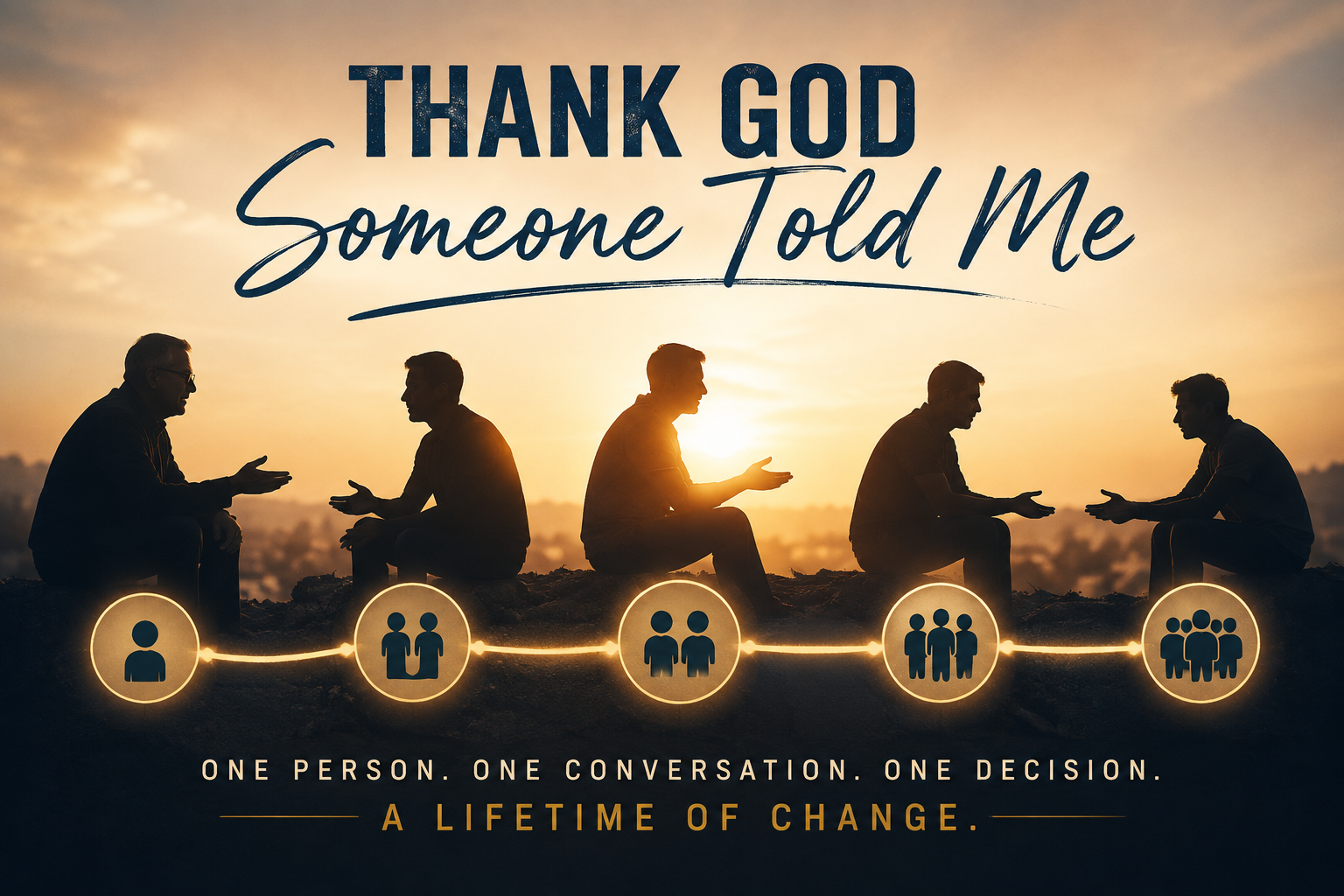
Thank God Someone Told Me
Dr. Jung told Rowland. Rowland told Ebby. Ebby told Bill. Bill told Dr. Bob. Thank God someone told me.
That simple progression is more than a clever slogan on a T-shirt I recently saw. It’s the story of Alcoholics Anonymous. It’s the story of my recovery. And if you’re sober today in A.A., it’s your story too.
When I stop and think about it, my sobriety rests on an unbroken chain of people who refused to keep hope to themselves.
Someone spoke.
Someone listened.
Someone passed it on.
Eventually, someone told me.
The Miracle Was Never Meant to Stop With Me
It’s easy to think of sobriety as something we receive. We receive a sponsor. We receive encouragement. We receive love when we don’t deserve it. We receive a design for living that works.
But the Big Book makes it clear that recovery isn’t merely received, it is transmitted.
Chapter Seven, Working With Others, doesn’t suggest carrying the message as a nice option for spiritually mature members. It presents it as part of the very process that keeps us alive.
“Practical experience shows that nothing will so much insure immunity from drinking as intensive work with other alcoholics.” (Working With Others)
Think about that.
The thing that best protects my sobriety isn’t another meeting. It isn’t another book. It isn’t another podcast. It’s giving away what was so freely given to me. Recovery was never designed to terminate with us.
One Alcoholic to Another
The founders of Alcoholics Anonymous discovered something physicians, psychiatrists, and clergy often could not. There is a unique power in one alcoholic talking to another. That truth was demonstrated during one of the most important conversations in recovery history.
When Bill Wilson arrived in Akron in May 1935, he wasn’t looking to start a movement. He was looking for another alcoholic to talk to so that he could stay sober. Through Henrietta Seiberling, Bill was introduced to Dr. Bob Smith.
Dr. Bob wasn’t especially interested. He reportedly told Henrietta, “I’ll give him fifteen minutes.” Those fifteen minutes turned into nearly six hours. Why?
Because for the first time, Dr. Bob wasn’t listening to a doctor explain alcoholism. He wasn’t hearing another lecture, another diagnosis, or another well-intentioned appeal to exercise more willpower. He was hearing someone who had been there. Someone who understood not only the drinking, but the thinking that always preceded it.
Bill spoke the language of the heart.
The Big Book captures this beautifully: “You can help when no one else can. You can secure their confidence when others fail.” (Working With Others)
That isn’t because physicians, counselors, clergy, or loved ones have nothing to offer. They often play an indispensable role in recovery. It’s because there is something uniquely powerful about one alcoholic talking to another alcoholic. Shared experience creates a bridge that education alone cannot build.
Dr. Bob later became the second co-founder of Alcoholics Anonymous because one recovered alcoholic sat across from him and simply shared his experience, strength, and hope.
Everything that followed, the growth of A.A., the writing of the Big Book, and millions of recovered lives, can be traced back to a conversation that was supposed to last fifteen minutes.
Sometimes, fifteen minutes is all God needs to change the world.
Every Name Represents Someone Who Didn’t Stay Silent
Dr. Jung could have simply treated Rowland Hazard and moved on. Rowland Hazard could have quietly enjoyed his newfound hope without mentioning it to anyone else. Ebby Thatcher could have decided Bill Wilson was beyond help. Bill Wilson could have stayed in Akron after his failed business trip feeling sorry for himself instead of picking up the telephone. Dr. Bob could have kept his recovery private.
Had any one of them decided, “Someone else will do it,” history might have looked very different.
Instead, each person accepted a simple responsibility:
Tell someone.
The ripple effect is almost impossible to comprehend. Millions of alcoholics have found recovery because a handful of people refused to let the message die with them.
We Are Part of the Same Chain
Sometimes we think carrying the message requires a microphone or a podium.
It doesn’t.
- Sometimes it looks like answering the phone at ten o’clock at night.
- Sometimes it’s introducing yourself to a frightened newcomer before the meeting.
- Sometimes it’s offering a ride.
- Sometimes it’s making coffee.
- Sometimes it’s sharing honestly instead of trying to sound impressive.
- Sometimes it’s sponsoring someone who doesn’t yet believe they’re worth saving.
We often underestimate the eternal significance of ordinary acts of service.
The person you welcome tonight may someday sponsor someone who sponsors someone else who helps save a family you’ve never met. We rarely get to see the full impact of our willingness.
Our Experience Is the Credential
One of the most beautiful things about Alcoholics Anonymous is that perfection isn’t required. The newcomer isn’t looking for someone who has never struggled. They’re looking for someone who survived the struggle.
The Big Book reminds us: “Burn the idea into the consciousness of every man that he can get well regardless of anyone. The only condition is that he trust in God and clean house.” (Working With Others)
Our job isn’t to impress people with how recovered we are. Our job is to tell the truth about what happened to us.
What we were like.
What happened.
What we’re like now.
That simple testimony has changed more lives than polished speeches ever could.
We Don’t Carry the Alcoholic – We Carry the Message
One lesson I continue learning as a sponsor is that I can’t make anyone stay sober.
- I can’t think for them.
- Pray for them.
- Work their Steps for them.
- I can’t want recovery more than they do.
But I can faithfully carry the message. That’s the distinction. Our responsibility is obedience, not outcomes.
God changes hearts.
We simply introduce people to the solution that changed ours.
- Sometimes they accept it immediately.
- Sometimes they disappear for years before returning.
- Sometimes they never come back.
None of that changes my assignment. Keep telling someone.
The Responsibility That Keeps Us Alive
There are days when service feels inconvenient.
Life gets busy.
Schedules fill up.
Phones ring at awkward times.
But then I remember that someone interrupted their life for me.
- Someone answered when I called.
- Someone stayed after the meeting.
- Someone patiently explained the Big Book.
- Someone listened to my fears for the hundredth time.
- Someone believed recovery was possible long before I did.
If they had decided they were too busy, I honestly don’t know where I would be today. You most certainly wouldn’t be reading this post written by me.
Carrying the message isn’t merely repayment for what we’ve received. It’s how Alcoholics Anonymous survives.
Every generation inherits the message because the previous generation refused to keep it.
Now it’s our turn.
Thank God Someone Told Me
When I read the names on that T-shirt, I didn’t just see historical figures. I saw links in a chain.
- Dr. Jung.
- Rowland Hazard.
- Ebby Thatcher.
- Bill Wilson.
- Dr. Bob Smith.
Then thousands more whose names history never recorded.
- Sponsors.
- Coffee makers.
- Greeters.
- People who stayed after the meeting to talk with someone who looked scared.
- Ordinary alcoholics doing extraordinary work through simple willingness.
And somewhere along that chain… someone told me.
Today, I have the incredible privilege, and the profound responsibility, to make sure the chain doesn’t end with me.
The Big Book tells us exactly what our purpose is: “Our real purpose is to fit ourselves to be of maximum service to God and the people about us.” (A Vision For You)
Carrying the message isn’t an extracurricular activity for long-timers. It isn’t something we do once we’ve “arrived.” It is one of the primary ways God keeps us sober while giving hope to someone else. There is a frightened newcomer walking into a meeting tonight wondering if anyone could possibly understand what goes on inside their head. There is. It’s us.
We speak the language of the heart because we’ve lived it. We carry the message from one alcoholic to another because that’s how it was carried to us.
One day, if we remain willing, someone else may look back over the chain that led to their own recovery and say the same words that have echoed through Alcoholics Anonymous for generations: “Thank God someone told me.”
In love and service,
