


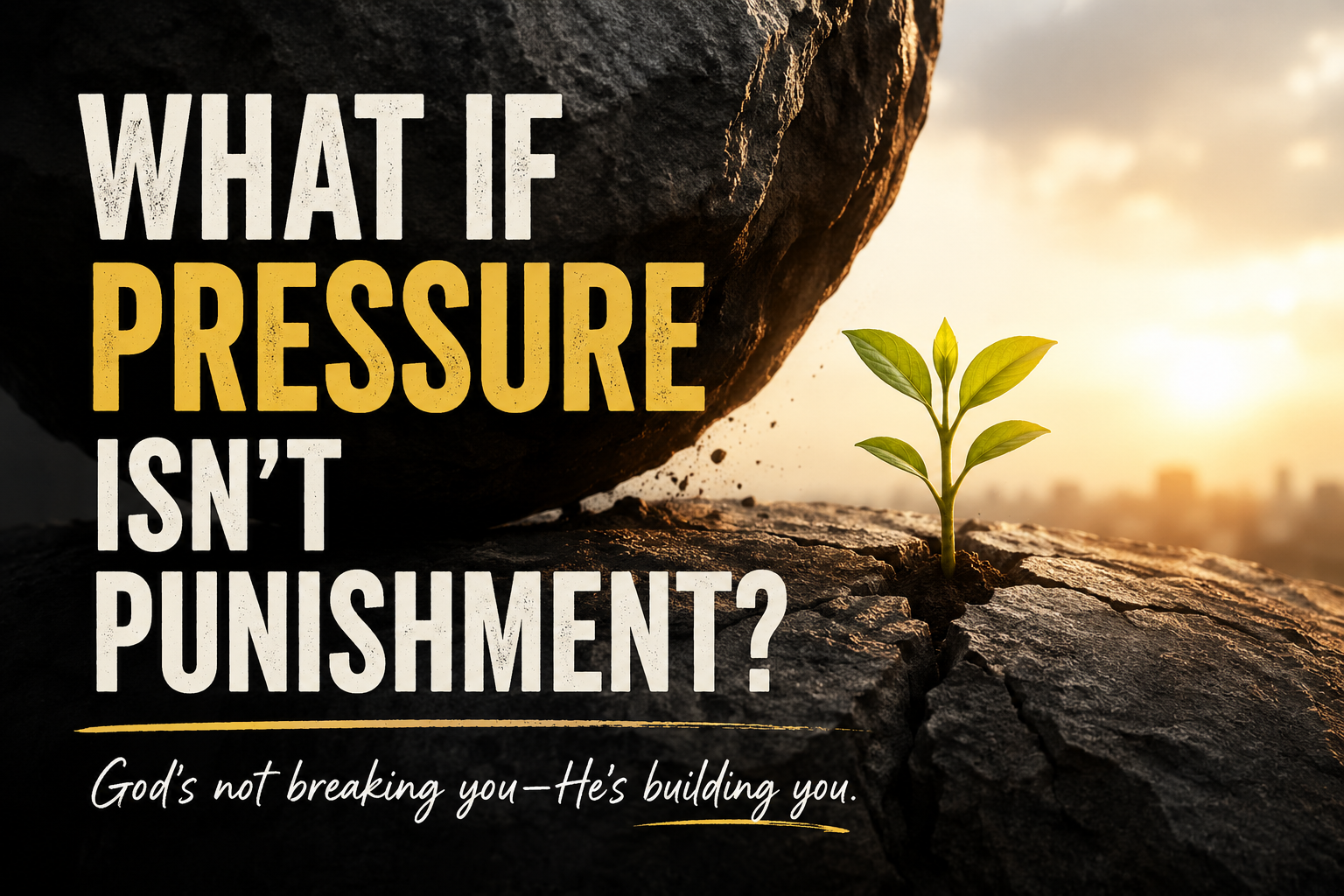
What If Pressure Isn’t Punishment?
There’s a moment in recovery where life starts pressing in from every side and it feels like everything is falling apart.
The relationship is strained.
The finances are tight.
The emotions are raw.
The character defects are impossible to ignore.
The loneliness feels louder now that the noise of alcohol, chaos, or compulsions has been turned down.
And somewhere in the middle of all of it, many of us quietly ask: “Why is this happening to me?”
In A.A., we often come in believing the hardest part will be putting the drink down. But for many of us, the real work begins after that. Sobriety has a way of removing the anesthesia and forcing us to finally sit face-to-face with ourselves. That can feel brutal.
But what if the pressure isn’t punishment?
What if the discomfort isn’t destruction?
What if God isn’t breaking you… but building you?
Recovery teaches us that growth rarely arrives wrapped in comfort. Most spiritual transformation comes disguised as inconvenience, disappointment, humility, delay, or struggle.
Step One begins by asking us to admit that our lives had become unmanageable. For many of us, that admission didn’t happen because life was comfortable. It happened because the pressure finally became too great to ignore. The very circumstances we hated were often the same circumstances that brought us to surrender.
When we needed honesty, life gave us consequences.
When we needed humility, life gave us failure.
When we needed surrender, life gave us situations we could not control.
When we needed compassion, life allowed us to feel pain.
When we needed dependence on a Higher Power, life finally exhausted our dependence on ourselves.
None of that feels good in the moment but neither does rebuilding a life from the ground up.
The Big Book says, “Pain was the touchstone of all spiritual progress” (p. 93). That sentence hits differently after you’ve been sober a while. Most of us wouldn’t have sought a spiritual solution if the old way of living hadn’t completely stopped working.
We didn’t arrive in Alcoholics Anonymous because life was going great. We arrived because something finally cracked open. And thank God it did.
Because the very things we thought would destroy us often became the things that saved us.
The divorce taught us acceptance.
The relapse taught us humility.
The loneliness taught us connection.
The fear taught us reliance on God.
The amends taught us freedom.
The wreckage taught us responsibility.
The meetings taught us we were never alone.
Step Three asks us to make a decision to turn our will and our lives over to the care of God as we understand Him. That sounds beautiful on paper. In reality, many of us only became willing to do that after self-will completely exhausted us.
The Big Book reminds us on page 62 that “selfishness—self-centeredness! That, we think, is the root of our troubles.” Recovery slowly teaches us that God’s goal is not simply to make us comfortable. It is to transform us.

Looking back, many of us can now see that God was working in places we once called “rock bottom.” Not abandoning or punishing us but preparing us.
A member once said something that stuck with me: “God is far more interested in your transformation than your comfort.” That’s hard to hear when life hurts. But recovery proves it over and over again. The people who become deeply grounded, compassionate, spiritually centered members of Alcoholics Anonymous usually aren’t the people who avoided hardship. They’re the people who allowed hardship to change them.
Sometimes I think I need God to remove every obstacle in front of me. But many times, the obstacle becomes the very thing that shapes me into who I was meant to become. In December 2016, I moved from New York City back to Texas. Thirty years earlier, when I left Texas, I swore I would never come back. Funny how when I make plans, God laughs. But moving back to Texas became one of the greatest blessings of my life outside of getting sober. At the time, it didn’t necessarily feel like a gift. It felt uncertain. Uncomfortable. Humbling. But looking back now, I can clearly see that God was building something in me long before I could recognize it.
That’s how recovery often works.
While I’m begging God for immediate relief, He may be quietly building endurance, wisdom, empathy, and spiritual depth underneath the surface. Step Seven teaches me humility. Step Nine teaches me responsibility. Step Ten teaches me ongoing growth. None of those Steps happen without discomfort. But they also don’t happen without transformation.
Recovery is not just about staying sober. It’s about becoming someone new.
The Big Book describes this process by saying, “We are not cured of alcoholism. What we really have is a daily reprieve contingent on the maintenance of our spiritual condition” (p. 85). That means recovery is not a finish line. It is an ongoing rebuilding project. And rebuilding can feel messy.
There are moments where it feels like everything familiar is being stripped away. Old coping mechanisms stop working. Old identities fall apart. Old resentments surface. Old fears scream for attention. But maybe that isn’t your life collapsing. Maybe that’s your foundation being rebuilt.
A.A. has taught countless people that God often does His best work in the middle of confusion, uncertainty, and surrender. Not after we have all the answers. Not after we become perfect. But right in the middle of our willingness.
The Big Book says on page 25, “There is a solution.” Sometimes that solution doesn’t arrive by removing all pressure from our lives. Sometimes the solution comes by allowing God to use the pressure to reshape us into people capable of living differently.
So if life feels heavy right now…
- Pause before assuming you’re being broken.
- Maybe be open to the possibility that pressure really isn’t punishment at all.
- Maybe it’s God’s way of loving you enough not to leave you where you are.
In love & service,
